Division of Medical Microbiology, Department of Pathology, Faculty of Health Sciences, University of Cape Town, Cape Town, South Africa.
Department of Statistics and Actuarial Science, Faculty of Economic and Management Sciences, Stellenbosch University, Stellenbosch, South Africa.
Sci Rep. 2018 Mar 22;8(1):5078. doi: 10.1038/s41598-018-22244-6.
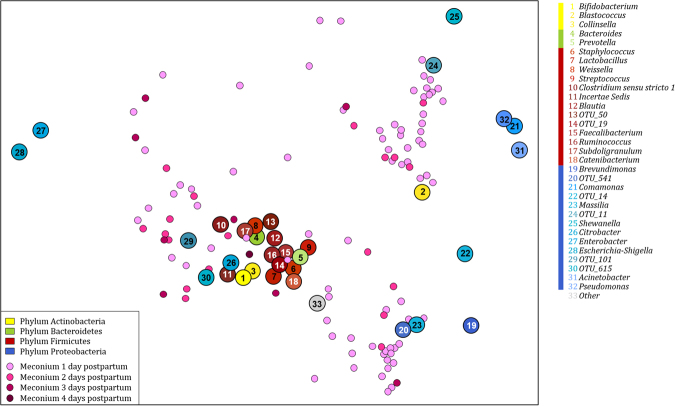
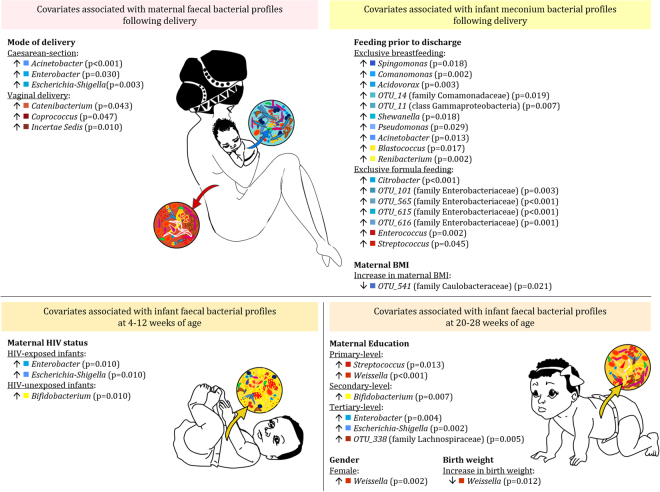
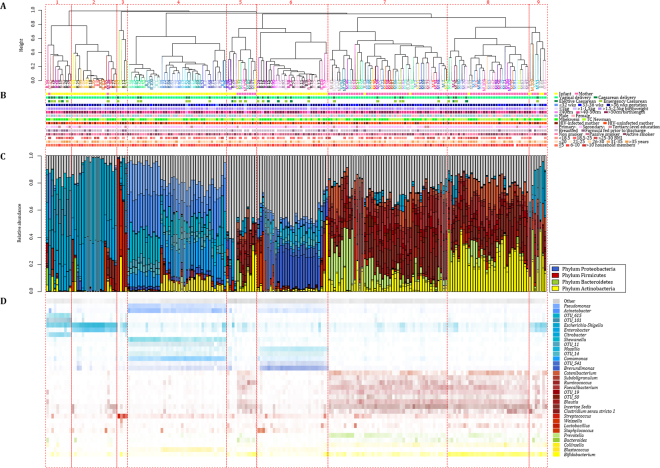
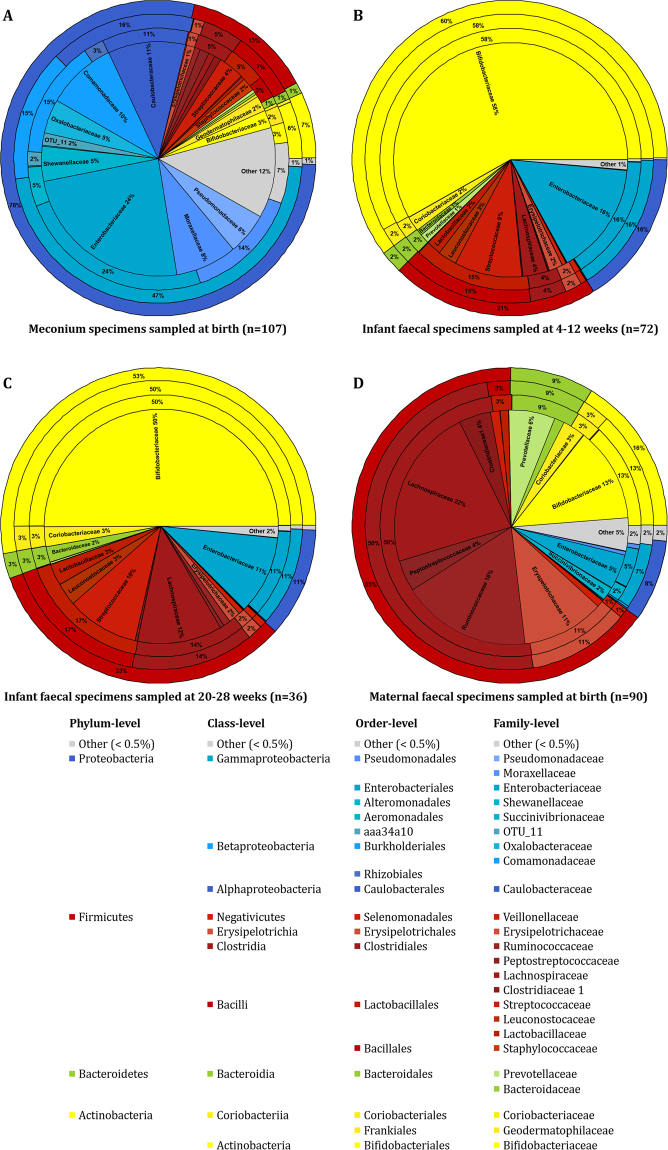
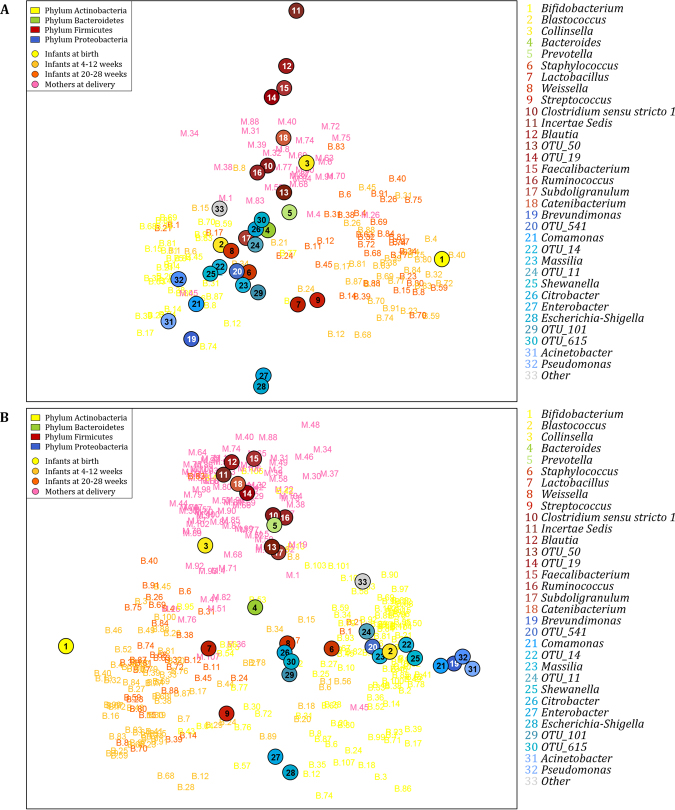
There are limited data on meconium and faecal bacterial profiles from African infants and their mothers. We characterized faecal bacterial communities of infants and mothers participating in a South African birth cohort. Stool and meconium specimens were collected from 90 mothers and 107 infants at birth, and from a subset of 72 and 36 infants at 4-12 and 20-28 weeks of age, respectively. HIV-unexposed infants were primarily exclusively breastfed at 4-12 (49%, 26/53) and 20-28 weeks (62%, 16/26). In contrast, HIV-exposed infants were primarily exclusively formula fed at 4-12 (53%; 10/19) and 20-28 weeks (70%, 7/10). Analysis (of the bacterial 16S rRNA gene sequences of the V4 hypervariable region) of the 90 mother-infant pairs showed that meconium bacterial profiles [dominated by Proteobacteria (89%)] were distinct from those of maternal faeces [dominated by Firmicutes (66%) and Actinobacteria (15%)]. Actinobacteria predominated at 4-12 (65%) and 20-28 (50%) weeks. HIV-exposed infants had significantly higher faecal bacterial diversities at both 4-12 (p = 0.026) and 20-28 weeks (p = 0.002). HIV-exposed infants had lower proportions of Bifidobacterium (p = 0.010) at 4-12 weeks. Maternal faecal bacterial profiles were influenced by HIV status, feeding practices and mode of delivery. Further longitudinal studies are required to better understand how these variables influence infant and maternal faecal bacterial composition.
关于非洲婴儿及其母亲的胎粪和粪便细菌特征,目前数据有限。我们对参与南非出生队列研究的婴儿及其母亲的粪便细菌群落进行了特征描述。在出生时收集了 90 位母亲和 107 位婴儿的粪便和胎粪标本,并且在 4-12 周和 20-28 周时分别从一个亚组的 72 位和 36 位婴儿中收集了粪便标本。在 4-12 周(49%,26/53)和 20-28 周(62%,16/26)时,未感染 HIV 的婴儿主要是纯母乳喂养。相比之下,在 4-12 周(53%,10/19)和 20-28 周(70%,7/10)时,感染 HIV 的婴儿主要是纯配方奶喂养。对 90 对母婴样本的 16S rRNA 基因 V4 高变区的细菌序列分析表明,胎粪的细菌特征(以变形菌门为主(89%))与母体粪便(以厚壁菌门为主(66%)和放线菌门为主(15%))明显不同。放线菌门在 4-12 周(65%)和 20-28 周(50%)时占优势。在 4-12 周(p=0.026)和 20-28 周(p=0.002)时,感染 HIV 的婴儿的粪便细菌多样性显著更高。在 4-12 周时,感染 HIV 的婴儿双歧杆菌的比例显著较低(p=0.010)。母体粪便的细菌特征受 HIV 状态、喂养方式和分娩方式的影响。需要进一步的纵向研究来更好地了解这些变量如何影响婴儿和母体粪便细菌组成。