Hirsch Mark A, van Wegen Erwin E H, Newman Mark A, Heyn Patricia C
1Carolinas Medical Center, Carolinas Rehabilitation, Department of Physical Medicine and Rehabilitation, 1100 Blythe Blvd, Charlotte, NC 28203 USA.
2Department of Rehabilitation Medicine, Amsterdam Movement Sciences/Amsterdam Neurosciences, VU University Medical Center, PO Box 7057, 1007 Amsterdam, MB The Netherlands.
Transl Neurodegener. 2018 Mar 20;7:7. doi: 10.1186/s40035-018-0112-1. eCollection 2018.
Animal models of exercise and Parkinson's disease (PD) have found that the physiologic use of exercise may interact with the neurodegenerative disease process, likely mediated by brain derived neurotrophic factor (BDNF). No reviews so far have assessed the methodologic quality of available intervention studies or have bundled the effect sizes of individual studies on exercise-induced effects on BDNF blood levels in human PD.
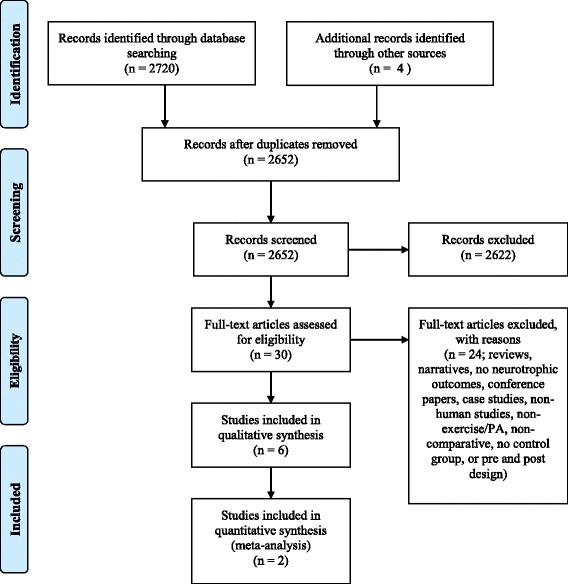
We searched MEDLINE, EMBASE, Cochrane Library, PsycINFO and PubMed from inception to June 2017.
Data aggregated from two randomized controlled trials and four pre-experimental studies with a total of 100 ambulatory patients with idiopathic PD (Hoehn/Yahr ≤3) found improvements in BDNF blood concentration levels in all 6 studies (two RCTs and 4 pre-experimental studies). Pooled BDNF level change scores from the 2 RCTs resulted in a significant homogeneous summary effect size (Standardized Mean Difference 2.06, 95% CI 1.36 to 2.76), and a significant heterogeneous SES for the motor part of the UPDRS-III examination (MD -5.53, 95% CI -10.42 to -0.64). Clinical improvements were noted in all studies using a variety of outcome measures.
The evidence-base consists primarily of small studies with low to moderate methodological quality.
This review provides preliminary evidence for the effectiveness of physical exercise treatments for persons with PD on BDNF blood levels. Further research is needed.
运动与帕金森病(PD)的动物模型研究发现,运动的生理作用可能与神经退行性疾病进程相互作用,这可能由脑源性神经营养因子(BDNF)介导。目前尚无综述评估现有干预研究的方法学质量,也未汇总个体研究中运动对人类PD患者BDNF血液水平影响的效应量。
我们检索了从数据库建立至2017年6月的MEDLINE、EMBASE、Cochrane图书馆、PsycINFO和PubMed数据库。
两项随机对照试验和四项预实验研究汇总的数据来自总共100例门诊特发性PD患者(Hoehn/Yahr分级≤3级),所有6项研究(两项随机对照试验和四项预实验研究)均发现BDNF血液浓度水平有所改善。两项随机对照试验汇总的BDNF水平变化得分产生了显著的同质性汇总效应量(标准化均数差2.06,95%可信区间1.36至2.76),而统一帕金森病评定量表第三部分(UPDRS-III)运动部分的汇总效应量显著异质性(均数差-5.53,95%可信区间-10.42至-0.64)。所有研究使用各种结局指标均观察到临床改善。
证据主要来自方法学质量低至中等的小型研究。
本综述为体育锻炼治疗对PD患者BDNF血液水平的有效性提供了初步证据。还需要进一步的研究。