ukactive Research Institute, 4th and 5th Floor, 26-28 Bedford Row, London, WC1R 4HE, UK.
Centre for Applied Biological and Exercise Sciences, Faculty of Health and Life Sciences, Coventry University, Coventry, UK.
BMC Public Health. 2018 Mar 27;18(1):420. doi: 10.1186/s12889-018-5289-9.
Many sedentary adults have high body fat along with low fitness, strength, and lean body mass (LBM) which are associated with poor health independently of body mass. Physical activity can aid in prevention, management, and treatment of numerous chronic conditions. The potential efficacy of resistance training (RT) in modifying risk factors for cardiovascular and metabolic disease is clear. However, RT is under researched in public health. We report community-based studies of RT in sedentary (Study 1), and overweight and pre-diabetic (Study 2) populations.
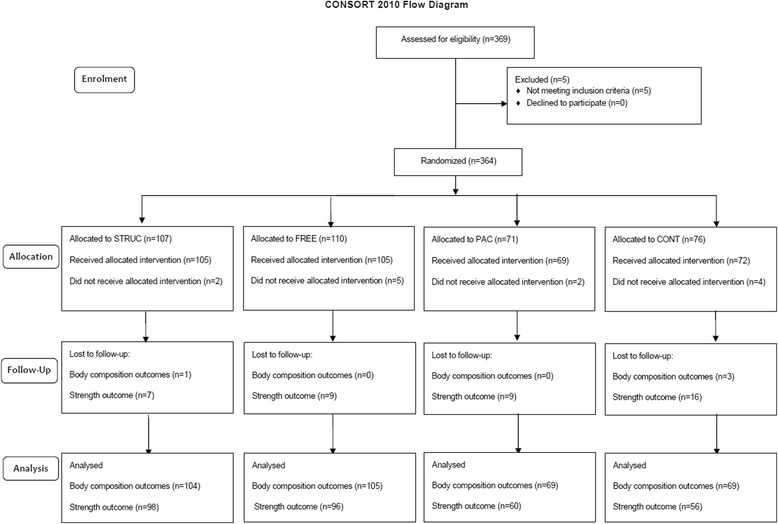
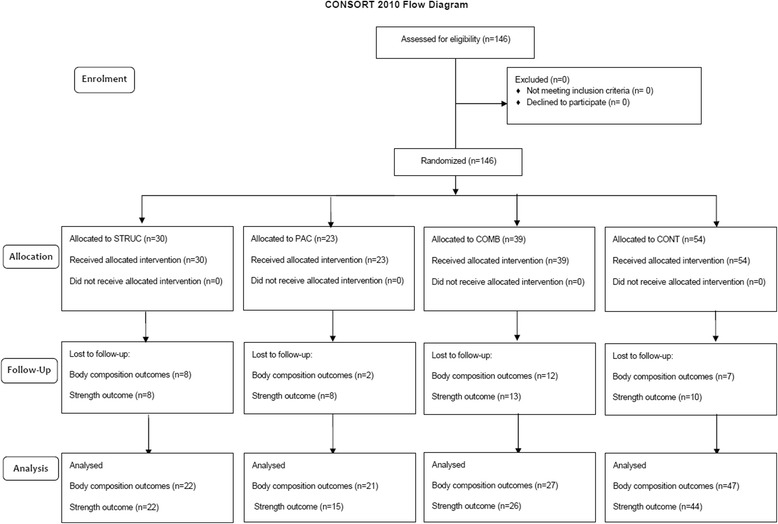
Study 1 - A semi randomised trial design (48-weeks): Participants choosing either a fitness centre approach, and randomised to structured-exercise (STRUC, n = 107), or free/unstructured gym use (FREE, n = 110), or not, and randomised to physical-activity-counselling (PAC, n = 71) or a measurement only comparator (CONT, n = 76). Study 2 - A randomised wait list controlled trial (12-weeks): Patients were randomly assigned to; traditional-supervised-exercise (STRUC, n = 30), physical-activity-counselling (PAC, n = 23), either combined (COMB, n = 39), or a wait-list comparator (CONT, n = 54). Outcomes for both were BF mass (kg), LBM (kg), BF percentage (%), and strength.
Study 1: One-way ANCOVA revealed significant between group effects for BF% and LBM, but not for BF mass or strength. Post hoc paired comparisons revealed significantly greater change in LBM for the STRUC group compared with the CONT group. Within group changes using 95%CIs revealed significant changes only in the STRUC group for both BF% (- 4.1 to - 0.9%) and LBM (0.1 to 4.5 kg), and in FREE (8.2 to 28.5 kg) and STRUC (5.9 to 26.0 kg) for strength. Study 2: One-way ANCOVA did not reveal significant between group effects for strength, BF%, BF mass, or LBM. For strength, 95%CIs revealed significant within group changes for the STRUC (2.4 to 14.1 kg) and COMB (3.7 to 15.0 kg) groups.
Strength increased in both studies across all RT treatments compared to controls, yet significant improvements in both strength and body-composition occurred only in programmed and/or supervised RT. As general increases in physical activity have limited impact upon body-composition, public health practitioners should structure interventions to include progressive RT.
Study 1: ISRCTN13024854 , retrospectively registered 20/02/2018. Study 2: ISRCTN13509468 , retrospectively registered 20/02/2018).
许多久坐不动的成年人身体脂肪含量高,同时健身水平、力量和瘦体重(LBM)较低,这些因素与身体健康有关,与体重无关。身体活动有助于预防、管理和治疗许多慢性疾病。阻力训练(RT)在改变心血管和代谢疾病风险因素方面的潜在功效是明确的。然而,RT 在公共卫生领域的研究还很不足。我们报告了针对久坐不动(研究 1)和超重及糖尿病前期(研究 2)人群的基于社区的 RT 研究。
研究 1- 一项半随机试验设计(48 周):参与者选择健身中心方法,并随机分为结构化锻炼组(STRUC,n=107)、自由/非结构化健身房使用组(FREE,n=110)或不参加,然后随机分为体力活动咨询组(PAC,n=71)或仅测量对照组(CONT,n=76)。研究 2- 一项随机等待期对照试验(12 周):患者随机分配到;传统监督锻炼组(STRUC,n=30)、体力活动咨询组(PAC,n=23)、联合组(COMB,n=39)或等待名单对照组(CONT,n=54)。两者的结果都是体脂肪量(kg)、瘦体重(kg)、体脂肪百分比(%)和力量。
研究 1:单因素方差分析显示 BF%和 LBM 存在显著的组间效应,但 BF 质量和力量则没有。事后配对比较显示,与 CONT 组相比,STRUC 组的 LBM 变化显著更大。95%置信区间的组内变化仅显示 STRUC 组 BF%(-4.1 至-0.9%)和 LBM(0.1 至 4.5kg)显著变化,以及 FREE(8.2 至 28.5kg)和 STRUC(5.9 至 26.0kg)的力量显著变化。研究 2:单因素方差分析未显示力量、BF%、BF 质量或 LBM 存在显著的组间效应。对于力量,95%置信区间显示 STRUC(2.4 至 14.1kg)和 COMB(3.7 至 15.0kg)组的组内变化显著。
与对照组相比,所有 RT 治疗均使力量在两项研究中均有所增加,但仅在有计划和/或监督的 RT 中才出现力量和身体成分的显著改善。由于一般的身体活动增加对身体成分的影响有限,公共卫生从业人员应将干预措施结构化,包括逐步进行 RT。
研究 1:ISRCTN13024854,于 2018 年 2 月 20 日回顾性注册。研究 2:ISRCTN13509468,于 2018 年 2 月 20 日回顾性注册。