Salles Tristan, Ding Xuesong, Webster Jody M, Vila-Concejo Ana, Brocard Gilles, Pall Jodie
Geocoastal Research Group, School of Geosciences, University of Sydney, Sydney, NSW, 2006, Australia.
Earthbyte, School of Geosciences, University of Sydney, Sydney, NSW, 2006, Australia.
Sci Rep. 2018 Mar 27;8(1):5252. doi: 10.1038/s41598-018-23519-8.
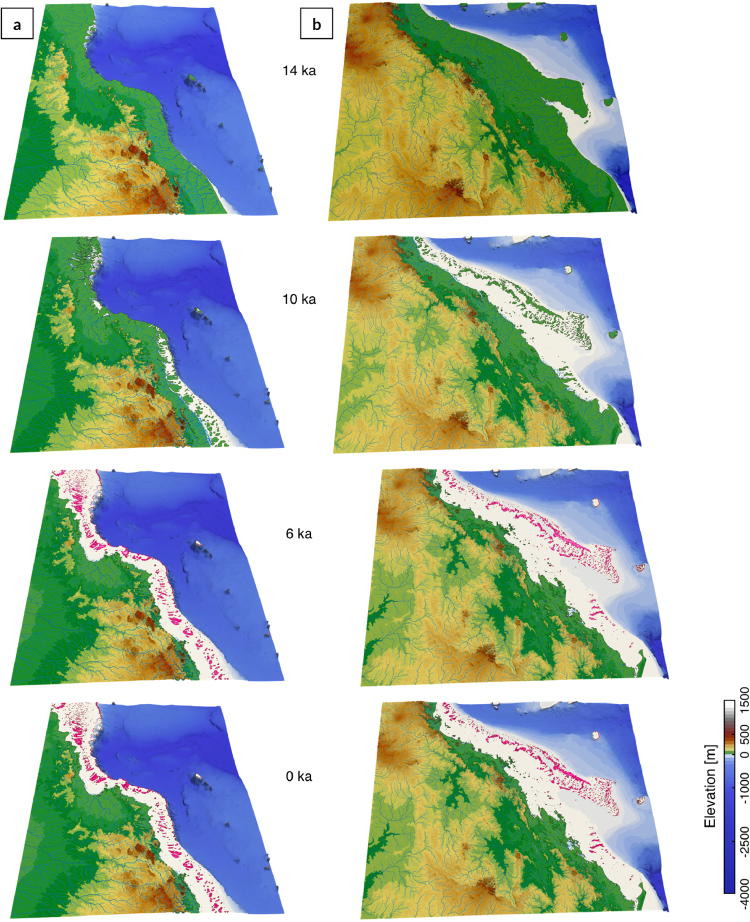
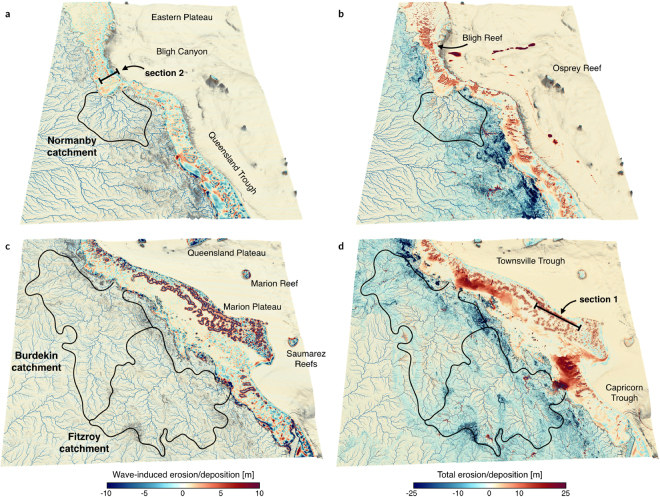
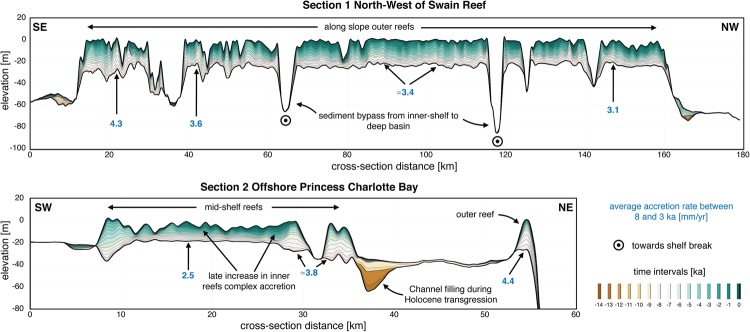
Understanding the effects of climatic variability on sediment dynamics is hindered by limited ability of current models to simulate long-term evolution of sediment transfer from source to sink and associated morphological changes. We present a new approach based on a reduced-complexity model which computes over geological time: sediment transport from landmasses to coasts, reworking of marine sediments by longshore currents, and development of coral reef systems. Our framework links together the main sedimentary processes driving mixed siliciclastic-carbonate system dynamics. It offers a methodology for objective and quantitative sediment fate estimations over regional and millennial time-scales. A simulation of the Holocene evolution of the Great Barrier Reef shows: (1) how high sediment loads from catchments erosion prevented coral growth during the early transgression phase and favoured sediment gravity-flows in the deepest parts of the northern region basin floor (prior to 8 ka before present (BP)); (2) how the fine balance between climate, sea-level, and margin physiography enabled coral reefs to thrive under limited shelf sedimentation rates after ~6 ka BP; and, (3) how since 3 ka BP, with the decrease of accommodation space, reduced of vertical growth led to the lateral extension of reefs consistent with available observational data.
当前模型模拟沉积物从源到汇的长期演化及相关形态变化的能力有限,这阻碍了我们对气候变率对沉积物动力学影响的理解。我们提出了一种基于简化模型的新方法,该模型可在地质时间尺度上进行计算:沉积物从陆地输送到海岸、沿岸流对海洋沉积物的再加工以及珊瑚礁系统的发育。我们的框架将驱动混合硅质碎屑 - 碳酸盐系统动力学的主要沉积过程联系在一起。它提供了一种在区域和千年时间尺度上进行客观和定量沉积物归宿估计的方法。对大堡礁全新世演化的模拟表明:(1)在海侵早期(距今8000年之前(BP)),集水区侵蚀产生的高沉积物负荷如何阻止珊瑚生长,并有利于北部区域盆底最深部分的沉积物重力流;(2)在距今约6000年BP之后,气候、海平面和边缘地貌之间的精细平衡如何使珊瑚礁在有限的陆架沉积速率下得以繁荣;以及(3)自距今3000年BP以来,随着可容纳空间的减少,垂直生长的降低如何导致珊瑚礁横向扩展,这与现有观测数据一致。