IMNC Laboratory, CNRS, Univ Paris Saclay, Univ Paris-Sud, Univ Paris Diderot, France.
Department of Neuropathology, Sainte-Anne Hospital, IMA-Brain, INSERM U894, Univ Paris Descartes, Paris, France.
PLoS Comput Biol. 2018 Mar 28;14(3):e1005977. doi: 10.1371/journal.pcbi.1005977. eCollection 2018 Mar.
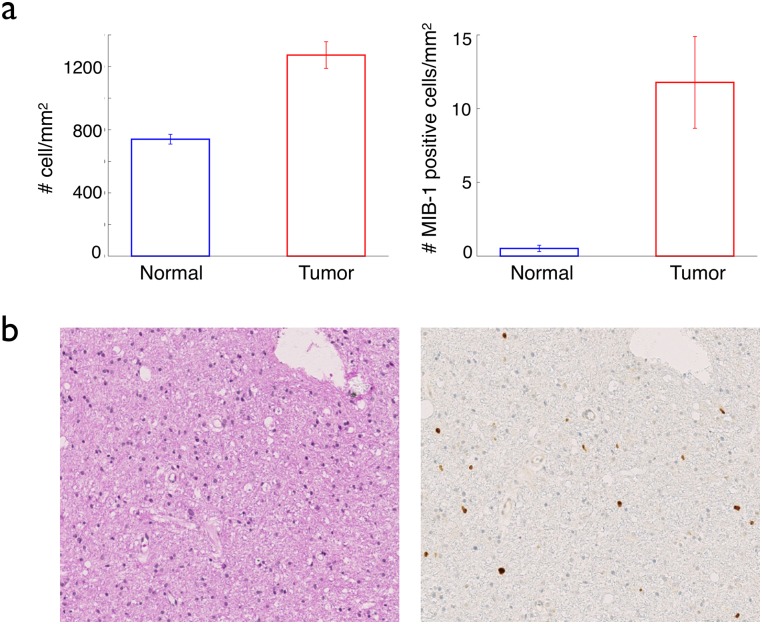
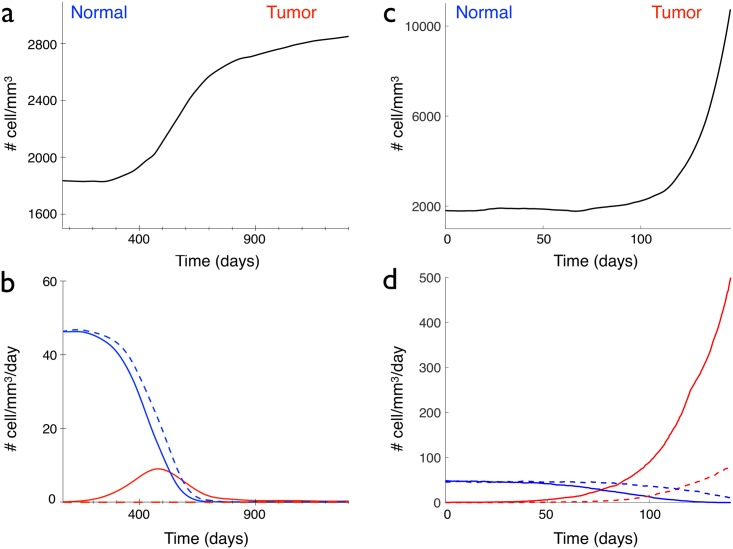
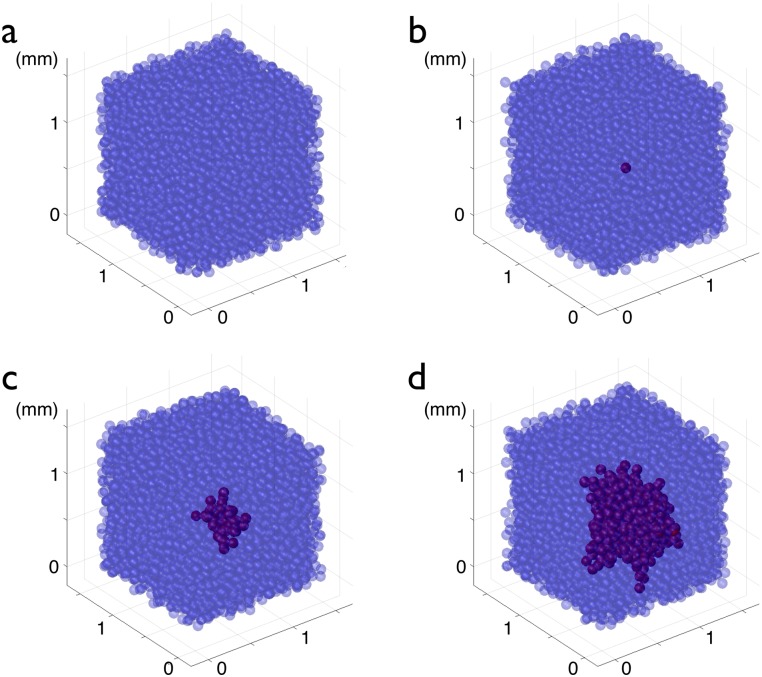
Oligodendrocyte precursor cells (OPCs) have remarkable properties: they represent the most abundant cycling cell population in the adult normal brain and they manage to achieve a uniform and constant density throughout the adult brain. This equilibrium is obtained by the interplay of four processes: division, differentiation or death, migration and active self-repulsion. They are also strongly suspected to be at the origin of gliomas, when their equilibrium is disrupted. In this article, we present a model of the dynamics of OPCs, first in a normal tissue. This model is based on a cellular automaton and its rules are mimicking the ones that regulate the dynamics of real OPCs. The model is able to reproduce the homeostasis of the cell population, with the maintenance of a constant and uniform cell density and the healing of a lesion. We show that there exists a fair quantitative agreement between the simulated and experimental parameters, such as the cell velocity, the time taken to close a lesion, and the duration of the cell cycle. We present three possible scenarios of disruption of the equilibrium: the appearance of an over-proliferating cell, of a deadless/non-differentiating cell, or of a cell that lost any contact-inhibition. We show that the appearance of an over-proliferating cell is sufficient to trigger the growth of a tumor that has low-grade glioma features: an invasive behaviour, a linear radial growth of the tumor with a corresponding growth velocity of less than 2 mm per year, as well a cell density at the center which exceeds the one in normal tissue by a factor of less than two. The loss of contact inhibition leads to a more high-grade-like glioma. The results of our model contribute to the body of evidence that identify OPCs as possible cells of origin of gliomas.
少突胶质前体细胞(OPC)具有显著的特性:它们是成年正常大脑中最丰富的分裂细胞群体,并且能够在整个成年大脑中保持均匀和恒定的密度。这种平衡是通过四个过程的相互作用实现的:分裂、分化或死亡、迁移和主动自我排斥。当它们的平衡被打破时,它们也被强烈怀疑是神经胶质瘤的起源。在本文中,我们提出了一个 OPC 动力学模型,首先是在正常组织中。该模型基于元胞自动机,其规则模拟了调节真实 OPC 动力学的规则。该模型能够再现细胞群体的动态平衡,维持恒定和均匀的细胞密度,并修复损伤。我们表明,模拟和实验参数之间存在相当数量的一致性,例如细胞速度、修复损伤所需的时间以及细胞周期的持续时间。我们提出了三种可能破坏平衡的情况:出现过度增殖的细胞、不死/非分化的细胞或失去任何接触抑制的细胞。我们表明,出现过度增殖的细胞足以引发具有低级别胶质瘤特征的肿瘤生长:侵袭性行为、肿瘤呈线性径向生长,相应的生长速度低于每年 2 毫米,以及肿瘤中心的细胞密度超过正常组织的两倍。接触抑制的丧失会导致更高级别样的胶质瘤。我们模型的结果有助于确定 OPC 作为神经胶质瘤起源细胞的证据。