Epidemiology Unit, Department of Preventative Veterinary Medicine, Faculty of Veterinary Sciences, University of Chile, Santiago, Chile.
Institut Pasteur-Cambodia, Phnom Penh, Cambodia.
Emerg Microbes Infect. 2018 Mar 29;7(1):44. doi: 10.1038/s41426-018-0046-9.
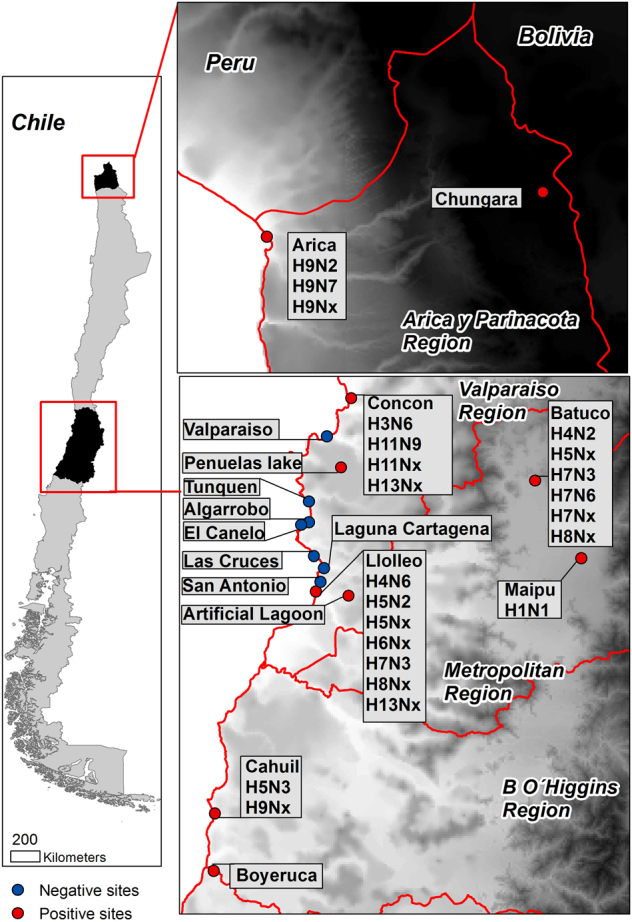
While the circulation of avian influenza viruses (IAV) in wild birds in the northern hemisphere has been well documented, data from South America remain sparse. To address this gap in knowledge, we undertook IAV surveillance in wild birds in parts of Central and Northern Chile between 2012 and 2015. A wide diversity of hemagglutinin (HA) and neuraminidase (NA) subtypes were identified and 16 viruses were isolated including low pathogenic H5 and H7 strains, making this the largest and most diverse collection of Chilean avian IAVs to date. Unlike IAVs isolated from wild birds in other South American countries where the genes were most like viruses isolated from wild birds in either North America or South America, the Chilean viruses were reassortants containing genes like viruses isolated from both continents. In summary, our studies demonstrate that genetically diverse avian IAVs are circulating in wild birds in Chile highlighting the need for further investigation in this understudied area of the world.
虽然有关北半球野鸟中流感病毒(IAV)的传播情况已有大量记录,但南美洲的数据仍然很少。为了填补这一知识空白,我们在 2012 年至 2015 年期间对智利中部和北部的野鸟进行了 IAV 监测。我们鉴定出了广泛的血凝素(HA)和神经氨酸酶(NA)亚型,共分离出 16 种病毒,包括低致病性 H5 和 H7 株,这是迄今为止智利最大和最多样化的禽类 IAV 集合。与在其他南美国家从野鸟中分离出的 IAV 不同,这些病毒的基因最类似于从北美的野鸟或南美的野鸟中分离出的病毒,而智利的病毒是包含来自两个大陆的病毒的基因重组病毒。总之,我们的研究表明,遗传上多样化的禽 IAV 正在智利的野鸟中传播,这突出表明需要对这一在世界范围内研究不足的地区进行进一步调查。