Department of Epidemiology, Rollins School of Public Health, Emory University, Atlanta, Georgia.
Division for Heart Disease and Stroke Prevention, National Center for Chronic Disease Prevention and Health Promotion, CDC, Atlanta, Georgia.
MMWR Surveill Summ. 2018 Mar 30;67(5):1-11. doi: 10.15585/mmwr.ss6705a1.
PROBLEM/CONDITION: Heart disease is the leading cause of death in the United States. In 2015, heart disease accounted for approximately 630,000 deaths, representing one in four deaths in the United States. Although heart disease death rates decreased 68% for the total population from 1968 to 2015, marked disparities in decreases exist by race and state.
1968-2015.
The National Vital Statistics System (NVSS) data on deaths in the United States were abstracted for heart disease using diagnosis codes from the eighth, ninth, and tenth revisions of the International Classification of Diseases (ICD-8, ICD-9, and ICD-10) for 1968-2015. Population estimates were obtained from NVSS files. National and state-specific heart disease death rates for the total population and by race for adults aged ≥35 years were calculated for 1968-2015. National and state-specific black-white heart disease mortality ratios also were calculated. Death rates were age standardized to the 2000 U.S. standard population. Joinpoint regression was used to perform time trend analyses.
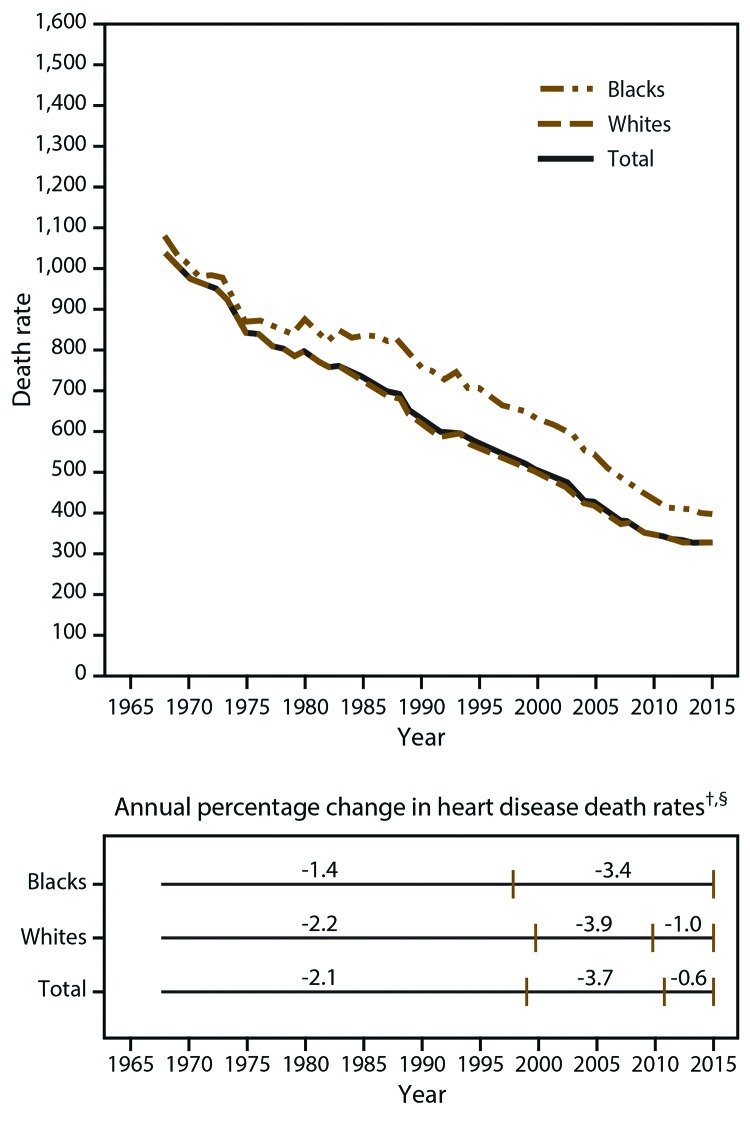
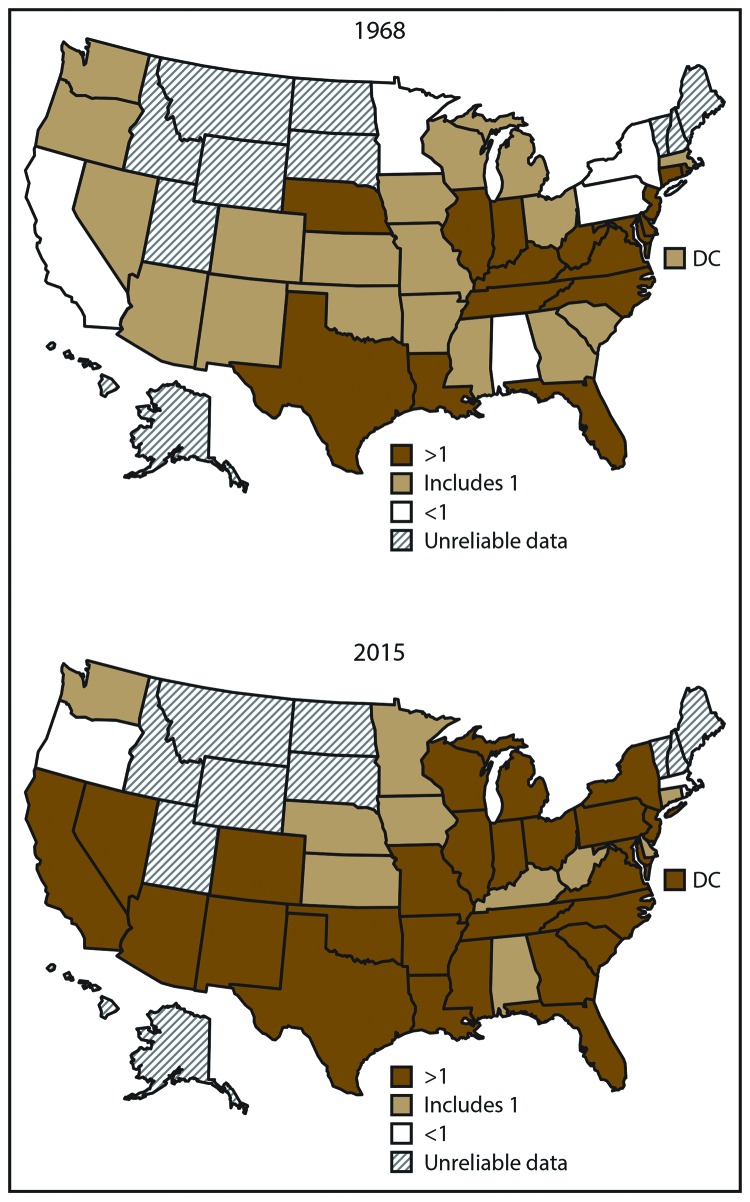
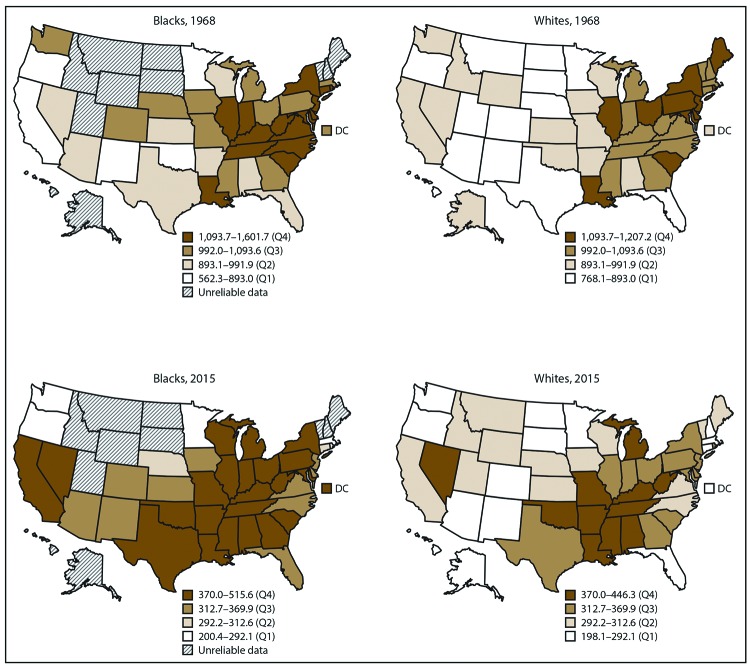
From 1968 to 2015, heart disease death rates decreased for the total U.S. population among adults aged ≥35 years, from 1,034.5 to 327.2 per 100,000 population, respectively, with variations in the magnitude of decreases by race and state. Rates decreased for the total population an average of 2.4% per year, with greater average decreases among whites (2.4% per year) than blacks (2.2% per year). At the national level, heart disease death rates for blacks and whites were similar at the start of the study period (1968) but began to diverge in the late 1970s, when rates for blacks plateaued while rates for whites continued to decrease. Heart disease death rates among blacks remained higher than among whites for the remainder of the study period. Nationwide, the black-white ratio of heart disease death rates increased from 1.04 in 1968 to 1.21 in 2015, with large increases occurring during the 1970s and 1980s followed by small but steady increases until approximately 2005. Since 2005, modest decreases have occurred in the black-white ratio of heart disease death rates at the national level. The majority of states had increases in black-white mortality ratios from 1968 to 2015. The number of states with black-white mortality ratios >1 increased from 16 (40%) to 27 (67.5%).
Although heart disease death rates decreased both for blacks and whites from 1968 to 2015, substantial differences in decreases were found by race and state. At the national level and in most states, blacks experienced smaller decreases in heart disease death rates than whites for the majority of the period. Overall, the black-white disparity in heart disease death rates increased from 1968 to 2005, with a modest decrease from 2005 to 2015.
Since 1968, substantial increases have occurred in black-white disparities of heart disease death rates in the United States at the national level and in many states. These increases appear to be due to faster decreases in heart disease death rates for whites than blacks, particularly from the late 1970s until the mid-2000s. Despite modest decreases in black-white disparities at the national level since 2005, in 2015, heart disease death rates were 21% higher among blacks than among whites. This study demonstrates the use of NVSS data to conduct surveillance of heart disease death rates by race and of black-white disparities in heart disease death rates. Continued surveillance of temporal trends in heart disease death rates by race can provide valuable information to policy makers and public health practitioners working to reduce heart disease death rates both for blacks and whites and disparities between blacks and whites.
问题/状况:心脏病是美国的主要死因。2015 年,心脏病导致约 63 万人死亡,占美国总死亡人数的四分之一。尽管自 1968 年至 2015 年,心脏病总人群死亡率下降了 68%,但不同种族和州之间的死亡率下降幅度存在显著差异。
1968 年至 2015 年。
使用国际疾病分类第 8、9 和 10 版(ICD-8、ICD-9 和 ICD-10)的诊断代码,从美国国家生命统计系统(NVSS)中提取美国心脏病死亡数据。人口估计数取自 NVSS 文件。计算了 1968 年至 2015 年总人群和≥35 岁成年人的种族特异性心脏病死亡率,以及全国和州特定的黑人和白人心脏病死亡率比值。死亡率按 2000 年美国标准人口进行年龄标准化。使用 Joinpoint 回归进行时间趋势分析。
自 1968 年至 2015 年,≥35 岁成年人的心脏病死亡率从每 10 万人中 1034.5 人下降至 327.2 人,降幅分别为 1,034.5 人至 327.2 人,不同种族和州的降幅幅度不同。总人群的平均年下降率为 2.4%,白人的平均下降率(每年 2.4%)高于黑人(每年 2.2%)。在国家层面,黑人的心脏病死亡率与白人在研究开始时(1968 年)相似,但在 20 世纪 70 年代后期开始出现差异,当时黑人的死亡率趋于平稳,而白人的死亡率继续下降。在研究期间的其余时间里,黑人的心脏病死亡率仍然高于白人。在全国范围内,黑人与白人的心脏病死亡率比值从 1968 年的 1.04 增加到 2015 年的 1.21,在 20 世纪 70 年代和 80 年代有较大幅度的增加,之后略有增加,直到 2005 年左右。自 2005 年以来,全国范围内心脏病死亡率的黑人和白人比值略有下降。大多数州的黑人和白人死亡率比值从 1968 年到 2015 年都有所增加。黑人与白人死亡率比值大于 1 的州从 16 个(40%)增加到 27 个(67.5%)。
尽管从 1968 年至 2015 年,黑人和白人的心脏病死亡率都有所下降,但不同种族和州之间的下降幅度存在显著差异。在国家层面和大多数州,黑人和白人的心脏病死亡率在大多数时期都有下降,但黑人的下降幅度小于白人。总的来说,从 1968 年到 2005 年,美国黑人和白人的心脏病死亡率差距扩大,从 2005 年到 2015 年略有缩小。
自 1968 年以来,美国全国和许多州的黑人和白人心脏病死亡率差距都有了显著增加。这些增加似乎是由于白人的心脏病死亡率下降速度快于黑人,尤其是从 20 世纪 70 年代末到 21 世纪 2000 年代中期。尽管自 2005 年以来,全国范围内的黑人和白人心脏病死亡率差距有所缩小,但 2015 年黑人的心脏病死亡率仍比白人高 21%。本研究展示了如何利用 NVSS 数据对种族特异性心脏病死亡率和黑人和白人心脏病死亡率差距进行监测。对种族特异性心脏病死亡率的时间趋势进行持续监测,可以为政策制定者和公共卫生从业者提供有价值的信息,帮助他们降低黑人和白人的心脏病死亡率,并缩小黑人和白人之间的差距。