Laboratory of Malaria and Vector Research, NIAID, NIH, Rockville, Maryland, United States of America.
Malaria Research and Training Center (MRTC), Faculty of Medicine, Pharmacy and Odonto-stomatology, University of Sciences, Techniques and Technologies, Bamako, Mali.
PLoS One. 2018 Mar 29;13(3):e0194899. doi: 10.1371/journal.pone.0194899. eCollection 2018.
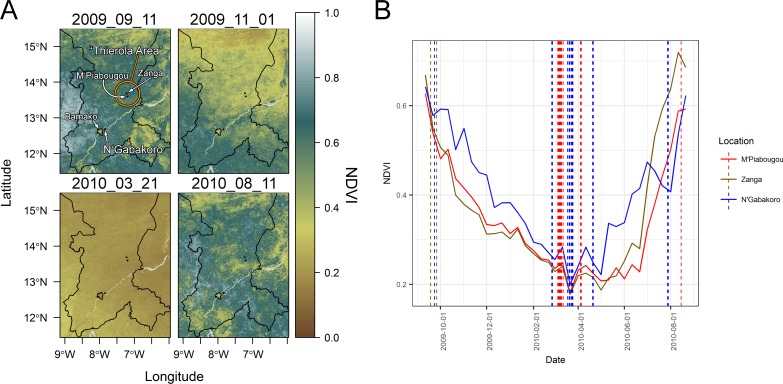
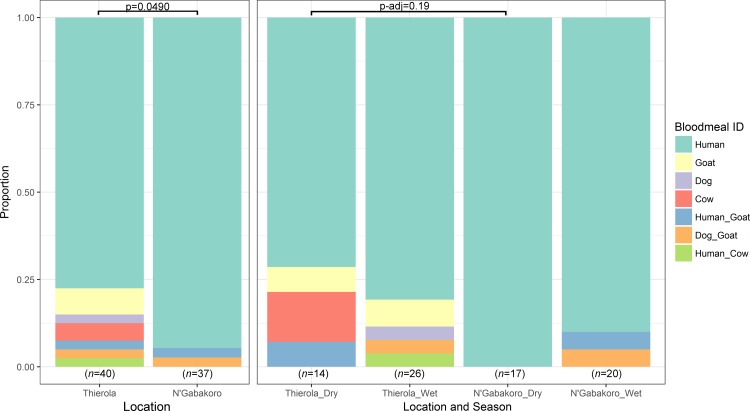
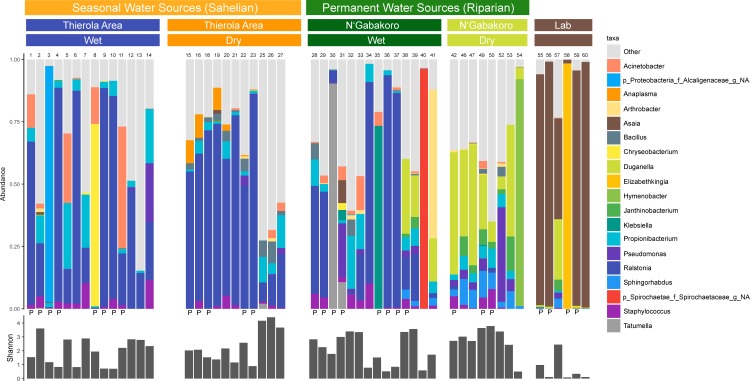
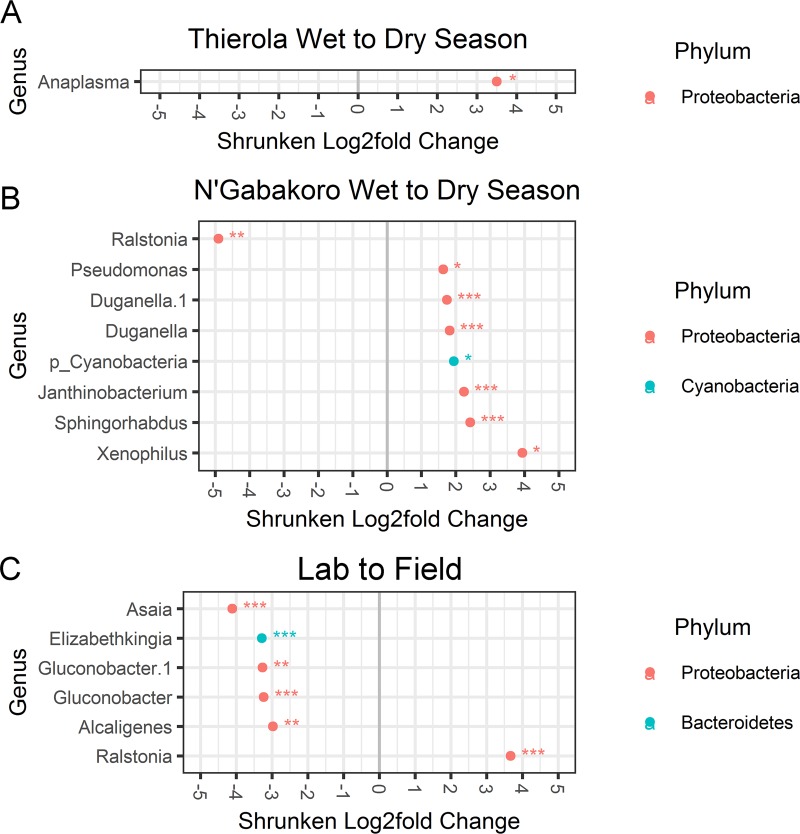
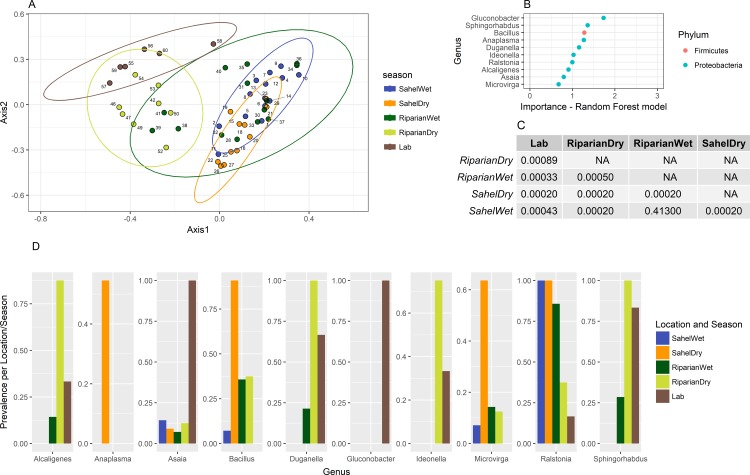
The poorly understood mechanisms of dry season persistence of Anopheles spp. mosquitoes through the dry season in Africa remain a critical gap in our knowledge of Plasmodium disease transmission. While it is thought that adult mosquitoes remain in a dormant state throughout this seven-month dry season, the nature of this state remains unknown and has largely not been recapitulated in laboratory settings. To elucidate possible connections of this state with microbial composition, the whole body microbiomes of adult mosquitoes in the dry and wet seasons in two locations of Mali with varying water availability were compared by sequencing the 16S ribosomal RNA gene. These locations were a village near the Niger River with year-round water sources (N'Gabakoro, "riparian"), and a typical Sahelian area with highly seasonal breeding sites (Thierola Area, "Sahelian"). The 16S bacterial data consisted of 2057 sequence variants in 426 genera across 184 families. From these data, we found several compositional differences that were seasonally and spatially linked. Counter to our initial hypothesis, there were more pronounced seasonal differences in the bacterial microbiome of riparian, rather than Sahelian areas. These seasonal shifts were primarily in Ralstonia, Sphingorhabdus, and Duganella spp. bacteria that are usually soil and water-associated, indicating these changes may be from bacteria acquired in the larval environment, rather than adulthood. In Sahelian dry season mosquitoes, there was a unique intracellular bacteria, Anaplasma, which likely was acquired through non-human blood feeding. Cytochrome B analysis of blood meals showed greater heterogeneity in host choice of An. coluzzii independent of season in the Thierola area compared to N'Gabakoro (77.5% vs. 94.6% human-origin blood meal, respectively), indicating a relaxation of anthropophily. Overall, this exploratory study provides valuable indications of spatial and seasonal differences in bacterial composition which help refine this difficult to study state.
在非洲,疟疾病媒按蚊(Anopheles spp.)在旱季的持续存在机制尚未被充分了解,这仍然是我们对疟疾病传播知识的一个关键空白。虽然人们认为成年蚊子在长达七个月的旱季都处于休眠状态,但这种状态的性质尚不清楚,而且在实验室环境中也没有得到广泛重现。为了阐明这种状态与微生物组成之间可能存在的联系,本研究通过对 16S 核糖体 RNA 基因进行测序,比较了马里两个具有不同水源可得性的地点(尼日尔河附近的一个全年都有水源的村庄[N'Gabakoro,“河畔”]和一个典型的萨赫勒地区[Thierola 地区,“萨赫勒”])的干季和湿季成年蚊子的全身微生物组。这些地点的 16S 细菌数据由 184 个科的 426 个属中的 2057 个序列变异体组成。从这些数据中,我们发现了一些与季节和空间相关的组成差异。与我们最初的假设相反,河畔地区的细菌微生物组在季节性方面的差异更为显著,而不是萨赫勒地区。这些季节性变化主要是在 Ralstonia、Sphingorhabdus 和 Duganella 等细菌中,这些细菌通常与土壤和水有关,这表明这些变化可能来自幼虫环境中获得的细菌,而不是成年蚊子。在萨赫勒地区的旱季蚊子中,有一种独特的细胞内细菌 Anaplasma,它可能是通过非人类血液摄入获得的。血液餐中的细胞色素 B 分析表明,与河畔地区相比,Thierola 地区的 An. coluzzii 在非人类血液摄入方面的宿主选择具有更大的异质性(分别为 77.5%和 94.6%的人源血液餐),表明嗜人程度降低。总的来说,这项探索性研究提供了有价值的指示,表明了细菌组成的空间和季节性差异,有助于更精确地研究这种难以研究的状态。