Center for Data-Intensive Biomedicine and Biotechnology, Skolkovo Institute of Science and Technology, Moscow 143028, Russia.
Molecular Biophysics Group, Peter Debye Institute for Soft Matter Physics, Universität Leipzig, Leipzig 04103, Germany.
Nucleic Acids Res. 2018 May 4;46(8):4087-4098. doi: 10.1093/nar/gky219.
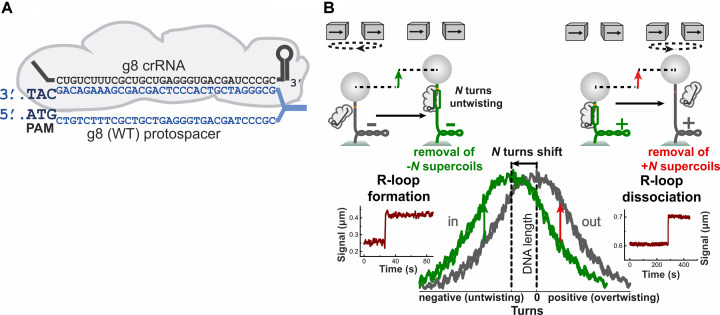
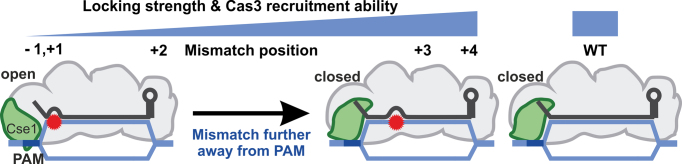
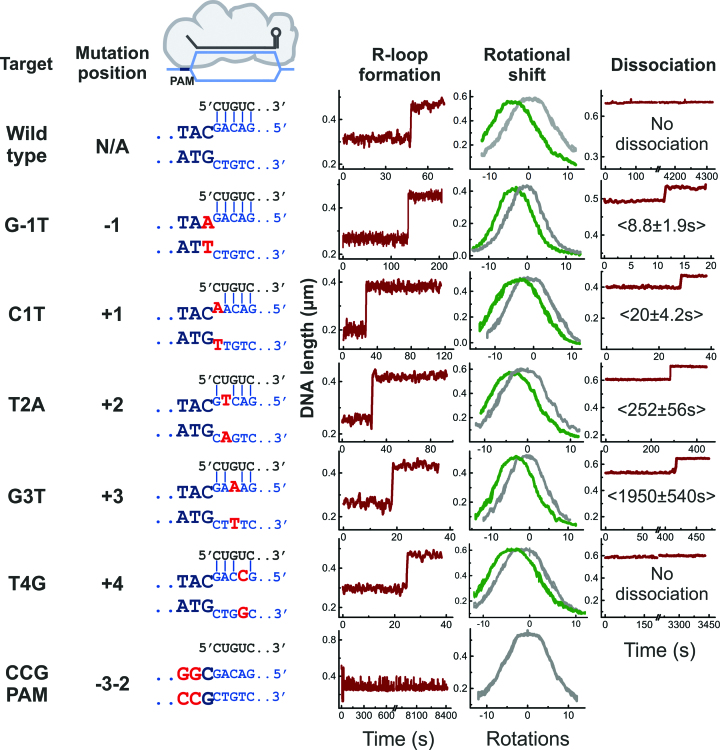
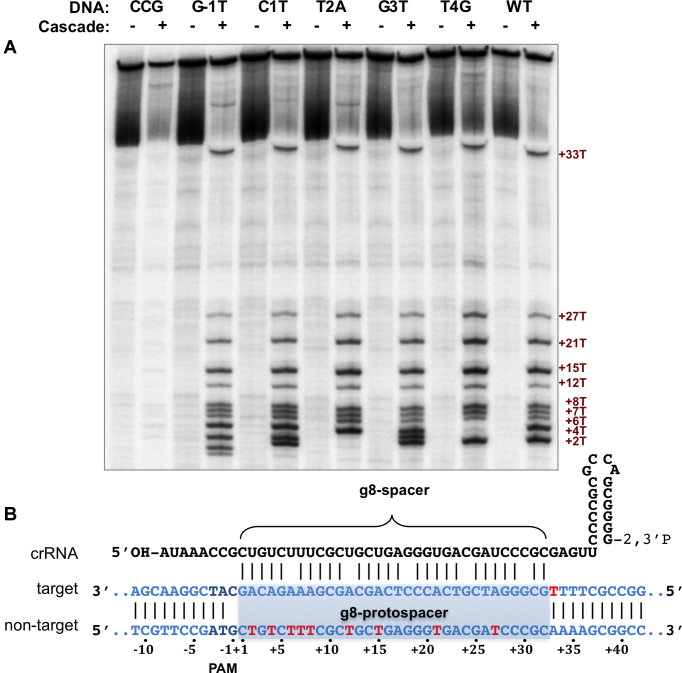
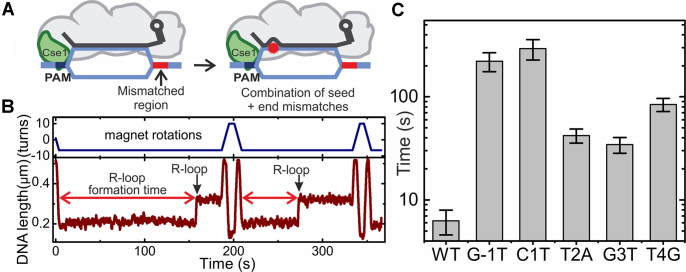
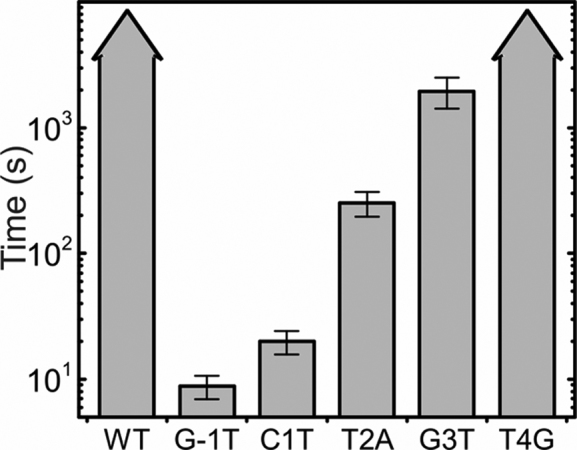
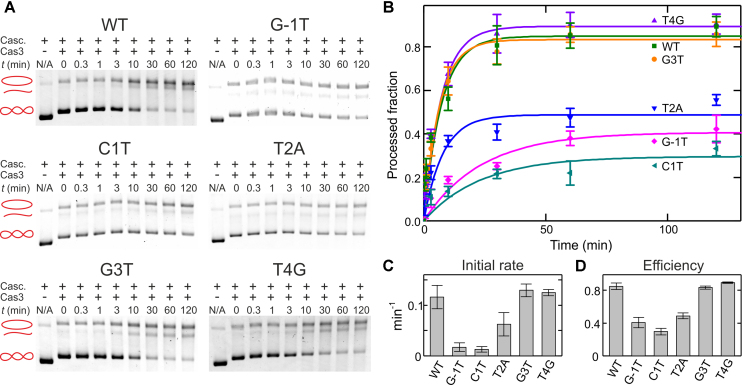
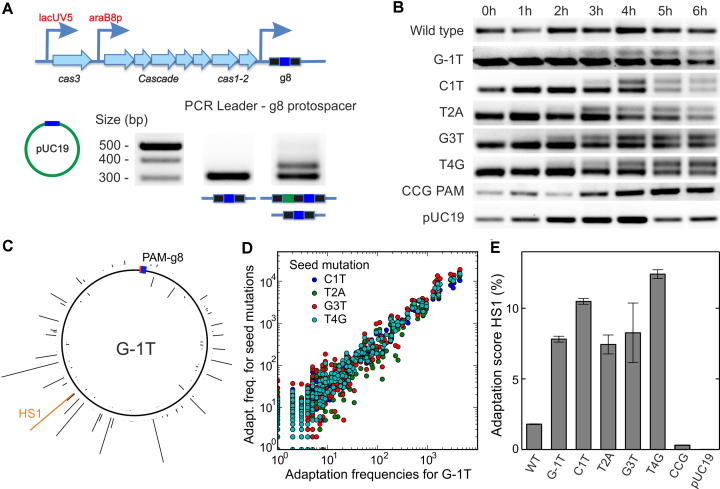
In type I CRISPR-Cas systems, primed adaptation of new spacers into CRISPR arrays occurs when the effector Cascade-crRNA complex recognizes imperfectly matched targets that are not subject to efficient CRISPR interference. Thus, primed adaptation allows cells to acquire additional protection against mobile genetic elements that managed to escape interference. Biochemical and biophysical studies suggested that Cascade-crRNA complexes formed on fully matching targets (subject to efficient interference) and on partially mismatched targets that promote primed adaption are structurally different. Here, we probed Escherichia coli Cascade-crRNA complexes bound to matched and mismatched DNA targets using a magnetic tweezers assay. Significant differences in complex stabilities were observed consistent with the presence of at least two distinct conformations. Surprisingly, in vivo analysis demonstrated that all mismatched targets stimulated robust primed adaptation irrespective of conformational states observed in vitro. Our results suggest that primed adaptation is a direct consequence of a reduced interference efficiency and/or rate and is not a consequence of distinct effector complex conformations on target DNA.
在 I 型 CRISPR-Cas 系统中,当效应物 Cascade-crRNA 复合物识别到未受有效 CRISPR 干扰的不完全匹配靶标时,新间隔区的预适应适应性就会发生。因此,预适应使细胞能够获得针对成功逃避干扰的移动遗传元件的额外保护。生化和生物物理研究表明,在完全匹配的靶标(受有效干扰)和促进预适应的部分不匹配靶标上形成的 Cascade-crRNA 复合物在结构上是不同的。在这里,我们使用磁镊测定法探测了与匹配和不匹配 DNA 靶标结合的大肠杆菌 Cascade-crRNA 复合物。观察到复合物稳定性存在显著差异,这与至少存在两种不同构象一致。令人惊讶的是,体内分析表明,所有不匹配的靶标都刺激了强大的预适应适应性,而与体外观察到的构象状态无关。我们的结果表明,预适应是干扰效率和/或速率降低的直接结果,而不是靶 DNA 上不同效应物复合物构象的结果。