Wong Joshua, Gunduz Aysegul, Shute Jonathan, Eisinger Robert, Cernera Stephanie, Ho Kwo Wei David, Martinez-Ramirez Daniel, Almeida Leonardo, Wilson Christina A, Okun Michael S, Hess Christopher W
Center for Movement Disorders and Neurorestoration, Department of Neurology, University of Florida College of Medicine and McKnight Brain Institute, Gainesville, FL, USA.
J. Crayton Pruitt Family Department of Biomedical Engineering, University of Florida Gainesville, FL, USA.
Tremor Other Hyperkinet Mov (N Y). 2018 Mar 26;8:542. doi: 10.7916/D8M62XTC. eCollection 2018.
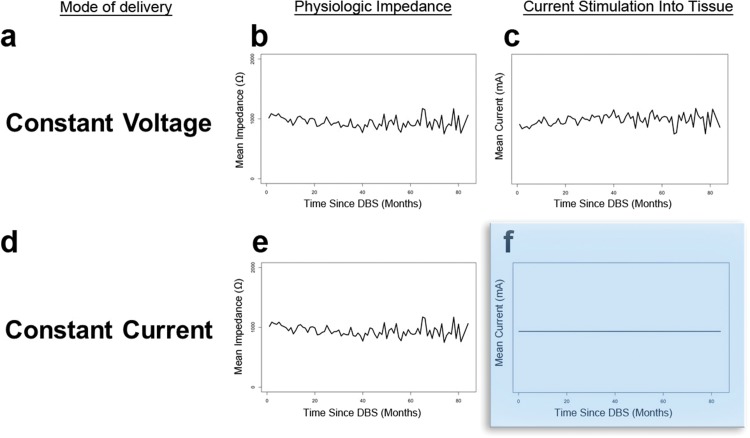
Impedance is an integral property of neuromodulation devices that determines the current delivered to brain tissue. Long-term variability in therapeutic impedance following deep brain stimulation (DBS) has not been extensively investigated across different brain targets. The aim was to evaluate DBS impedance drift and variability over an extended postoperative period across common DBS targets.
Retrospective data from 1,764 electrode leads were included and drawn from 866 DBS patients enrolled in the University of Florida Institutional Review Board-approved INFORM database and analyzed up to 84 months post implantation. An exploratory analysis was conducted to identify trends in impedances using a Mann-Kendall test of trend.
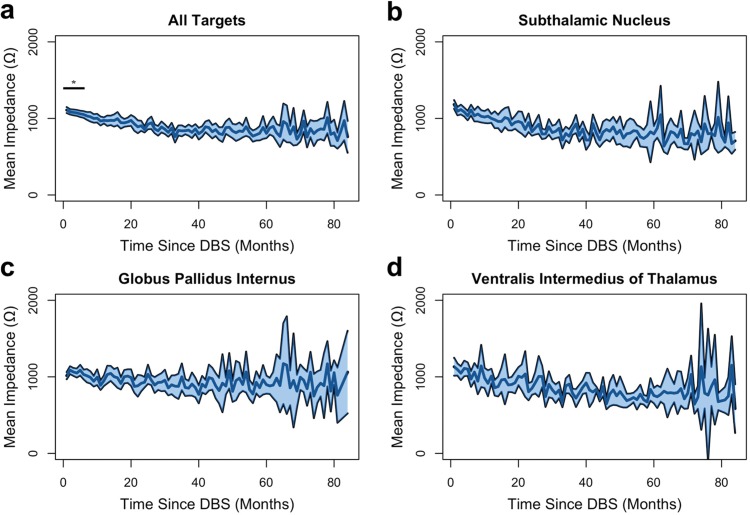
There were 866 patients and 1,764 leads available for analysis. The majority of subjects had Parkinson's disease (60.7%). The mean age at implantation was 58.7 years old and the mean follow-up time was 36.8 months. There were significant fluctuations in the mean impedance of all electrodes analyzed that largely stabilized by 6 months except for the subthalamic nucleus (STN) target, in which fluctuations persisted throughout the duration of follow-up with a continued downward trend (p < 0.001).
The drift in impedance observed primarily within the first 6 months is in keeping with prior studies and is likely due to surgical micro-lesioning effects and brain parenchyma remodeling at the electrode-tissue interface, typically at values approximating 1,000 . The differences in impedance trends over time in the various DBS targets may be due to underlying differences in structure and tissue composition.
阻抗是神经调节设备的一个重要特性,它决定了传递到脑组织的电流。深部脑刺激(DBS)后治疗阻抗的长期变异性在不同脑靶点尚未得到广泛研究。目的是评估在较长术后期间常见DBS靶点的DBS阻抗漂移和变异性。
纳入来自1764个电极导线的回顾性数据,这些数据取自佛罗里达大学机构审查委员会批准的INFORM数据库中的866例DBS患者,并在植入后长达84个月进行分析。使用Mann-Kendall趋势检验进行探索性分析以确定阻抗趋势。
有866例患者和1764个导线可供分析。大多数受试者患有帕金森病(60.7%)。植入时的平均年龄为58.7岁,平均随访时间为36.8个月。分析的所有电极的平均阻抗均有显著波动,除丘脑底核(STN)靶点外,大部分在6个月时稳定,在STN靶点中,波动在整个随访期间持续存在且呈持续下降趋势(p<0.001)。
主要在最初6个月内观察到的阻抗漂移与先前研究一致,可能是由于手术微损伤效应以及电极-组织界面处的脑实质重塑,通常在接近1000的值时出现。不同DBS靶点随时间的阻抗趋势差异可能是由于结构和组织组成的潜在差异。