Alessandra-Perini Jéssica, Perini Jamila Alessandra, Rodrigues-Baptista Karina Cristina, de Moura Roberto Soares, Junior Antonio Palumbo, Dos Santos Thiago Alves, Souza Pergentino José Cunha, Nasciutti Luiz Eurico, Machado Daniel Escorsim
Morphological Sciences Program, Biomedical Sciences Institute, Federal University of Rio de Janeiro, Rio de Janeiro, RJ, Brazil.
Research Laboratory of Pharmaceutical Sciences, West Zone State University, Av Manuel Caldeira de Alvarenga, 1.203, Campo Grande, Rio de Janeiro, RJ, 23070-200, Brazil.
BMC Complement Altern Med. 2018 Apr 2;18(1):116. doi: 10.1186/s12906-018-2183-z.
Among the processes involved in the breast tumor microenvironment, angiogenesis and inflammation play a central role, and the main factors of these processes are the vascular endothelial growth factor (VEGF), cyclooxygenase 2 (COX-2) and macrophages. Recently, the extract of Euterpe oleracea (açaí), a fruit that is widely found in the Amazon region, already showed antitumorigenic effects in vitro in human breast cancer cell lines. The present study aimed to investigate the effect of açaí on breast cancer using a chemically DMBA (7,12-dimethylbenzanthracene) experimental model.
One day after initiation of treatment with açaí, mammary carcinogenesis was induced in female Wistar rats using a subcutaneous injection of 25 mg/kg of DMBA in the mammary gland. Forty rats were randomized into two groups: treated with 200 mg/kg of either açaí extract or vehicle, via gastric tube for 16 consecutive weeks. After treatment, the tumor was collected for macroscopic, histological and immunohistochemical (VEGF, vascular endothelial growth factor receptor 2 -VEGFR-2, COX-2 and matrix metalloproteinase -MMP-9) analyses; peritoneal fluid was subjected to flow cytometry (F4-80/MAC-2+) and ELISA immunoassay (VEGF, prostaglandin E -PGE and interleukin-10 -IL-10). Heart, liver and kidney samples were collected for histological analysis.
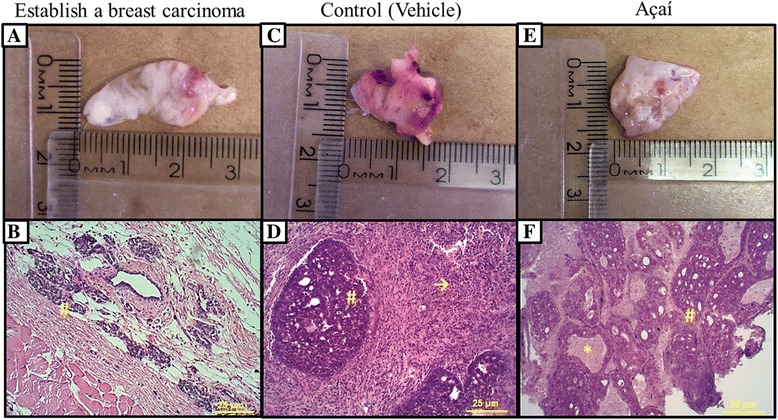
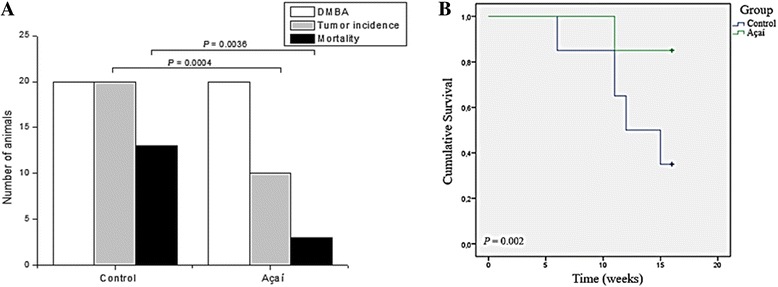
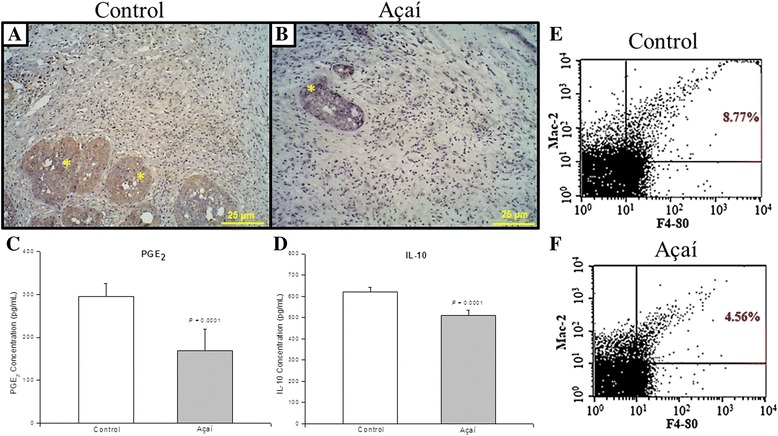
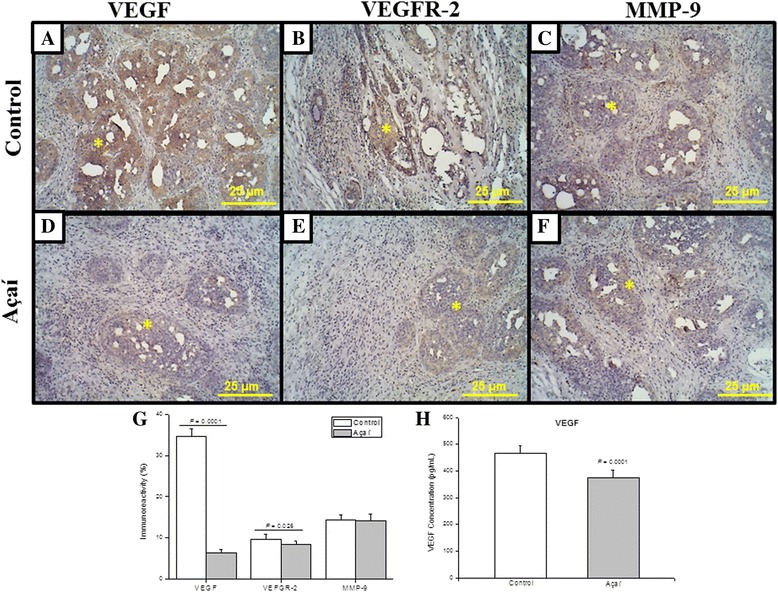
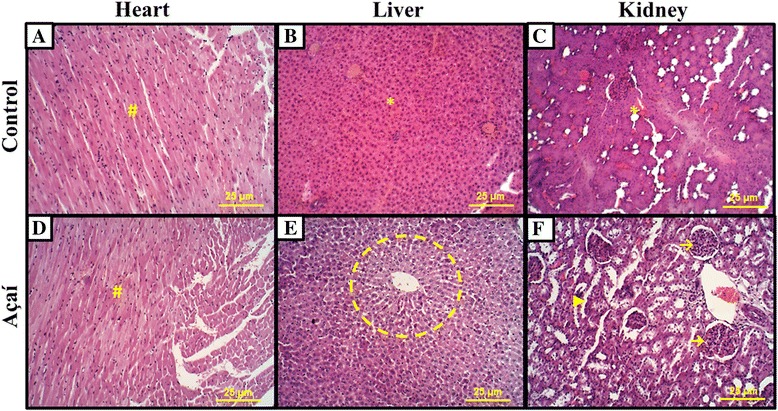
After 16 weeks of induction, the mammary carcinoma was confirmed by macroscopic and histological evaluation. Survival analysis indicates that açaí increased the survival (P = .0002, long-rank test) and reduced the deaths number (P = .0036, Chi-square test). Açaí treatment decreased the number of inflammatory cells and macrophage positive cells (Mac-2 + F4-80+), as well as promoting a reduction in immunostaining of VEGF, VEGFR-2 and COX-2. The açaí group also exhibited lower concentrations of PGE, VEGF and IL-10 compared to the control. The histopathological results of the liver and kidneys showed protective effect of açaí, since in the control group, there was an increase in fibrosis, atypical cells and hemorrhagic microenvironment.
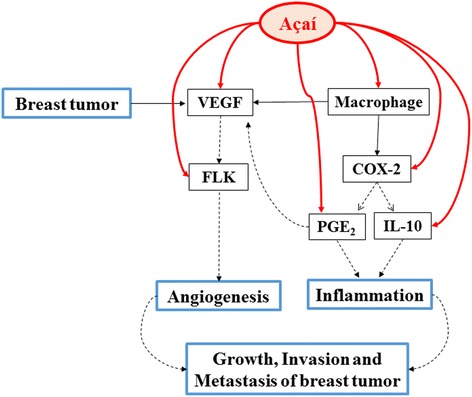
The results of this study demonstrated the antiangiogenic and anti-inflammatory potential of açaí, like due to the decreases of the number of activated macrophages, resulting in the inhibition of DMBA carcinogenicity in breast cancer.
在乳腺肿瘤微环境相关过程中,血管生成和炎症起着核心作用,这些过程的主要因素是血管内皮生长因子(VEGF)、环氧合酶2(COX - 2)和巨噬细胞。最近,在亚马逊地区广泛发现的一种水果——巴西莓(Euterpe oleracea)的提取物,已在体外人乳腺癌细胞系中显示出抗肿瘤作用。本研究旨在使用化学诱导剂DMBA(7,12 - 二甲基苯并蒽)实验模型研究巴西莓对乳腺癌的影响。
在用巴西莓治疗开始一天后,通过在乳腺皮下注射25 mg/kg的DMBA诱导雌性Wistar大鼠发生乳腺癌。40只大鼠随机分为两组:分别通过胃管连续16周给予200 mg/kg的巴西莓提取物或赋形剂。治疗后,收集肿瘤进行宏观、组织学和免疫组织化学(VEGF、血管内皮生长因子受体2 - VEGFR - 2、COX - 2和基质金属蛋白酶 - MMP - 9)分析;对腹腔液进行流式细胞术(F4 - 80/MAC - 2 +)和ELISA免疫测定(VEGF、前列腺素E - PGE和白细胞介素 - 10 - IL - 10)。收集心脏、肝脏和肾脏样本进行组织学分析。
诱导16周后,通过宏观和组织学评估确认发生了乳腺癌。生存分析表明,巴西莓提高了生存率(P = 0.0002,对数秩检验)并减少了死亡数量(P = 0.0036,卡方检验)。巴西莓治疗减少了炎症细胞和巨噬细胞阳性细胞(Mac - 2 + F4 - 80 +)的数量,并促进了VEGF、VEGFR - 2和COX - 2免疫染色的降低。与对照组相比,巴西莓组还表现出较低的PGE、VEGF和IL - 10浓度。肝脏和肾脏的组织病理学结果显示巴西莓具有保护作用,因为在对照组中,纤维化、非典型细胞和出血性微环境有所增加。
本研究结果证明了巴西莓具有抗血管生成和抗炎潜力,这可能是由于活化巨噬细胞数量减少,从而抑制了DMBA在乳腺癌中的致癌性。