IEEE Trans Med Imaging. 2018 Apr;37(4):955-965. doi: 10.1109/TMI.2017.2776324.
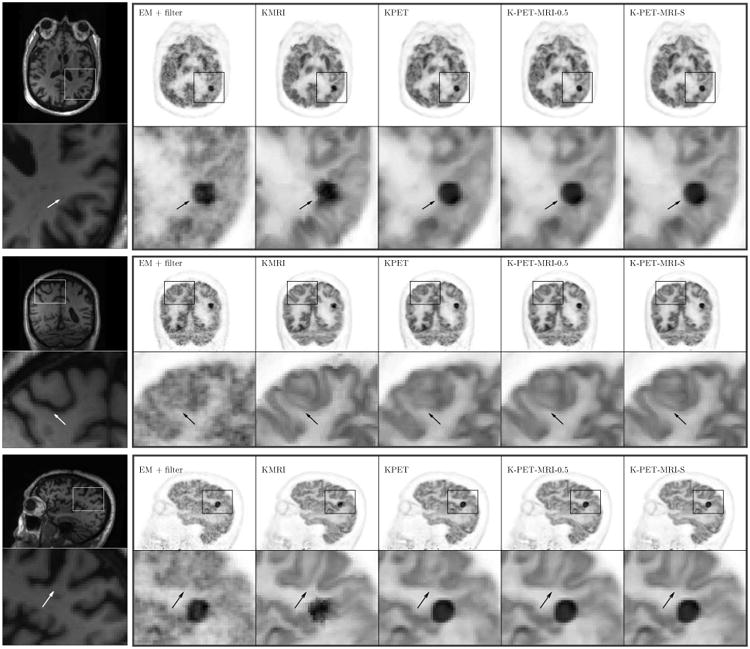
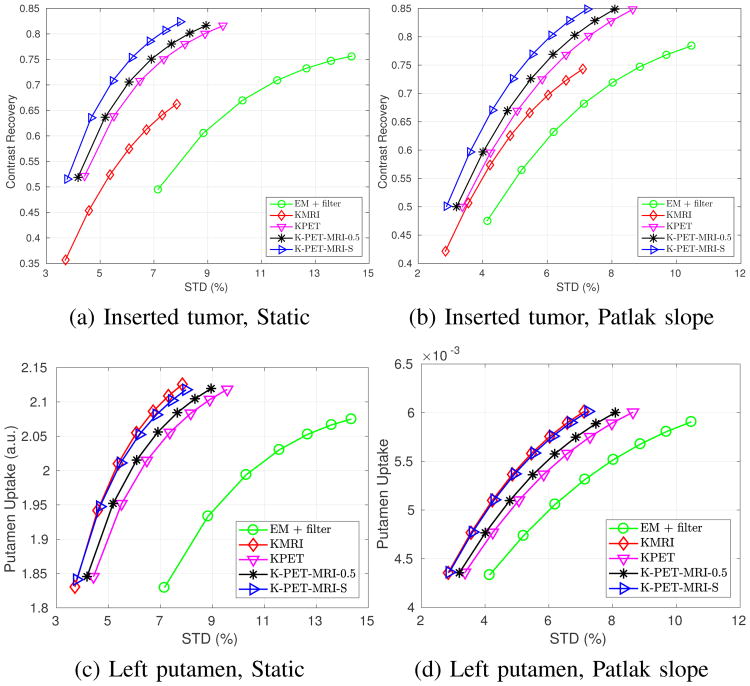
Positron emission tomography (PET) is a functional imaging modality widely used in oncology, cardiology, and neuroscience. It is highly sensitive, but suffers from relatively poor spatial resolution, as compared with anatomical imaging modalities, such as magnetic resonance imaging (MRI). With the recent development of combined PET/MR systems, we can improve the PET image quality by incorporating MR information into image reconstruction. Previously, kernel learning has been successfully embedded into static and dynamic PET image reconstruction using either PET temporal or MRI information. Here, we combine both PET temporal and MRI information adaptively to improve the quality of direct Patlak reconstruction. We examined different approaches to combine the PET and MRI information in kernel learning to address the issue of potential mismatches between MRI and PET signals. Computer simulations and hybrid real-patient data acquired on a simultaneous PET/MR scanner were used to evaluate the proposed methods. Results show that the method that combines PET temporal information and MRI spatial information adaptively based on the structure similarity index has the best performance in terms of noise reduction and resolution improvement.
正电子发射断层扫描(PET)是一种广泛应用于肿瘤学、心脏病学和神经科学的功能成像方式。与磁共振成像(MRI)等解剖成像方式相比,它具有较高的灵敏度,但空间分辨率相对较差。随着最近的 PET/MR 联合系统的发展,我们可以通过将 MR 信息纳入图像重建来提高 PET 图像质量。此前,基于 PET 时间或 MRI 信息,核学习已经成功地应用于静态和动态 PET 图像重建中。在这里,我们自适应地结合了 PET 时间和 MRI 信息,以提高直接 Patlak 重建的质量。我们研究了不同的方法来在核学习中结合 PET 和 MRI 信息,以解决 MRI 和 PET 信号之间潜在失配的问题。使用计算机模拟和在同时采集的 PET/MR 扫描仪上获得的混合真实患者数据来评估所提出的方法。结果表明,基于结构相似性指数自适应地结合 PET 时间信息和 MRI 空间信息的方法在降噪和分辨率提高方面表现最佳。