Deidda Daniel, Denis-Bacelar Ana M, Fenwick Andrew J, Ferreira Kelley M, Heetun Warda, Hutton Brian F, Robinson Andrew P, Scuffham James, Thielemans Kris
National Physical Laboratory, Teddington, UK.
Institute of Nuclear Medicine, University College London, London, UK.
EJNMMI Phys. 2022 Apr 4;9(1):25. doi: 10.1186/s40658-022-00452-4.
Selective internal radiation therapy with Yttrium-90 microspheres is an effective therapy for liver cancer and liver metastases. Yttrium-90 is mainly a high-energy beta particle emitter. These beta particles emit Bremsstrahlung radiation during their interaction with tissue making post-therapy imaging of the radioactivity distribution feasible. Nevertheless, image quality and quantification is difficult due to the continuous energy spectrum which makes resolution modelling, attenuation and scatter estimation challenging and therefore the dosimetry quantification is inaccurate. As a consequence a reconstruction algorithm able to improve resolution could be beneficial.
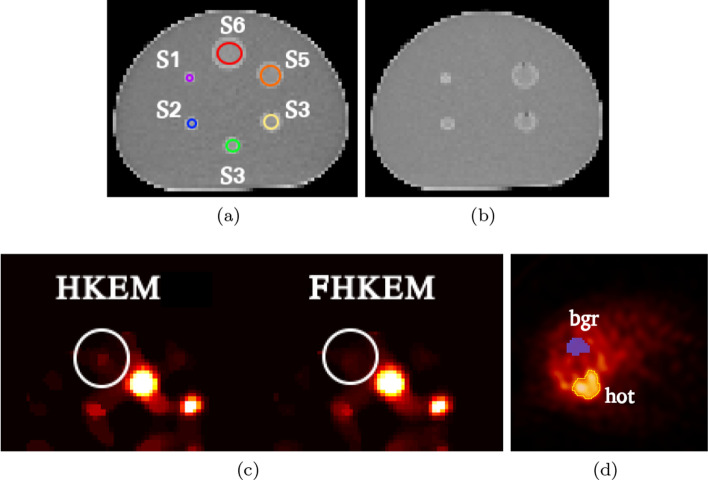
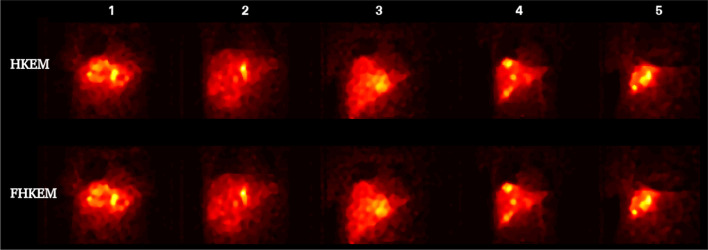
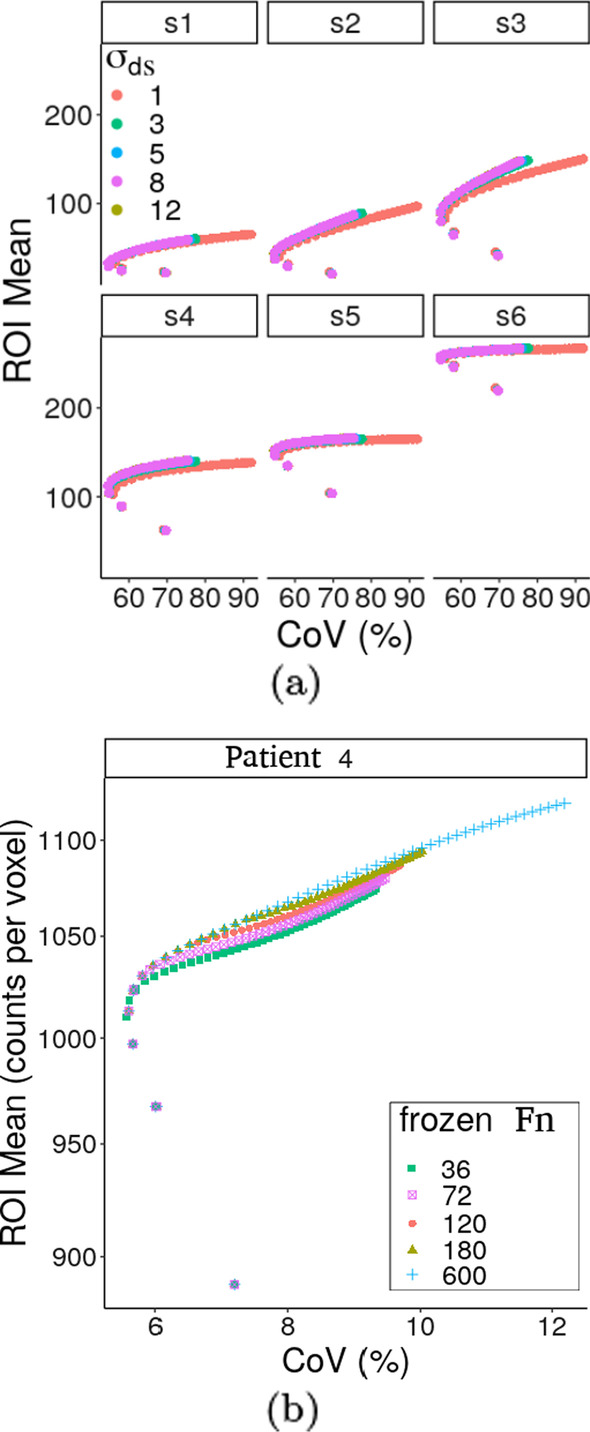
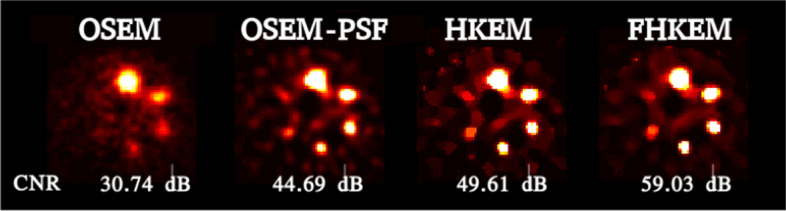
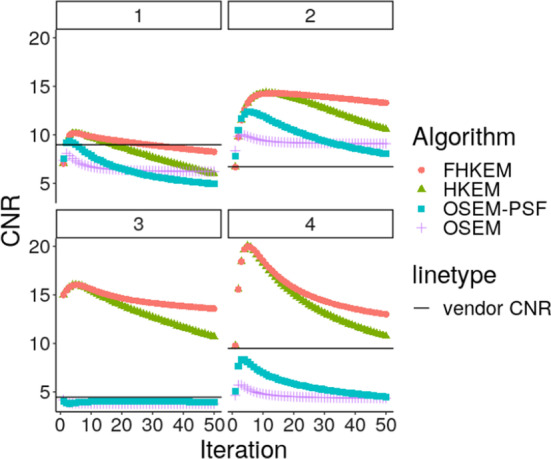
In this study, the hybrid kernelised expectation maximisation (HKEM) is used to improve resolution and contrast and reduce noise, in addition a modified HKEM called frozen HKEM (FHKEM) is investigated to further reduce noise. The iterative part of the FHKEM kernel was frozen at the 72nd sub-iteration. When using ordered subsets algorithms the data is divided in smaller subsets and the smallest algorithm iterative step is called sub-iteration. A NEMA phantom with spherical inserts was used for the optimisation and validation of the algorithm, and data from 5 patients treated with Selective internal radiation therapy were used as proof of clinical relevance of the method.
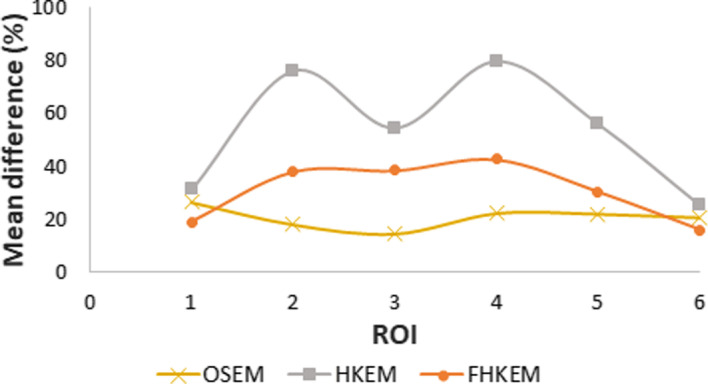
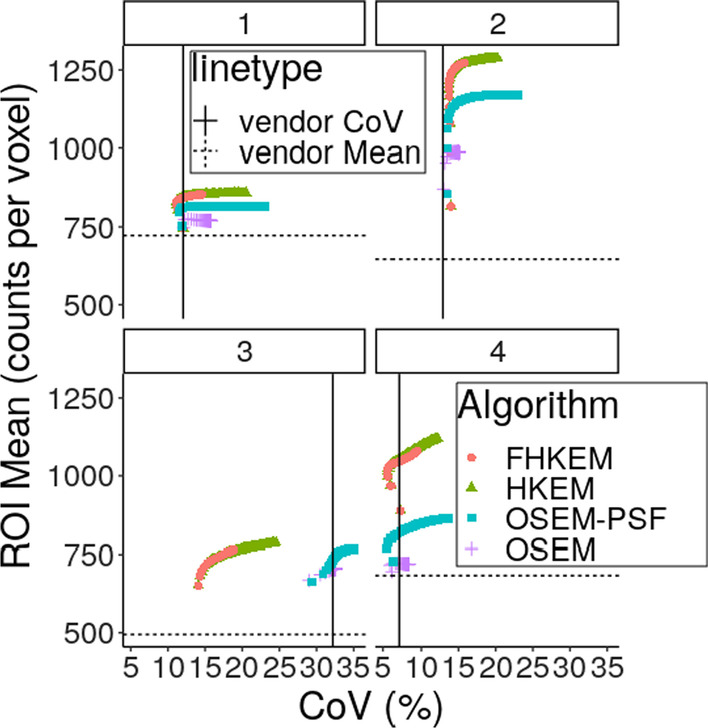
The results suggest a maximum improvement of 56% for region of interest mean recovery coefficient at fixed coefficient of variation and better identification of the hot volumes in the NEMA phantom. Similar improvements were achieved with patient data, showing 47% mean value improvement over the gold standard used in hospitals.
Such quantitative improvements could facilitate improved dosimetry calculations with SPECT when treating patients with Selective internal radiation therapy, as well as provide a more visible position of the cancerous lesions in the liver.
使用钇 - 90微球进行选择性内放射治疗是肝癌和肝转移瘤的有效治疗方法。钇 - 90主要是一种高能β粒子发射体。这些β粒子在与组织相互作用时会发出轫致辐射,使得治疗后放射性分布的成像成为可能。然而,由于连续能谱,图像质量和定量分析存在困难,这使得分辨率建模、衰减和散射估计具有挑战性,因此剂量测定量化不准确。因此,一种能够提高分辨率的重建算法可能会有所帮助。
在本研究中,使用混合核期望最大化(HKEM)来提高分辨率和对比度并降低噪声,此外还研究了一种称为冻结HKEM(FHKEM)的改进型HKEM以进一步降低噪声。FHKEM核的迭代部分在第72次子迭代时被冻结。当使用有序子集算法时,数据被分成较小的子集,最小的算法迭代步骤称为子迭代。使用带有球形插入物的NEMA体模对算法进行优化和验证,并将5例接受选择性内放射治疗患者的数据用作该方法临床相关性的证据。
结果表明,在固定变异系数下,感兴趣区域平均恢复系数最大可提高56%,并且在NEMA体模中能更好地识别热区。患者数据也取得了类似的改善,与医院使用的金标准相比,平均值提高了47%。
这种定量改善在对患者进行选择性内放射治疗时,有助于使用SPECT进行更精确的剂量计算,同时也能使肝脏中癌性病变的位置更加清晰可见。