Department of Bacteriology and Immunology, Medicum, Research Programs Unit, Immunobiology, University of Helsinki, 00014 Helsinki, Finland.
Department of Microbiology, Faculty of Medicine, University of Benghazi, Benghazi 16063, Libya.
Viruses. 2018 Apr 3;10(4):174. doi: 10.3390/v10040174.
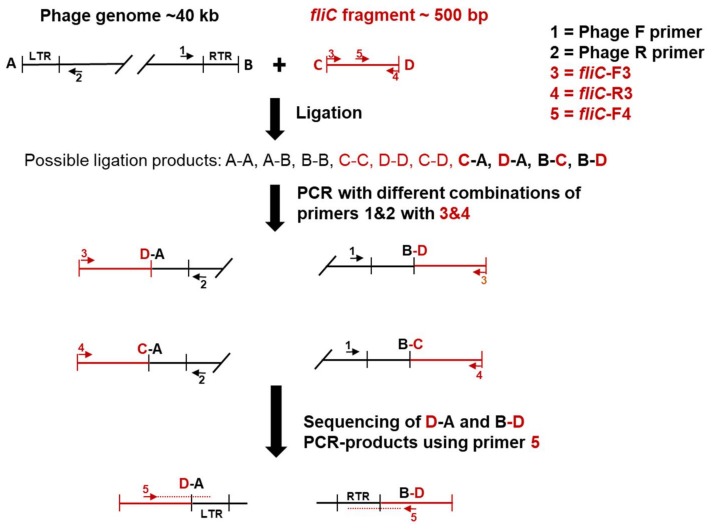
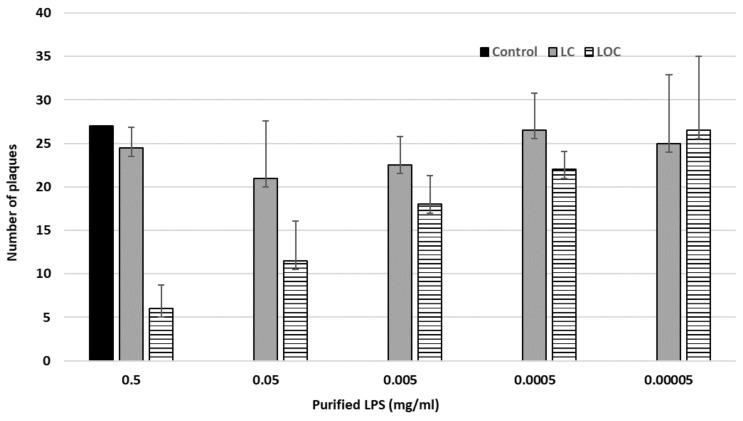
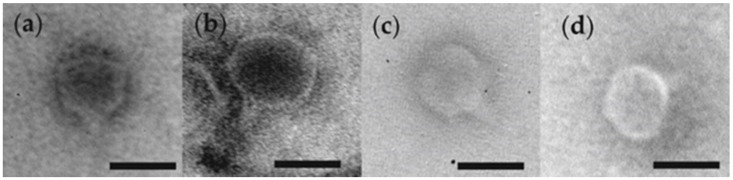
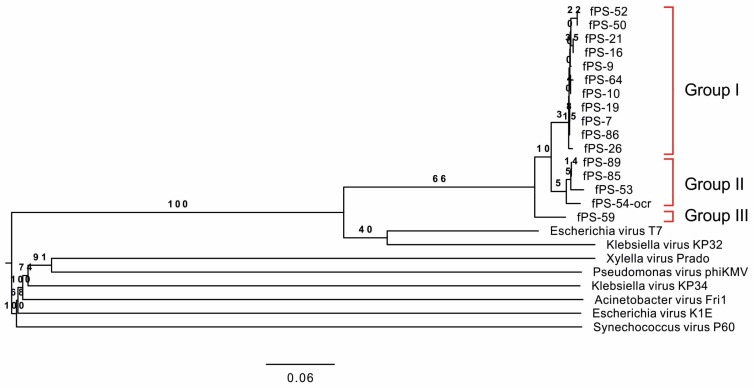
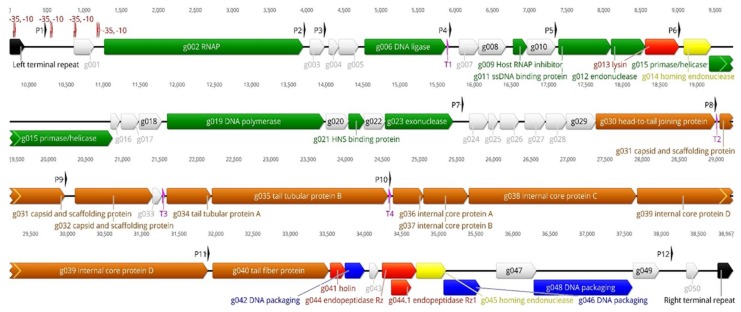
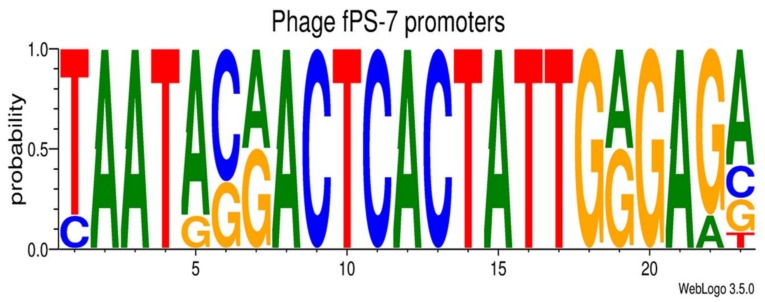
causes enteric infections in humans and animals. Human infections are often caused by contaminated pork meat. colonizes pig tonsils and pigs secrete both the human pathogen and its specific bacteriophages into the stools. In this work, sixteen -infecting lytic bacteriophages isolated from pig stools originating from several pig farms were characterized. All phages belong to the family and their genomes range between 38,391-40,451 bp in size. The overall genome organization of all the phages resembled that of T7-like phages, having 3-6 host RNA polymerase (RNAP)-specific promoters at the beginning of the genomes and 11-13 phage RNAP-specific promoters as well as 3-5 rho-independent terminators, scattered throughout the genomes. Using a ligation-based approach, the physical termini of the genomes containing direct terminal repeats of 190-224 bp were established. No genes associated with lysogeny nor any toxin, virulence factor or antibiotic resistance genes were present in the genomes. Even though the phages had been isolated from different pig farms the nucleotide sequences of their genomes were 90-97% identical suggesting that the phages were undergoing microevolution within and between the farms. Lipopolysaccharide was found to be the surface receptor of all but one of the phages. The phages are classified as new species within the genus of subfamily.
在人类和动物中引起肠内感染。人类感染通常是由受污染的猪肉引起的。定植于猪扁桃体,猪将人类病原体及其特定噬菌体分泌到粪便中。在这项工作中,从几个养猪场的猪粪便中分离出了 16 种感染性裂解噬菌体进行了特征描述。所有噬菌体均属于科,其基因组大小在 38391-40451bp 之间。所有噬菌体的总体基因组组织类似于 T7 样噬菌体,在基因组的开头具有 3-6 个宿主 RNA 聚合酶(RNAP)特异性启动子,以及 11-13 个噬菌体 RNAP 特异性启动子以及 3-5 个 rho 非依赖性终止子,散布在整个基因组中。使用基于连接的方法,确定了基因组中含有 190-224bp 直接末端重复序列的物理末端。基因组中不存在与溶原性相关的基因,也不存在毒素、毒力因子或抗生素抗性基因。尽管这些噬菌体是从不同的养猪场分离出来的,但它们的基因组核苷酸序列的相似度为 90-97%,表明噬菌体在农场内部和之间发生了微观进化。发现除了一种噬菌体之外,所有噬菌体的表面受体都是脂多糖。这些噬菌体被分类为科属中的新物种。