• 文献检索
  • 文档翻译
  • 深度研究
  • 学术资讯
  • Suppr Zotero 插件Zotero 插件
  • 邀请有礼
  • 套餐&价格
  • 历史记录
应用&插件
Suppr Zotero 插件Zotero 插件浏览器插件Mac 客户端Windows 客户端微信小程序
定价
高级版会员购买积分包购买API积分包
服务
文献检索文档翻译深度研究API 文档MCP 服务
关于我们
关于 Suppr公司介绍联系我们用户协议隐私条款
关注我们

Suppr 超能文献

核心技术专利:CN118964589B侵权必究
粤ICP备2023148730 号-1Suppr @ 2026

文献检索

告别复杂PubMed语法,用中文像聊天一样搜索,搜遍4000万医学文献。AI智能推荐,让科研检索更轻松。

立即免费搜索

文件翻译

保留排版,准确专业,支持PDF/Word/PPT等文件格式,支持 12+语言互译。

免费翻译文档

深度研究

AI帮你快速写综述,25分钟生成高质量综述,智能提取关键信息,辅助科研写作。

立即免费体验

血清素作为自闭症谱系障碍中肠-脑-微生物群轴的联系。

Serotonin as a link between the gut-brain-microbiome axis in autism spectrum disorders.

机构信息

Columbia University Vagelos College of Physicians and Surgeons, 630 W 168(th) St, New York, NY, 10032, USA.

Department of Pediatrics, Morgan Stanley Children's Hospital, Columbia University Medical Center, 620 W 168(th) St, New York, NY, 10032, USA.

出版信息

Pharmacol Res. 2018 Jun;132:1-6. doi: 10.1016/j.phrs.2018.03.020. Epub 2018 Mar 31.

DOI:10.1016/j.phrs.2018.03.020
PMID:29614380
原文链接:https://pmc.ncbi.nlm.nih.gov/articles/PMC6368356/
Abstract

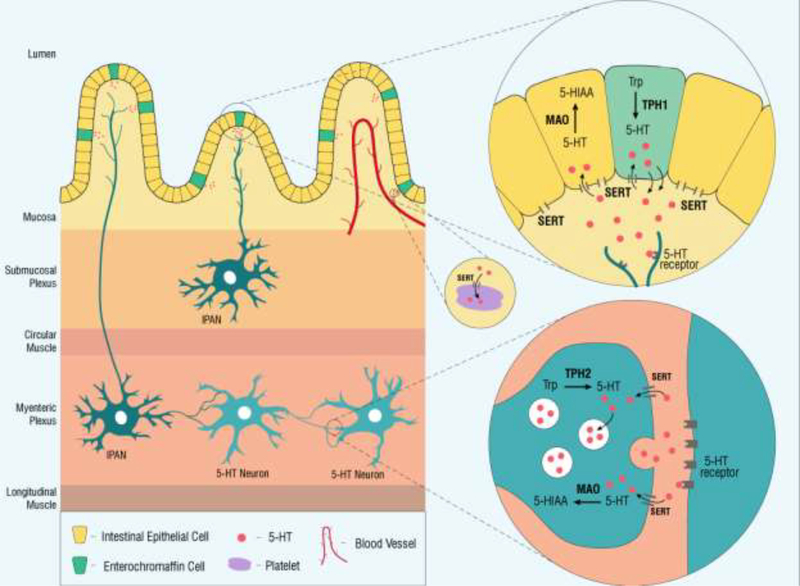
Autism-spectrum disorder (ASD) is a neurodevelopmental disorder characterized by persistent deficits in social communication and repetitive patterns of behavior. ASD is, however, often associated with medical comorbidities and gastrointestinal (GI) dysfunction is among the most common. Studies have demonstrated a correlation between GI dysfunction and the degree of social impairment in ASD. The etiology of GI abnormalities in ASD is unclear, though the association between GI dysfunction and ASD-associated behaviors suggest that overlapping developmental defects in the brain and the intestine and/or a defect in communication between the enteric and central nervous systems (ENS and CNS, respectively), known as the gut-brain axis, could be responsible for the observed phenotypes. Brain-gut abnormalities have been increasingly implicated in several disease processes, including ASD. As a critical modulator of ENS and CNS development and function, serotonin may be a nexus for the gut-brain axis in ASD. This paper reviews the role of serotonin in ASD from the perspective of the ENS. A murine model that has been demonstrated to possess brain, behavioral and GI abnormalities mimicking those seen in ASD harbors the most common serotonin transporter (SERT) based mutation (SERT Ala56) found in children with ASD. Discussion of the gut-brain manifestations in the SERT Ala56 mice, and their correction with developmental administration of a 5-HT agonist, are also addressed in conjunction with other future directions for diagnosis and treatment.

摘要

自闭症谱系障碍(ASD)是一种神经发育障碍,其特征是社会交往持续存在缺陷和行为重复模式。然而,ASD 通常与医学合并症有关,胃肠道(GI)功能障碍是最常见的合并症之一。研究表明,GI 功能障碍与 ASD 中的社交障碍程度之间存在相关性。ASD 中 GI 异常的病因尚不清楚,尽管 GI 功能障碍与 ASD 相关行为之间的关联表明,大脑和肠道之间重叠的发育缺陷和/或肠神经系统(ENS)和中枢神经系统(CNS)之间的通讯缺陷(分别为肠-脑轴)可能是导致观察到的表型的原因。脑-肠异常与包括 ASD 在内的几种疾病过程的关系越来越密切。作为 ENS 和 CNS 发育和功能的关键调节剂,血清素可能是 ASD 中肠-脑轴的枢纽。本文从 ENS 的角度综述了血清素在 ASD 中的作用。已经证明具有模拟 ASD 中所见的大脑、行为和 GI 异常的小鼠模型,携带有 ASD 儿童中最常见的血清素转运蛋白(SERT)基于突变(SERT Ala56)。还讨论了 SERT Ala56 小鼠中的肠-脑表现,以及用 5-HT 激动剂进行发育性给药对其的纠正,同时还讨论了其他未来的诊断和治疗方向。
https://cdn.ncbi.nlm.nih.gov/pmc/blobs/bbb9/6368356/f04db72ed912/nihms-958592-f0001.jpg

相似文献

1
Serotonin as a link between the gut-brain-microbiome axis in autism spectrum disorders.血清素作为自闭症谱系障碍中肠-脑-微生物群轴的联系。
Pharmacol Res. 2018 Jun;132:1-6. doi: 10.1016/j.phrs.2018.03.020. Epub 2018 Mar 31.
2
Reprint of: Serotonin as a link between the gut-brain-microbiome axis in autism spectrum disorders.转载自:血清素作为自闭症谱系障碍中肠-脑-微生物群轴之间的联系
Pharmacol Res. 2019 Feb;140:115-120. doi: 10.1016/j.phrs.2018.12.023. Epub 2019 Jan 15.
3
Serotonin transporter variant drives preventable gastrointestinal abnormalities in development and function.血清素转运体变异体导致发育和功能中可预防的胃肠道异常。
J Clin Invest. 2016 Jun 1;126(6):2221-35. doi: 10.1172/JCI84877. Epub 2016 Apr 25.
4
p38α MAPK signaling drives pharmacologically reversible brain and gastrointestinal phenotypes in the SERT Ala56 mouse.p38α MAPK 信号通路驱动 SERT Ala56 小鼠脑和胃肠道表型的药物逆转。
Proc Natl Acad Sci U S A. 2018 Oct 23;115(43):E10245-E10254. doi: 10.1073/pnas.1809137115. Epub 2018 Oct 8.
5
A role for the serotonin reuptake transporter in the brain and intestinal features of autism spectrum disorders and developmental antidepressant exposure.血清素再摄取转运体在自闭症谱系障碍和发育性抗抑郁药暴露的大脑及肠道特征中的作用。
J Chem Neuroanat. 2017 Oct;83-84:36-40. doi: 10.1016/j.jchemneu.2017.02.001. Epub 2017 Feb 14.
6
The serotonin system in autism spectrum disorder: From biomarker to animal models.自闭症谱系障碍中的血清素系统:从生物标志物到动物模型。
Neuroscience. 2016 May 3;321:24-41. doi: 10.1016/j.neuroscience.2015.11.010. Epub 2015 Nov 11.
7
Probiotics and fructo-oligosaccharide intervention modulate the microbiota-gut brain axis to improve autism spectrum reducing also the hyper-serotonergic state and the dopamine metabolism disorder.益生菌和低聚果糖干预调节微生物群-肠道-大脑轴,改善自闭症谱系,同时减少血清素过度活跃状态和多巴胺代谢紊乱。
Pharmacol Res. 2020 Jul;157:104784. doi: 10.1016/j.phrs.2020.104784. Epub 2020 Apr 17.
8
Altered Autonomic Functions and Gut Microbiome in Individuals with Autism Spectrum Disorder (ASD): Implications for Assisting ASD Screening and Diagnosis.自闭症谱系障碍(ASD)个体的自主神经功能和肠道微生物群改变:对辅助ASD筛查和诊断的意义。
J Autism Dev Disord. 2021 Jan;51(1):144-157. doi: 10.1007/s10803-020-04524-1.
9
Human Gut Microbiota from Autism Spectrum Disorder Promote Behavioral Symptoms in Mice.自闭症谱系障碍患者的肠道微生物群可促进小鼠的行为症状
Cell. 2019 May 30;177(6):1600-1618.e17. doi: 10.1016/j.cell.2019.05.004.
10
The Brain-Gut-Microbiome Axis: What Role Does It Play in Autism Spectrum Disorder?脑-肠-微生物群轴:它在自闭症谱系障碍中起什么作用?
Curr Dev Disord Rep. 2016 Mar;3(1):75-81. doi: 10.1007/s40474-016-0077-7. Epub 2016 Feb 26.

引用本文的文献

1
Sex-Specific effects of vitamin D on autistic behavior and gastrointestinal symptoms in rats via the regulation of serotonin metabolism.维生素D通过调节血清素代谢对大鼠自闭症行为和胃肠道症状的性别特异性影响。
Sci Rep. 2025 Jul 1;15(1):21769. doi: 10.1038/s41598-025-05845-w.
2
Urine Metabolomic Profiling and Machine Learning in Autism Spectrum Disorder Diagnosis: Toward Precision Treatment.自闭症谱系障碍诊断中的尿液代谢组学分析与机器学习:迈向精准治疗
Metabolites. 2025 May 16;15(5):332. doi: 10.3390/metabo15050332.
3
Cognitive and behavioral benefits of 2'-fucosyllactose in growing mice: the roles of 5-hydroxytryptophan and gut microbiota.

本文引用的文献

1
Microbiota-related Changes in Bile Acid & Tryptophan Metabolism are Associated with Gastrointestinal Dysfunction in a Mouse Model of Autism.肠道菌群相关的胆汁酸和色氨酸代谢变化与自闭症小鼠模型的胃肠道功能障碍有关。
EBioMedicine. 2017 Oct;24:166-178. doi: 10.1016/j.ebiom.2017.09.020. Epub 2017 Sep 21.
2
Prenatal fever and autism risk.产前发热与自闭症风险。
Mol Psychiatry. 2018 Mar;23(3):759-766. doi: 10.1038/mp.2017.119. Epub 2017 Jun 13.
3
Brief Report: Association Between Autism Spectrum Disorder, Gastrointestinal Problems and Perinatal Risk Factors Within Sibling Pairs.
2'-岩藻糖基乳糖对生长中小鼠的认知和行为益处:5-羟色氨酸和肠道微生物群的作用
Microbiome. 2025 Apr 12;13(1):97. doi: 10.1186/s40168-025-02094-x.
4
Intervention and research progress of gut microbiota-immune-nervous system in autism spectrum disorders among students.学生自闭症谱系障碍中肠道微生物群-免疫-神经系统的干预与研究进展
Front Microbiol. 2025 Mar 12;16:1535455. doi: 10.3389/fmicb.2025.1535455. eCollection 2025.
5
Beyond weight loss: exploring the neurological ramifications of altered gut microbiota post-bariatric surgery.超越体重减轻:探索减肥手术后肠道微生物群改变的神经学后果。
J Transl Med. 2025 Feb 24;23(1):223. doi: 10.1186/s12967-025-06201-2.
6
Large-scale metagenomic analysis of oral microbiomes reveals markers for autism spectrum disorders.大规模宏基因组分析口腔微生物组揭示自闭症谱系障碍的标志物。
Nat Commun. 2024 Nov 11;15(1):9743. doi: 10.1038/s41467-024-53934-7.
7
Analysis of Gut Bacterial and Fungal Microbiota in Children with Autism Spectrum Disorder and Their Non-Autistic Siblings.自闭症谱系障碍儿童及其非自闭症兄弟姐妹肠道细菌和真菌微生物群分析。
Nutrients. 2024 Sep 5;16(17):3004. doi: 10.3390/nu16173004.
8
Systematic Insights into the Relationship between the Microbiota-Gut-Brain Axis and Stroke with the Focus on Tryptophan Metabolism.关于微生物群-肠道-脑轴与中风之间关系的系统见解:聚焦色氨酸代谢
Metabolites. 2024 Jul 24;14(8):399. doi: 10.3390/metabo14080399.
9
Autism spectrum disorder and a possible role of anti-inflammatory treatments: experience in the pediatric allergy/immunology clinic.自闭症谱系障碍与抗炎治疗的潜在作用:儿科过敏/免疫诊所的经验
Front Psychiatry. 2024 Jun 24;15:1333717. doi: 10.3389/fpsyt.2024.1333717. eCollection 2024.
10
A Systematic Review on Autism and Hyperserotonemia: State-of-the-Art, Limitations, and Future Directions.关于自闭症与高血清素血症的系统评价:现状、局限性及未来方向
Brain Sci. 2024 May 10;14(5):481. doi: 10.3390/brainsci14050481.
简短报告:自闭症谱系障碍、胃肠道问题与同胞对围产期危险因素之间的关联
J Autism Dev Disord. 2017 Aug;47(8):2621-2627. doi: 10.1007/s10803-017-3169-2.
4
Non-conventional features of peripheral serotonin signalling - the gut and beyond.外周5-羟色胺信号传导的非常规特征——肠道及其他部位。
Nat Rev Gastroenterol Hepatol. 2017 Jul;14(7):412-420. doi: 10.1038/nrgastro.2017.51. Epub 2017 May 10.
5
Maternal immune activation dysregulation of the fetal brain transcriptome and relevance to the pathophysiology of autism spectrum disorder.母体免疫激活对胎儿大脑转录组的失调作用及其与自闭症谱系障碍的病理生理学的相关性。
Mol Psychiatry. 2018 Apr;23(4):1001-1013. doi: 10.1038/mp.2017.15. Epub 2017 Mar 21.
6
Association of Rigid-Compulsive Behavior with Functional Constipation in Autism Spectrum Disorder.自闭症谱系障碍中强迫性刻板行为与功能性便秘的关联。
J Autism Dev Disord. 2017 Jun;47(6):1673-1681. doi: 10.1007/s10803-017-3084-6.
7
Distinct Microbiome-Neuroimmune Signatures Correlate With Functional Abdominal Pain in Children With Autism Spectrum Disorder.独特的微生物群-神经免疫特征与自闭症谱系障碍儿童的功能性腹痛相关。
Cell Mol Gastroenterol Hepatol. 2016 Dec 11;3(2):218-230. doi: 10.1016/j.jcmgh.2016.11.008. eCollection 2017 Mar.
8
Maternal Immunoreactivity to Herpes Simplex Virus 2 and Risk of Autism Spectrum Disorder in Male Offspring.母亲对单纯疱疹病毒2的免疫反应性与男性后代患自闭症谱系障碍的风险
mSphere. 2017 Feb 22;2(1). doi: 10.1128/mSphere.00016-17. eCollection 2017 Jan-Feb.
9
Microbiota Transfer Therapy alters gut ecosystem and improves gastrointestinal and autism symptoms: an open-label study.微生物群转移治疗改变肠道生态系统,改善胃肠道和自闭症症状:一项开放标签研究。
Microbiome. 2017 Jan 23;5(1):10. doi: 10.1186/s40168-016-0225-7.
10
Can probiotics benefit children with autism spectrum disorders?益生菌对自闭症谱系障碍儿童有益吗?
World J Gastroenterol. 2016 Dec 14;22(46):10093-10102. doi: 10.3748/wjg.v22.i46.10093.