Department of Neuroscience Imaging and Clinical Sciences, University G. d'Annunzio of Chieti-Pescara, Chieti, Italy.
Local Health Unit of Pescara, Italy.
J Alzheimers Dis. 2018;63(1):203-215. doi: 10.3233/JAD-171134.
Post traumatic stress disorder (PTSD) is associated with cognitive decline. The dementia type following PTSD is unclear.
To assess whether PTSD is associated with a specific dementia.
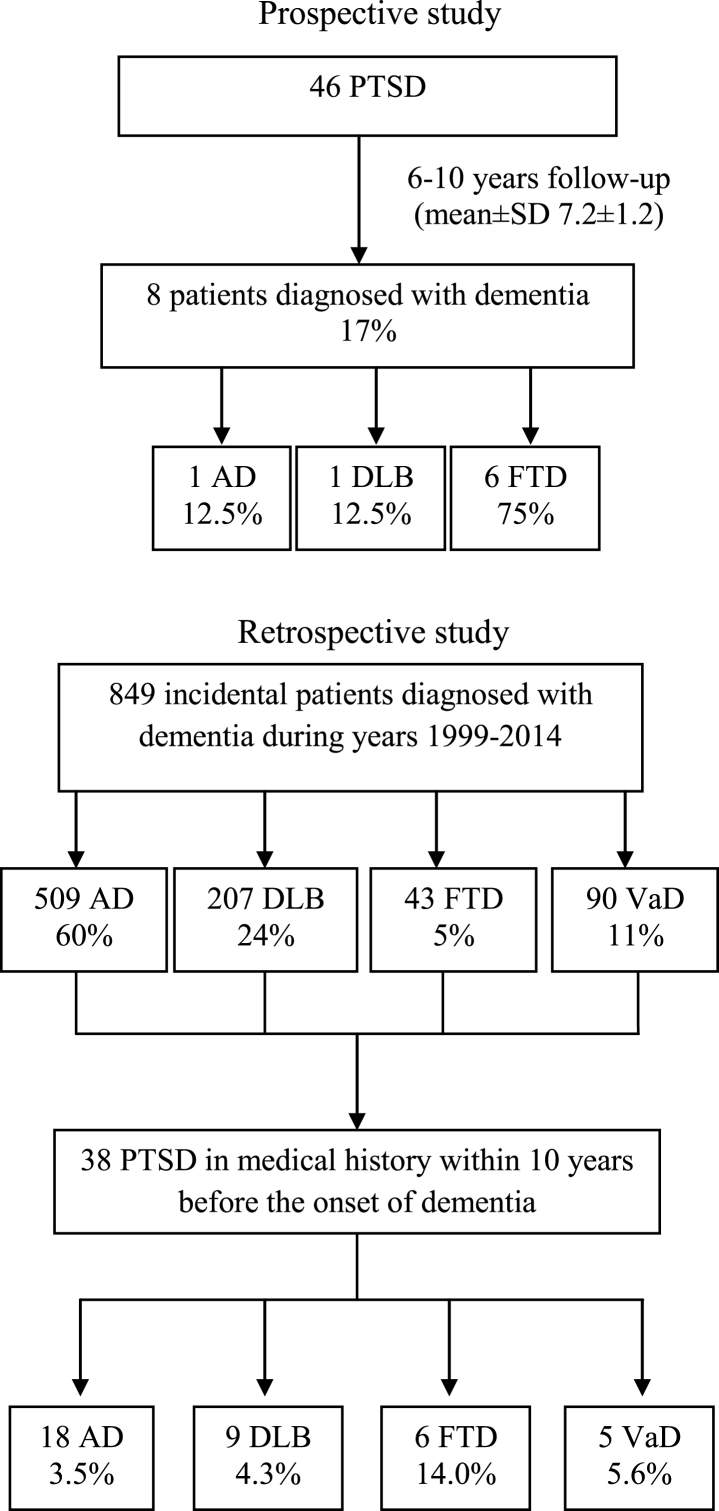
Prospective study: 46 PTSD patients (DSM-IV-TR) were followed for 6-10 years with clinical, neuropsychological, imaging evaluations for possible development of dementia.Retrospective study:849 dementia patients followed during 1999-2014 (509 Alzheimer's disease, AD; 207 dementia with Lewy bodies, DLB; 90 vascular dementia, VaD; 43 frontotemporal dementia, FTD) and 287 patients with any neurological condition (including patients with/without dementia) were evaluated for the presence of PTSD in their history.
Prospective study: 8 patients developed dementia; 1 AD, 1 DLB, 6 semantic FTD (13.0% of the PTSD population). Retrospective study: 38 patients (4.5%) had a history of PTSD; 3.5% of AD, 4.3% of DLB, 14.0% of FTD, 5.6% of VaD. The percentage was higher in FTD than in AD or DLB (χ2 = 10, p = 0.001, and χ2 = 6, p = 0.02). At difference with AD, DLB, or VaD, FTD incidence among dementia patients with PTSD history (38 patients) was higher than in the dementia population overall (16% versus 5%, χ2 = 8, p = 0.005). The impact of possible demographical/clinical confounders (age, gender, MMSE) was excluded by Poisson regression. PTSD prevalence in the comparative group without dementia matched the prevalence in the Italian general population (1.1%). PTSD prevalence in the demented comparative group matched the prevalence in our dementia retrospective cohort, 3.7%).
PTSD was associated with the development of semantic FTD.
创伤后应激障碍(PTSD)与认知能力下降有关。 PTSD 后发生的痴呆类型尚不清楚。
评估 PTSD 是否与特定类型的痴呆有关。
前瞻性研究:46 名 PTSD 患者(DSM-IV-TR)接受了 6-10 年的临床、神经心理学、影像学评估,以评估是否可能发生痴呆。回顾性研究:对 1999-2014 年期间就诊的 849 名痴呆患者(509 名阿尔茨海默病患者、AD;207 名路易体痴呆患者、DLB;90 名血管性痴呆患者、VaD;43 名额颞叶痴呆患者、FTD)和 287 名有任何神经病史的患者(包括有/无痴呆患者)进行了 PTSD 病史评估。
前瞻性研究:8 名患者发生痴呆,其中 1 例为 AD,1 例为 DLB,6 例为语义性 FTD(PTSD 人群的 13.0%)。回顾性研究:38 名患者(4.5%)有 PTSD 病史,其中 3.5%为 AD,4.3%为 DLB,14.0%为 FTD,5.6%为 VaD。与 AD 或 DLB 相比,FTD 的发生率更高(χ2 = 10,p = 0.001,和 χ2 = 6,p = 0.02)。与 AD、DLB 或 VaD 不同,PTSD 病史的痴呆患者(38 例)的 FTD 发生率高于总体痴呆人群(16%与 5%,χ2 = 8,p = 0.005)。用泊松回归排除了可能的人口统计学/临床混杂因素(年龄、性别、MMSE)的影响。无痴呆的对照组 PTSD 患病率与意大利普通人群的患病率(1.1%)相匹配。痴呆对照组的 PTSD 患病率与我们的痴呆回顾性队列相匹配,为 3.7%)。
PTSD 与语义性 FTD 的发生有关。