Department of Social Medicine, CAPHRI Care and Public Health Research Institute, Maastricht University, P.O. Box 616, 6200, MD, Maastricht, the Netherlands.
Department of Data Collection, Statistics Netherlands (CBS), P.O. Box 4481, 6401, CZ, Heerlen, the Netherlands.
BMC Public Health. 2018 Apr 3;18(1):443. doi: 10.1186/s12889-018-5210-6.
In-depth qualitative research into perceived socioeconomic position-related stigmatisation among people living at the lower end of our socioeconomic hierarchy is necessary for getting more insight in the possible downside of living in an increasingly meritocratic and individualistic society.
Seventeen interviews were conducted among a group of Dutch people with a low socioeconomic position to examine their experiences with stigmatisation, how they coped with it and what they perceived as consequences.
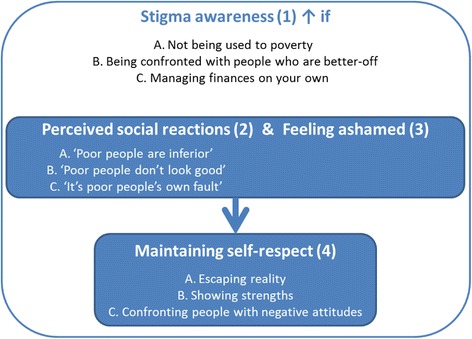
Social reactions perceived by participants related to being inferior, being physically recognisable as a poor person, and being responsible for their own financial problems. Participants with less experience of living in poverty, a heterogeneous social network and greater sense of financial responsibility seemed to be more aware of stigmas than people with long-term experience of poverty, a homogeneous social network and less sense of financial responsibility. Perceived stigmatisation mainly had emotional consequences. To maintain a certain level of self-respect, participants tried to escape from reality, showed their strengths or confronted other people who expressed negative attitudes towards them.
Despite the good intentions of policies to enhance self-reliance, responsibility and active citizenship, these policies and related societal beliefs might affect people at the lower end of our socioeconomic hierarchies by making them feel inferior, ashamed and blamed, especially when they cannot meet societal expectations or when they feel treated disrespectfully, unjustly or unequally by social workers or volunteers of charity organisations.
深入研究生活在社会经济底层的人群对与社会经济地位相关的污名化的感知,对于了解生活在日益崇尚精英主义和个人主义的社会中的可能弊端很有必要。
对一群荷兰社会经济地位较低的人进行了 17 次访谈,以考察他们的污名化经历、应对方式以及他们认为的后果。
参与者感知到的社会反应与低人一等、身体上被认作穷人以及对自己的财务问题负责有关。与长期贫困、社会关系单一、财务责任感较弱的人相比,生活贫困经历较少、社会关系多样化、财务责任感较强的人似乎更能意识到污名化的存在。感知到的污名化主要带来情绪后果。为了保持一定的自尊心,参与者试图逃避现实,展示自己的优势,或面对那些对他们持消极态度的人。
尽管政策的初衷是增强自力更生、责任感和积极的公民意识,但这些政策和相关的社会观念可能会使社会经济层级较低的人感到自卑、羞愧和被指责,尤其是当他们无法满足社会期望,或当他们感到受到社工或慈善组织志愿者的不尊重、不公正或不平等对待时。