Department of General Surgery, The Second Affiliated Hospital of Nanjing Medical University, No.121 Jiangjiayuan, Nanjing, 210011, China.
Department of Gastroenterology, Nanjing University Medical School Affiliated Nanjing Drum Tower Hospital, Nanjing, China.
Stem Cell Res Ther. 2018 Apr 3;9(1):85. doi: 10.1186/s13287-018-0827-z.
Mesenchymal stem cell (MSC) transplantation shows promise for treating transplant arteriosclerosis, at least partly via promoting endothelial regeneration. However, the efficacy and safety are still under investigation especially regarding recent findings that neointimal smooth muscle cells are derived from MSC-like cells. The high mobility group box 1 (HMGB1)/receptor for advanced glycation end-product (RAGE) axis is involved in regulating proliferation, migration, and differentiation of MSCs, and therefore it can be presumably applied to improve the outcome of cell therapy. The aim of the current study was to investigate this hypothesis.
Rat MSCs were treated with HMGB1 or modified with HMGB1 vectors to activate the HMGB1/RAGE axis. RAGE was targeted and inhibited by specific short hairpin RNA vectors. We assessed the capacity for cell proliferation, migration, and differentiation after vector transfection in vitro and in a rat model of transplant arteriosclerosis. The expression of CD31 and α-smooth muscle actin (αSMA) was determined to evaluate the differentiation of MSCs to endothelial cells and smooth muscle cells.
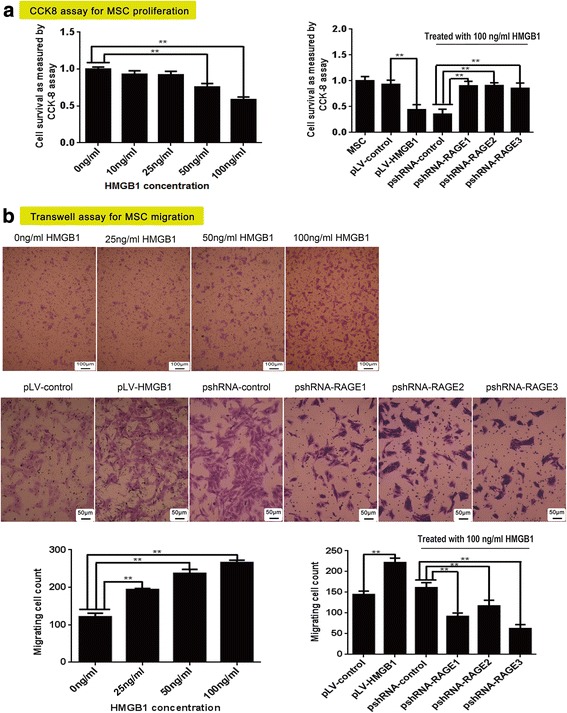
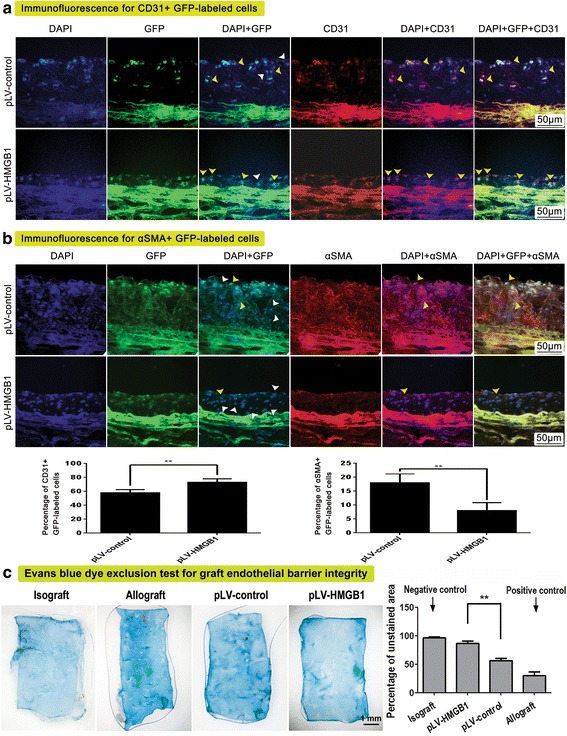
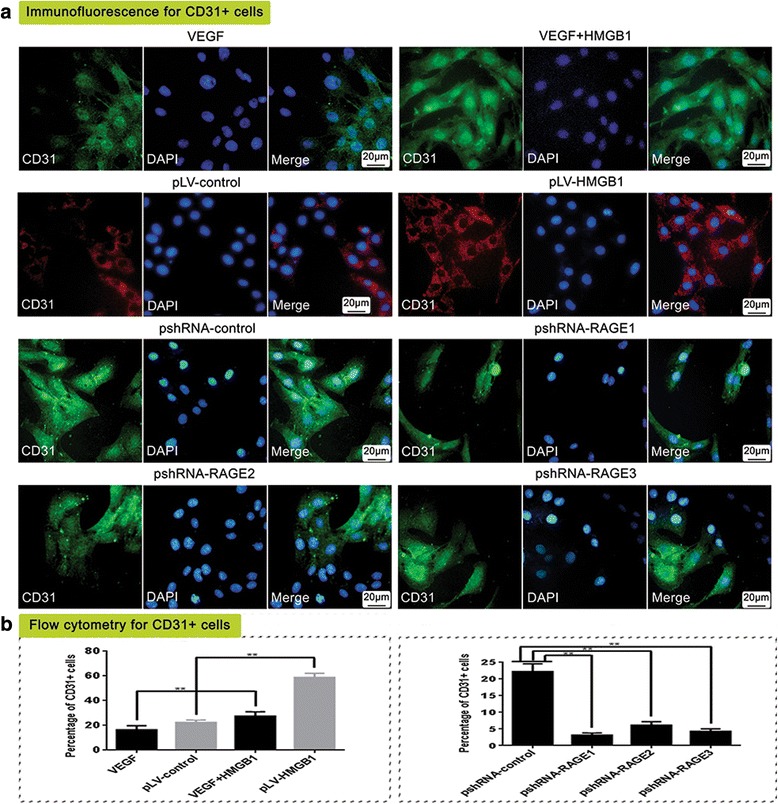
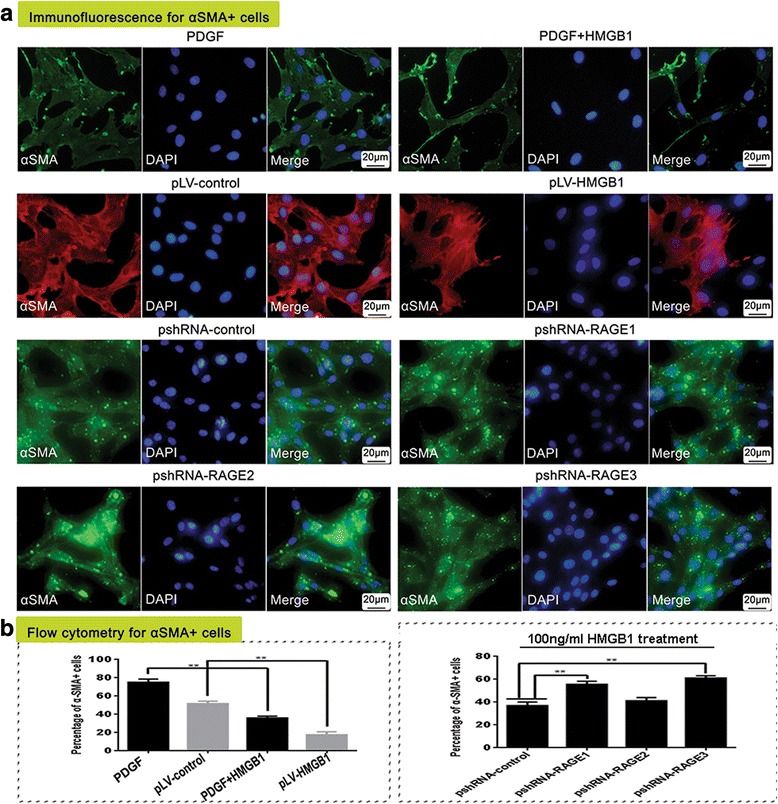
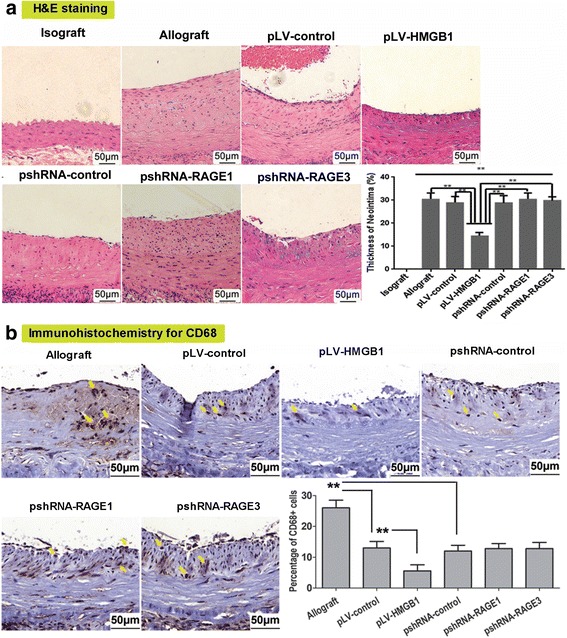
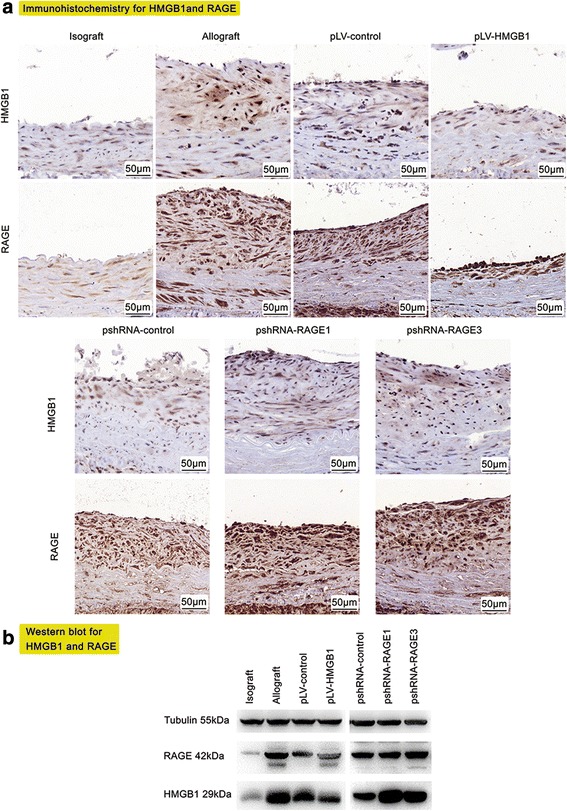
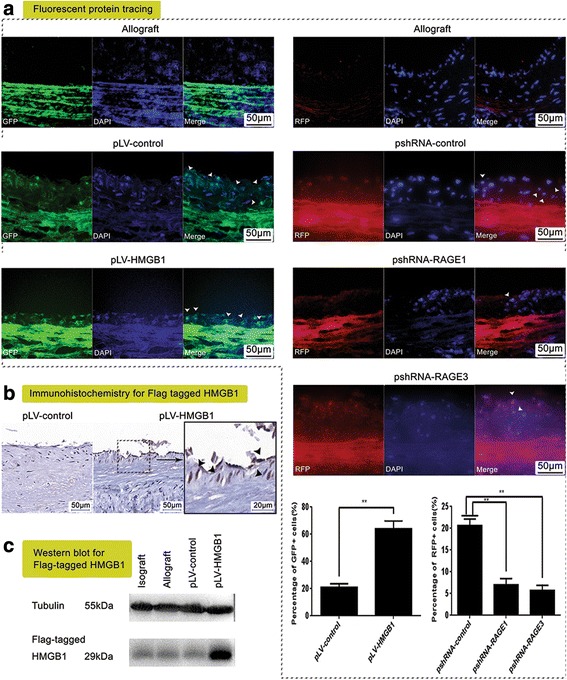
Exogenous HMGB1 treatment and transfection with HMGB1 vectors promoted MSC migration and vascular endothelial growth factor (VEGF)-induced differentiation to CD31 cells while inhibiting their proliferation and platelet-derived growth factor (PDGF)-induced differentiation to αSMA cells. Such an effect was blocked by RAGE knockdown. HMGB1-modified cells preferably migrated to graft neointima and differentiated to CD31 cells along with significant relief of transplant arteriosclerosis and inhibition of HMGB1 and RAGE expression in graft vessels. RAGE knockdown inhibited cell migration to graft vessels.
HMGB1 stimulated MSCs to migrate and differentiate to endothelial cells via RAGE signaling, which we translated to successful application in cell therapy for transplant arteriosclerosis.
间充质干细胞(MSC)移植治疗移植性动脉硬化症显示出一定的前景,至少部分是通过促进内皮细胞再生。然而,其疗效和安全性仍在研究中,尤其是最近的发现表明,新生内膜平滑肌细胞来源于 MSC 样细胞。高迁移率族蛋白 B1(HMGB1)/晚期糖基化终产物受体(RAGE)轴参与调节 MSC 的增殖、迁移和分化,因此可以推测其应用可以改善细胞治疗的效果。本研究旨在验证这一假说。
用 HMGB1 处理大鼠 MSC 或用 HMGB1 载体修饰 MSC 以激活 HMGB1/RAGE 轴。用特异性短发夹 RNA 载体靶向并抑制 RAGE。我们评估了体外和移植性动脉硬化大鼠模型中转染载体后细胞增殖、迁移和分化的能力。通过检测 CD31 和α-平滑肌肌动蛋白(αSMA)的表达来评估 MSC 向内皮细胞和平滑肌细胞的分化情况。
外源性 HMGB1 处理和转染 HMGB1 载体促进 MSC 迁移和血管内皮生长因子(VEGF)诱导的 CD31 细胞分化,同时抑制其增殖和血小板衍生生长因子(PDGF)诱导的 αSMA 细胞分化。这种作用可被 RAGE 敲低所阻断。HMGB1 修饰的细胞更喜欢迁移到移植物内新内膜,并分化为 CD31 细胞,同时明显缓解移植性动脉硬化,并抑制移植物血管中 HMGB1 和 RAGE 的表达。RAGE 敲低抑制细胞向移植物血管迁移。
HMGB1 通过 RAGE 信号刺激 MSC 迁移并向内皮细胞分化,我们将其成功应用于移植性动脉硬化症的细胞治疗。