School of Cardiovascular Medicine & Science, King's College London, British Heart Foundation Centre, London SE5 9NU, United Kingdom.
Centre for Lipid Research, Key Laboratory of Molecular Biology for Infectious Diseases (Ministry of Education), Department of Infectious Diseases, the Second Affiliated Hospital, Chongqing Medical University, Centre for Nephrology, University College London, Rowland Hill Street, London NW3 2PF, United Kingdom.
J Biol Chem. 2018 May 25;293(21):8089-8102. doi: 10.1074/jbc.RA118.001739. Epub 2018 Apr 11.
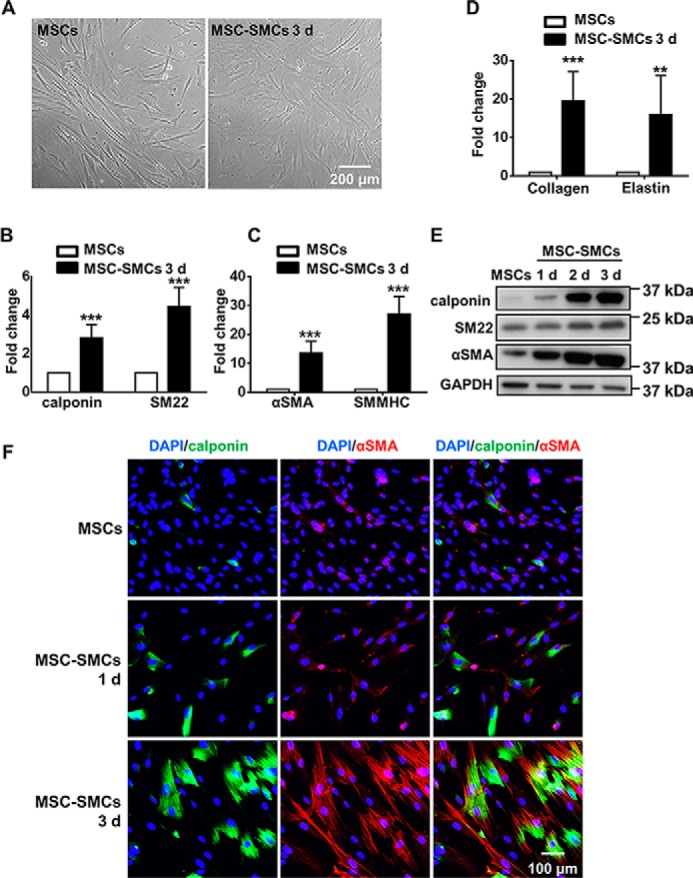
Tissue-engineered vascular grafts with long-term patency are greatly needed in the clinical settings, and smooth muscle cells (SMCs) are a critical graft component. Human mesenchymal stem cells (MSCs) are used for generating SMCs, and understanding the underlying regulatory mechanisms of the MSC-to-SMC differentiation process could improve SMC generation in the clinic. Here, we found that in response to stimulation of transforming growth factor-β1 (TGFβ1), human umbilical cord-derived MSCs abundantly express the SMC markers α-smooth muscle actin (αSMA), smooth muscle protein 22 (SM22), calponin, and smooth muscle myosin heavy chain (SMMHC) at both gene and protein levels. Functionally, MSC-derived SMCs displayed contracting capacity and supported vascular structure formation in the Matrigel plug assay More importantly, SMCs differentiated from human MSCs could migrate into decellularized mouse aorta and give rise to the smooth muscle layer of vascular grafts, indicating the potential of utilizing human MSC-derived SMCs to generate vascular grafts. Of note, microRNA (miR) array analysis and TaqMan microRNA assays identified miR-503 and miR-222-5p as potential regulators of MSC differentiation into SMCs at early time points. Mechanistically, miR-503 promoted SMC differentiation by directly targeting SMAD7, a suppressor of SMAD-related, TGFβ1-mediated signaling pathways. Moreover, miR-503 expression was SMAD4-dependent. SMAD4 was enriched at the miR-503 promoter. Furthermore, miR-222-5p inhibited SMC differentiation by targeting and down-regulating ROCK2 and αSMA. In conclusion, MSC differentiation into SMCs is regulated by miR-503 and miR-222-5p and yields functional SMCs for use in vascular grafts.
组织工程血管移植物需要长期通畅,这在临床环境中非常需要,而平滑肌细胞(SMC)是移植物的关键组成部分。人骨髓间充质干细胞(MSCs)用于生成 SMC,了解 MSC 向 SMC 分化过程的潜在调节机制可以改善临床中 SMC 的生成。在这里,我们发现,在转化生长因子-β1(TGFβ1)刺激下,人脐带衍生的 MSCs 在基因和蛋白水平上大量表达 SMC 标志物α-平滑肌肌动蛋白(αSMA)、平滑肌蛋白 22(SM22)、钙调蛋白和平滑肌肌球蛋白重链(SMMHC)。功能上,MSC 衍生的 SMC 具有收缩能力,并在 Matrigel 塞植入物检测中支持血管结构的形成。更重要的是,从人 MSCs 分化而来的 SMC 可以迁移到脱细胞的小鼠主动脉中,并产生血管移植物的平滑肌层,这表明利用人 MSC 衍生的 SMC 生成血管移植物的潜力。值得注意的是,微阵列分析和 TaqMan 微 RNA 检测鉴定 miR-503 和 miR-222-5p 是 MSC 早期向 SMC 分化的潜在调节因子。在机制上,miR-503 通过直接靶向 SMAD7(SMAD 相关,TGFβ1 介导的信号通路的抑制剂)促进 SMC 分化。此外,miR-503 的表达依赖于 SMAD4。SMAD4 富集在 miR-503 启动子上。此外,miR-222-5p 通过靶向和下调 ROCK2 和 αSMA 抑制 SMC 分化。总之,MSC 向 SMC 的分化受 miR-503 和 miR-222-5p 调节,并产生用于血管移植物的功能性 SMC。