Ding Jingxian, Guo Yonghong, Li Qingge, Chen Jun, Hu Pinghua, Liu Qiuming, Cao Yali, Wu Jiong
Department of Radiation Oncology, The Third Hospital of Nanchang, Nanchang, China.
Department of Oncology, Fudan University Shanghai Cancer Center, Shanghai, China.
Onco Targets Ther. 2018 Mar 23;11:1665-1670. doi: 10.2147/OTT.S156066. eCollection 2018.
To investigate the incidence of skin acute reaction and its influencing factors in postoperative breast cancer radiotherapy patients.
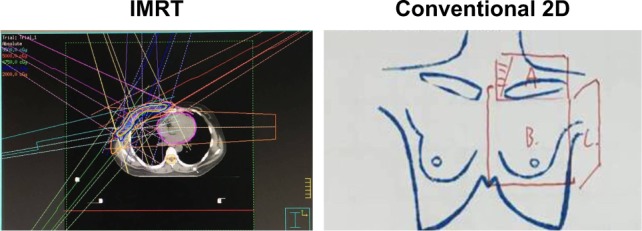
One hundred and seventy three cases of breast cancer patients treated with postoperative radiotherapy were consecutively enrolled from June 1, 2016 to July 31, 2017 in our breast cancer center. Irradiation technology includes conformal intensity-modulated radiotherapy and a conventional two-dimensional one with conventional fraction. Any acute radiation dermatitis was recorded and the influencing factors were analyzed at the end of the radiation treatment.
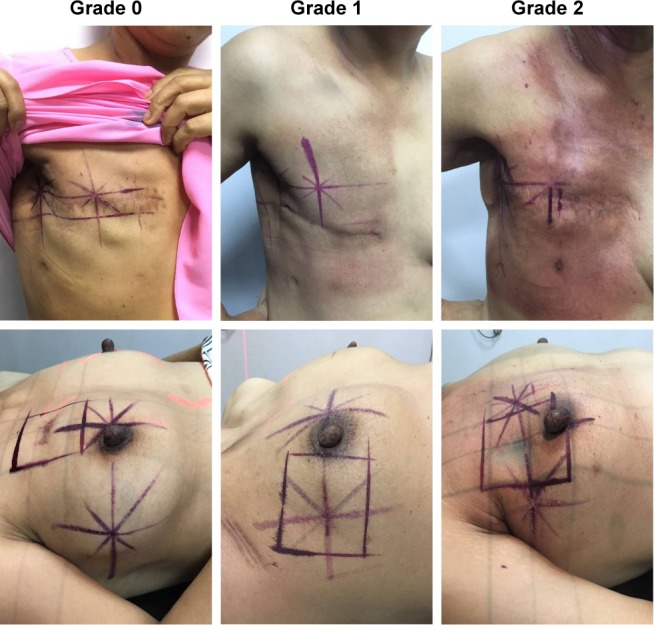
Radiotherapy-induced acute dermatitis in patients with breast-conserving surgery was relatively mild. Among the 173 patients, 33 cases had no obvious changes in the skin (grade 0); 121 cases had grade 1 skin reactions, manifested as local dark erythema and dry peeling; 29 cases had grade 2 skin reactions, characterized by edema, hyperemia, or erosion part; no grade 3 cases of skin reactions were observed. The incidence of grade 0, grade 1, and grade 2 reactions in all patients was 19.1%, 69.9%, and 11.0%, respectively. The severity of skin acute reaction is independent of the tumor sites, molecular subtypes, patients' age, and irradiation modalities, but it depends on the surgical types, fields treated, and planned total radiation. There is a trend favoring no chemotherapy over chemotherapy, though -value is 0.074.
Skin acute reaction in postoperative radiotherapy breast cancer patients is generally common but mild, and there are quite a few patients who need interruption or cessation of the radiotherapy process. The patients need to be well informed and made aware that any skin reaction will likely be mild, especially for the breast-conserving patients.
探讨乳腺癌术后放疗患者皮肤急性反应的发生率及其影响因素。
2016年6月1日至2017年7月31日,连续纳入我院乳腺癌中心173例接受术后放疗的乳腺癌患者。照射技术包括适形调强放疗和传统二维常规分割放疗。记录所有急性放射性皮炎情况,并在放疗结束时分析影响因素。
保乳手术患者放疗引起的急性皮炎相对较轻。173例患者中,33例皮肤无明显变化(0级);121例有1级皮肤反应,表现为局部暗红色红斑和干性脱皮;29例有2级皮肤反应,特征为水肿、充血或部分糜烂;未观察到3级皮肤反应病例。所有患者0级、1级和2级反应的发生率分别为19.1%、69.9%和11.0%。皮肤急性反应的严重程度与肿瘤部位、分子亚型、患者年龄和照射方式无关,但取决于手术类型、照射野和计划总照射剂量。未化疗患者的皮肤急性反应程度有低于化疗患者的趋势,尽管P值为0.074。
乳腺癌术后放疗患者的皮肤急性反应普遍常见但程度较轻,仍有不少患者需要中断或停止放疗过程。需要让患者充分了解情况并意识到任何皮肤反应可能都很轻微,尤其是保乳患者。