Kim Sun-Hee, Roszik Jason, Grimm Elizabeth A, Ekmekcioglu Suhendan
Department of Melanoma Medical Oncology, The University of Texas MD Anderson Cancer Center, Houston, TX, United States.
Front Oncol. 2018 Mar 16;8:67. doi: 10.3389/fonc.2018.00067. eCollection 2018.
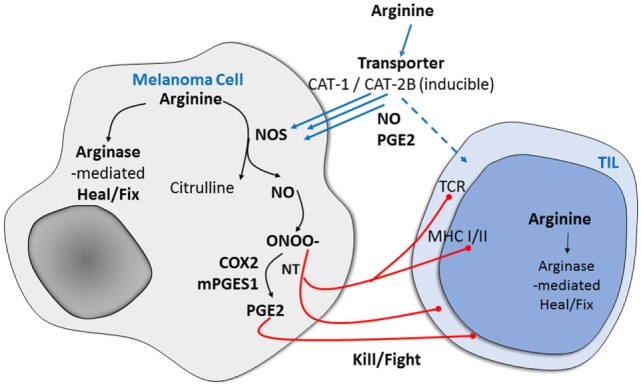
The progression from neoplastic initiation to malignancy happens in part because of the failure of immune surveillance. Cancer cells successfully escape immune recognition and elimination and create an immune-suppressive microenvironment. A suppressive metabolic microenvironment may also contribute to ineffective T-cell function. Tumor progression is characterized by a complex network of interactions among different cell types that cooperatively exploit metabolic reprogramming. As we start to recognize that cancer cells use different metabolism processes than normal cells do, a better understanding of the functional mechanisms of the regulation and reprogramming of the metabolic landscape in cancer cells is crucial to successful immunotherapy strategies. However, the exact role of metabolism in T cells and in the tumor microenvironment is not known. One pathway that plays an important role in the regulation of immune cell reactivity is arginine metabolism, which has complex cellular functions. l-arginine and its downstream metabolites (e.g., ornithine and citrulline) could be essential to T-cell activation and thus modulate innate and adaptive immunity to further promote tumor survival and growth. Identifying metabolic targets that mediate immunosuppression and are fundamental to sustaining tumor growth is key to increasing the efficacy of immunotherapies.
从肿瘤起始到恶性肿瘤的进展部分是由于免疫监视功能的失败。癌细胞成功逃避免疫识别和清除,并营造出免疫抑制性微环境。抑制性代谢微环境也可能导致T细胞功能失效。肿瘤进展的特征是不同细胞类型之间存在复杂的相互作用网络,这些细胞协同利用代谢重编程。随着我们开始认识到癌细胞与正常细胞的代谢过程不同,更好地理解癌细胞代谢格局的调控和重编程的功能机制对于成功的免疫治疗策略至关重要。然而,代谢在T细胞和肿瘤微环境中的确切作用尚不清楚。精氨酸代谢在调节免疫细胞反应性方面发挥重要作用,它具有复杂的细胞功能。L-精氨酸及其下游代谢产物(如鸟氨酸和瓜氨酸)可能对T细胞活化至关重要,从而调节固有免疫和适应性免疫,进一步促进肿瘤的存活和生长。确定介导免疫抑制且对维持肿瘤生长至关重要的代谢靶点是提高免疫治疗疗效的关键。