Ochs Katrin, Meili Gesine, Diebold Joachim, Arndt Volker, Günthert Andreas
Department of Obstetrics and Gynecology, Cantonal Hospital of Lucerne, Lucerne, Switzerland.
Institute of Pathology, Cantonal Hospital of Lucerne, Lucerne, Switzerland.
Front Med (Lausanne). 2018 Mar 16;5:58. doi: 10.3389/fmed.2018.00058. eCollection 2018.
Cervical cancer (CC) screening by Pap smears has led to a decrease in the incidence of CC worldwide. Indeed, the incidence of CC in Switzerland is very low; however, there is a lack of data to evaluate the efficiency of the Pap smear as a screening tool. Until now, only Pap smears have been used and other methods such as the presence of an infection with HPV have not been integrated into the routine screening. The aim of this study is to evaluate trends in the incidence of CC and its precancerous lesions in Central Switzerland, which represents a rural region, with those in urban regions and the entire country of Switzerland.
All conizations and CC registered between 2000 and 2014 at the Institute of Pathology at the Cantonal Hospital of Lucerne have been included in our study. The incidence of CC and its precancerous lesions have been categorized according to age, stage, morphology, and study period. Age-standardized incidence in the Canton of Zurich and the entire country served as reference for the assessment of trends in CC incidence in the study region.
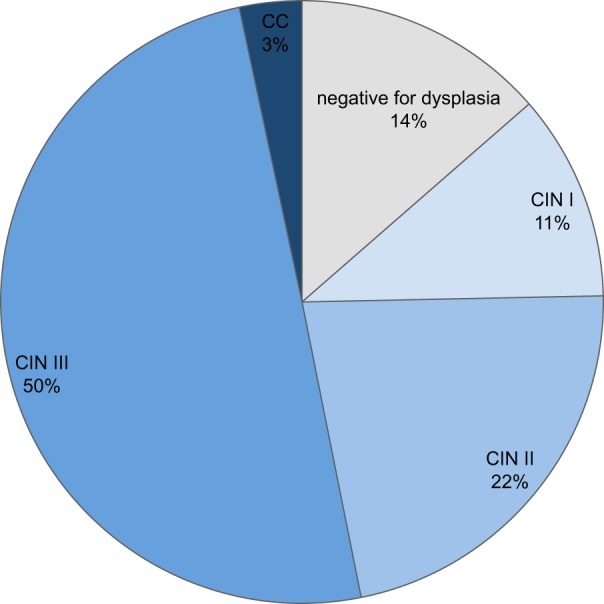
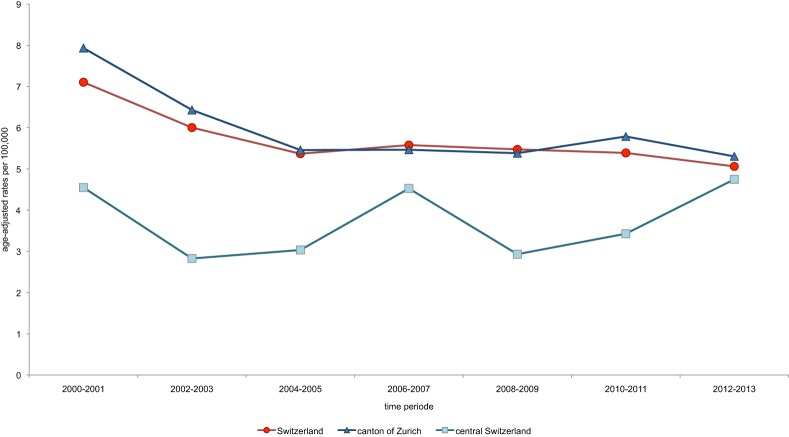
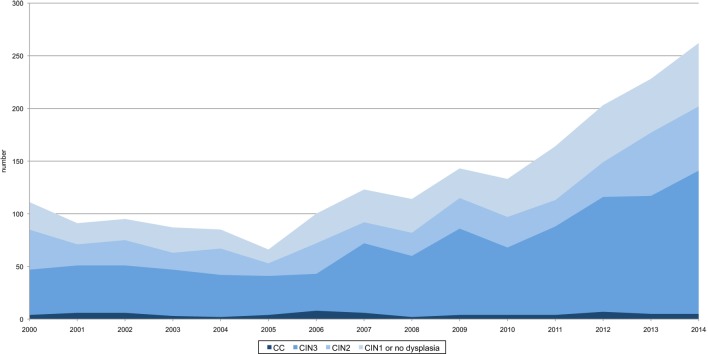
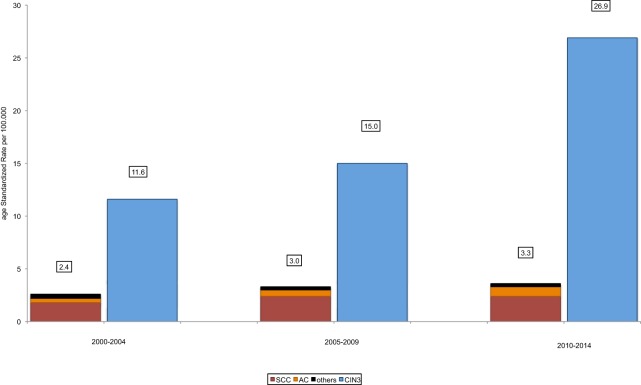
In Central Switzerland, the number of conizations performed annually has more than doubled over the observed 15 years. There has been a significant increase in precancerous lesions, which were found in approximately 50% of conizations. The total number of CC diagnosed by conization increased by 37.5% and the total of CIN3 increased by 130%. Age-standardized incidence of CC and CIN3 increased from 2.4 to 3.3/100,000 and from 11.6 to 26.9/100,000, respectively. The incidence of CC was lower in Central Switzerland compared to incidence in the Canton of Zurich and in Switzerland generally.
Approximately 50% of all conizations were performed on women without serious precancerous lesions. For this reason, we recommend the adaptation of screening modalities and the use of risk stratification to avoid overtreatment. In light of the forthcoming implementation of an HPV vaccination program, our data provides important baseline information.
通过巴氏涂片进行宫颈癌(CC)筛查已使全球CC发病率有所下降。事实上,瑞士的CC发病率非常低;然而,缺乏数据来评估巴氏涂片作为一种筛查工具的效率。到目前为止,仅使用了巴氏涂片,而其他方法如HPV感染情况尚未纳入常规筛查。本研究的目的是评估瑞士中部(代表一个农村地区)CC及其癌前病变的发病率趋势,并与城市地区以及瑞士全国的情况进行比较。
我们的研究纳入了2000年至2014年在卢塞恩州立医院病理研究所登记的所有锥切术病例和CC病例。CC及其癌前病变的发病率已根据年龄、分期、形态学和研究时期进行了分类。苏黎世州和瑞士全国的年龄标准化发病率作为评估研究区域CC发病率趋势的参考。
在瑞士中部,在观察的15年中,每年进行的锥切术数量增加了一倍多。癌前病变显著增加,约50%的锥切术中发现了癌前病变。通过锥切术诊断的CC总数增加了37.5%,CIN3总数增加了130%。CC和CIN3的年龄标准化发病率分别从2.4/10万增加到3.3/10万,从11.6/10万增加到26.9/10万。与苏黎世州和瑞士总体情况相比,瑞士中部的CC发病率较低。
所有锥切术中约50%是对没有严重癌前病变的女性进行的。因此,我们建议调整筛查方式并采用风险分层以避免过度治疗。鉴于即将实施HPV疫苗接种计划,我们的数据提供了重要的基线信息。