Chen Duo, Wei Lin, Meng Lingpan, Wang Dong, Chen Yanxue, Tian Yufeng, Yan Shishen, Mei Liangmo, Jiao Jun
School of Physics and State Key Laboratory of Crystal Materials, Shandong University, Jinan, 250100, People's Republic of China.
School of Microelectronics, Shandong University, Jinan, 250100, People's Republic of China.
Nanoscale Res Lett. 2018 Apr 3;13(1):92. doi: 10.1186/s11671-018-2501-x.
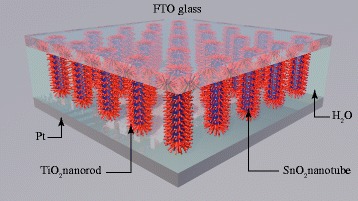
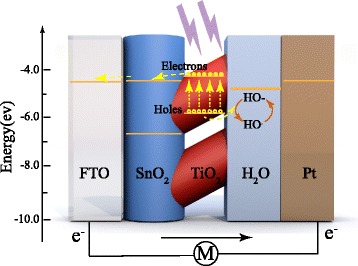
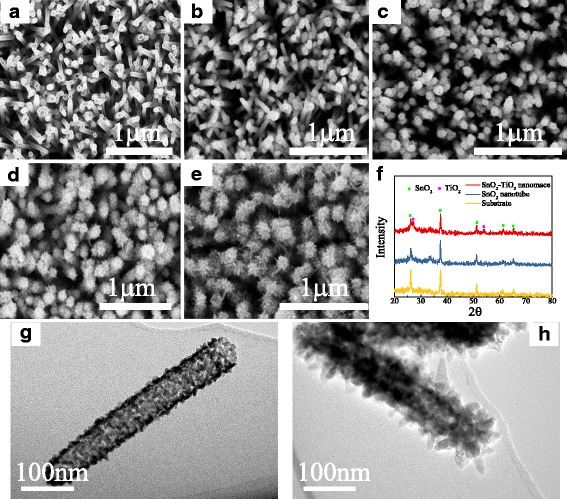
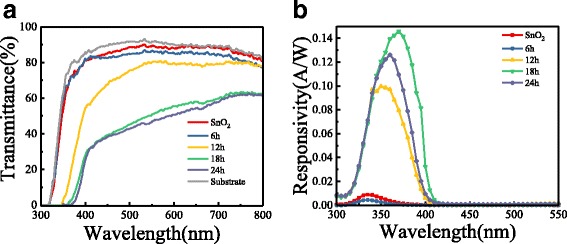
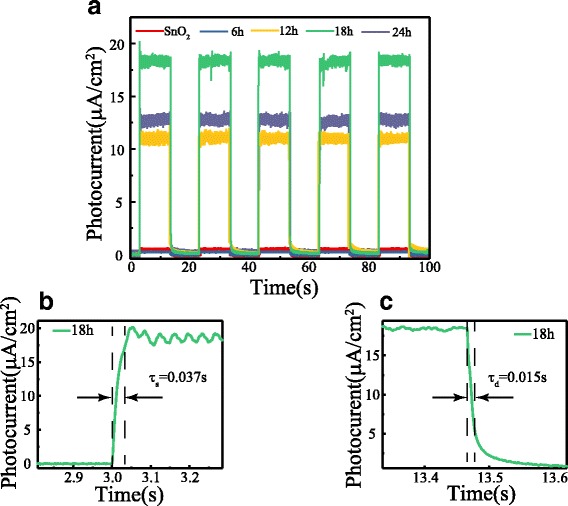
Photoelectrochemical cell-typed self-powered UV detectors have attracted intensive research interest due to their low cost, simple fabrication process, and fast response. In this paper, SnO-TiO nanomace arrays composed of SnO nanotube trunk and TiO nanobranches were prepared using soft chemical methods, and an environment-friendly self-powered UV photodetector using this nanostructure as the photoanode was assembled. Due to the synergistic effect of greatly accelerated electron-hole separation, enhanced surface area, and reduced charge recombination provided by SnO-TiO nanomace array, the nanostructured detector displays an excellent performance over that based on bare SnO arrays. The impact of the growing time of TiO branches on the performance of UV photodetector was systematically studied. The device based on optimized SnO-TiO nanomace arrays exhibits a high responsivity of 0.145 A/W at 365 nm, a fast rising time of 0.037 s, and a decay time of 0.015 s, as well as excellent spectral selectivity. This self-powered photodetector is a promising candidate for high-sensitivity, high-speed UV-detecting application.
光电化学池型自供电紫外探测器因其成本低、制造工艺简单和响应速度快而引起了广泛的研究兴趣。本文采用软化学方法制备了由SnO纳米管主干和TiO纳米分支组成的SnO-TiO纳米棒阵列,并组装了一种以这种纳米结构为光阳极的环境友好型自供电紫外光电探测器。由于SnO-TiO纳米棒阵列提供了极大加速的电子-空穴分离、增大的表面积和减少的电荷复合的协同效应,这种纳米结构探测器表现出优于基于裸SnO阵列探测器的优异性能。系统研究了TiO分支生长时间对紫外光电探测器性能的影响。基于优化的SnO-TiO纳米棒阵列的器件在365nm处具有0.145 A/W的高响应度、0.037 s的快速上升时间和0.015 s的衰减时间,以及优异的光谱选择性。这种自供电光电探测器是高灵敏度、高速紫外探测应用的有前途的候选者。