a Department of Hepatology and Gastroenterology , Aarhus University Hospital , Aarhus , Denmark.
b Department of Clinical Immunology , Aarhus University Hospital , Aarhus , Denmark.
Gut Microbes. 2018 Nov 2;9(6):540-550. doi: 10.1080/19490976.2018.1458179. Epub 2018 May 24.
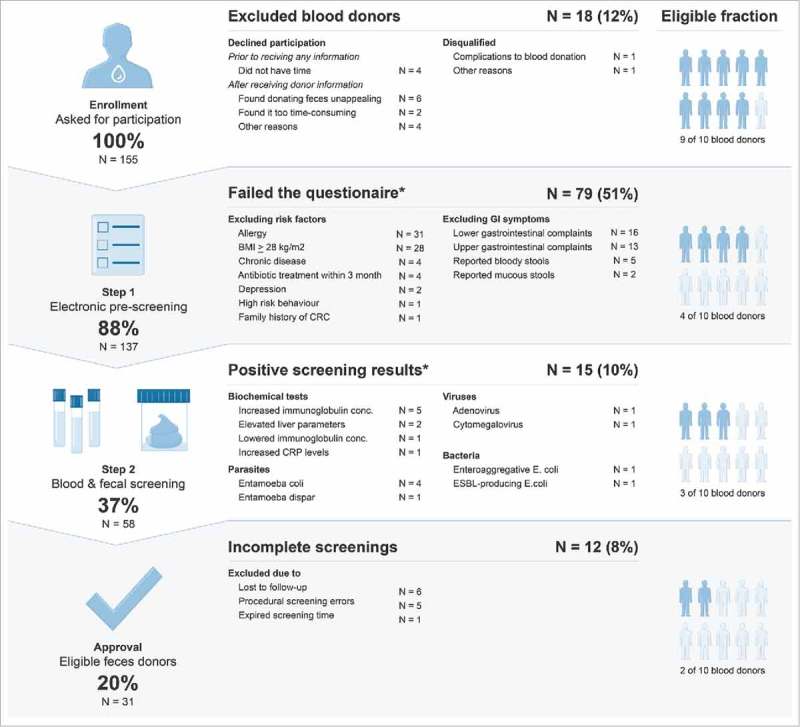
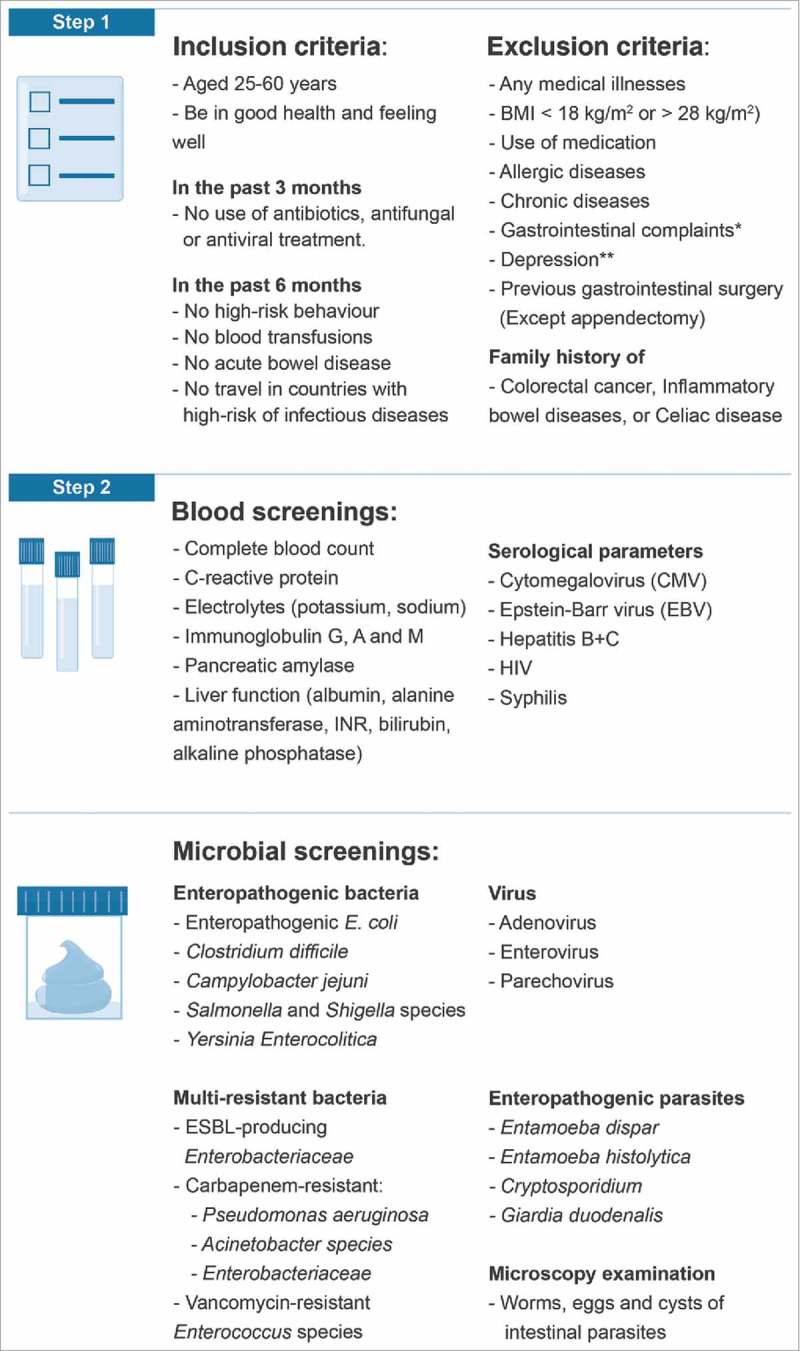
As the use of fecal microbiota transplantation (FMT) has gained momentum, an increasing need for continuous access to healthy feces donors has developed. Blood donors constitute a healthy subset of the general population and may serve as an appropriate group for recruitment. In this study, we investigated the suitability of blood donors as feces donors. In a prospective cohort study, we recruited blood donors onsite at a public Danish blood bank. Following their consent, the blood donors underwent a stepwise screening process: First, blood donors completed an electronic pre-screening questionnaire to rule out predisposing risk factors. Second, eligible blood donors had blood and fecal samples examined. Of 155 blood donors asked to participate, 137 (88%) completed the electronic pre-screening questionnaire, 16 declined, and 2 were excluded. Of the 137 donors who completed the questionnaire, 79 (58%) were excluded mainly due to having an allergy, being overweight, or presenting gastrointestinal complaints. Among the remaining 58 (37%) donors, complete blood and feces screenings were obtained from 46 (79%). Of these 46 donors, 15 (33%) were excluded primarily due to abnormal blood results or the presence of apathogenic intestinal parasites. Overall, 31 (20%; 95% confidence interval 14-27%) of the 155 blood donors qualified as feces donors. In conclusion, blood donors constitute a suitable and motivated population for a continuous recruitment of voluntary feces donors. We found that a stepwise recruitment procedure was feasible and that 20% of the blood donors were eligible for feces donation.
随着粪便微生物群移植(FMT)的应用不断增加,对持续获得健康粪便供体的需求也在不断增加。献血者是普通人群中的一个健康群体,可以作为招募的合适人群。在这项研究中,我们调查了献血者作为粪便供体的适宜性。我们在丹麦一家公共血库对现场献血者进行了一项前瞻性队列研究。在获得他们的同意后,献血者接受了逐步筛选过程:首先,献血者完成电子预筛选问卷,以排除潜在的危险因素。其次,合格的献血者进行血液和粪便样本检查。在被要求参与的 155 名献血者中,137 名(88%)完成了电子预筛选问卷,16 名拒绝,2 名被排除。在完成问卷的 137 名献血者中,79 名(58%)主要由于过敏、超重或胃肠道投诉而被排除。在其余 58 名(37%)献血者中,从 46 名(79%)获得了完整的血液和粪便筛查。在这 46 名献血者中,15 名(33%)主要由于血液结果异常或存在无病原体肠道寄生虫而被排除。总的来说,在 155 名献血者中,有 31 名(20%;95%置信区间 14-27%)符合粪便供体的条件。总之,献血者是一个合适的、有动力的人群,可以持续招募自愿的粪便供体。我们发现,逐步招募程序是可行的,有 20%的献血者有资格捐赠粪便。