HIV/STI Unit, Institute of Tropical Medicine, Antwerp, Belgium.
Division of Infectious Diseases and HIV Medicine, University of Cape Town, Cape Town, South Africa.
PLoS One. 2018 Apr 4;13(4):e0195431. doi: 10.1371/journal.pone.0195431. eCollection 2018.
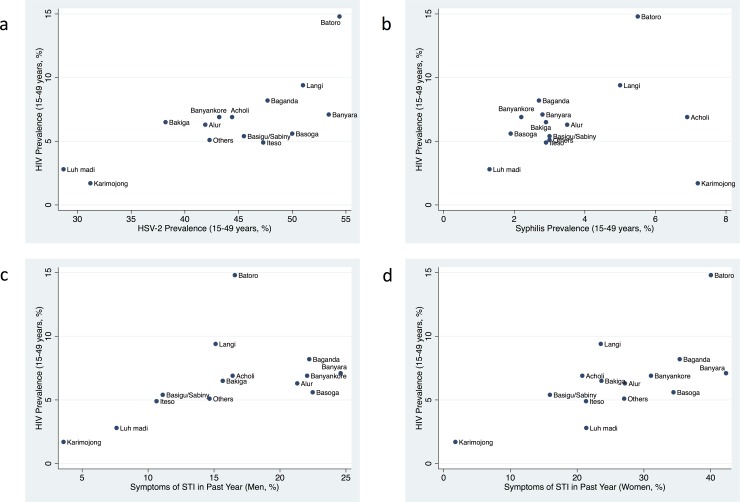
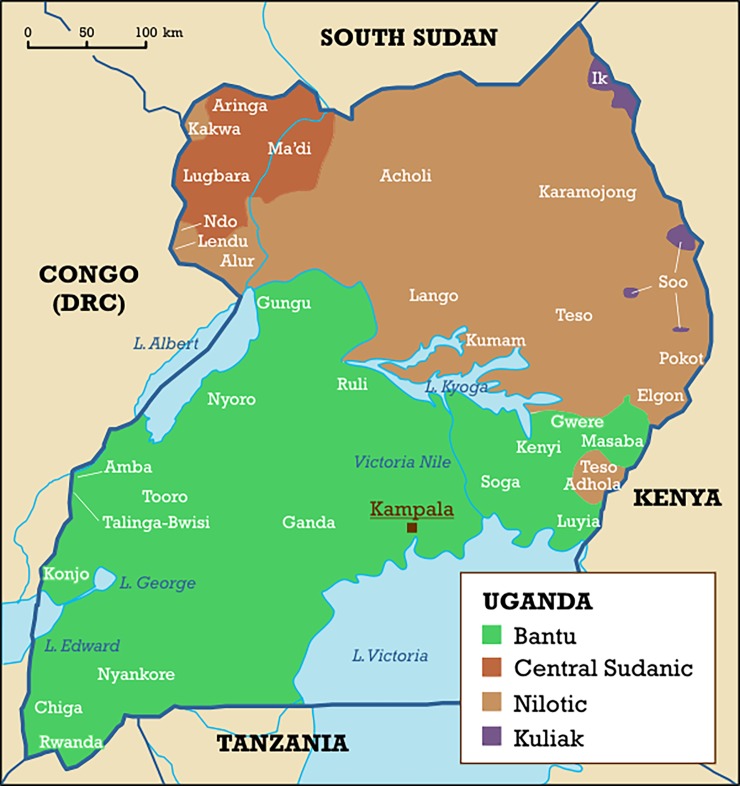
HIV prevalence varies from 1.7% to 14.8% between ethnic groups in Uganda. Understanding the factors responsible for this heterogeneity in HIV spread may guide prevention efforts.
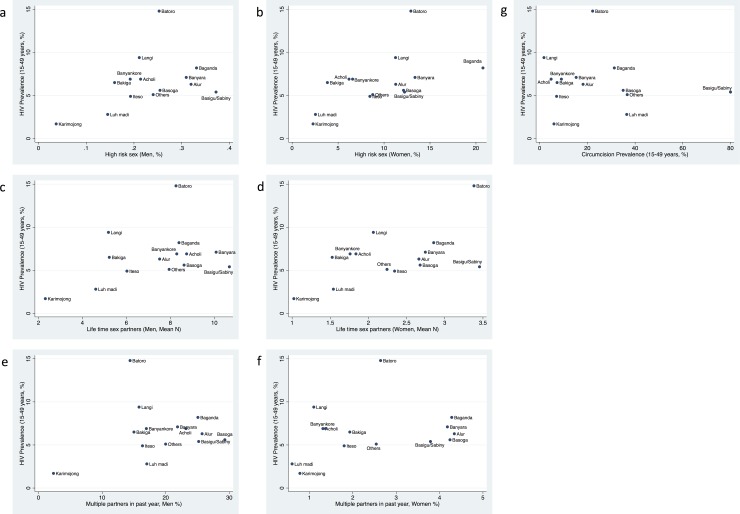
We evaluated the relationship between HIV prevalence by ethnic group and a range of risk factors as well as the prevalence of herpes simplex virus-2 (HSV-2), syphilis and symptomatic STIs in the 2004/2005 Uganda HIV/AIDS Sero-Behavioural Survey-a two stage, nationally representative, population based survey of 15-59-year-olds. Spearman's correlation was used to assess the relationship between HIV prevalence and each variable.
There was a positive association between HIV prevalence and HSV-2, symptomatic STIs and high-risk sex (sex with a non-cohabiting, non-marital partner) for women. Non-significant positive associations were present between HIV and high-risk sex for men and lifetime number of partners for men and women.
Variation in sexual behavior may contribute to the variations in HIV, HSV-2 and other STI prevalence by ethnic group in Uganda. Further work is necessary to delineate which combinations of risk factors determine differential STI spread in Uganda.
在乌干达,不同种族群体的艾滋病毒流行率从 1.7%到 14.8%不等。了解导致艾滋病毒传播这种异质性的因素可能有助于指导预防工作。
我们评估了 2004/2005 年乌干达艾滋病毒/艾滋病血清行为调查中按种族划分的艾滋病毒流行率与一系列风险因素以及单纯疱疹病毒 2(HSV-2)、梅毒和有症状性性传播感染(STI)的流行率之间的关系。这是一项在 15-59 岁人群中进行的两阶段、全国代表性、基于人群的调查。我们使用 Spearman 相关系数来评估艾滋病毒流行率与每个变量之间的关系。
对于女性,艾滋病毒流行率与 HSV-2、有症状性 STI 和高危性行为(与非同居、非婚姻伴侣发生性行为)呈正相关。对于男性,艾滋病毒与高危性行为之间以及男性和女性的终身伴侣数量之间存在不显著的正相关关系。
性行为的差异可能导致乌干达不同种族群体中艾滋病毒、HSV-2 和其他性传播感染的流行率存在差异。需要进一步研究来阐明哪些风险因素组合决定了乌干达不同的性传播感染传播。