Kang Ee-Seul, Kim Da-Seul, Suhito Intan Rosalina, Lee Wanhee, Song Inbeom, Kim Tae-Hyung
1School of Integrative Engineering, Chung-Ang University, 84 Heukseok-ro, Dongjak-gu, Seoul, 06974 Republic of Korea.
2Integrative Research Center for Two-Dimensional Functional Materials, Institute of Interdisciplinary Convergence Research, Chung-Ang University, Seoul, 06974 Republic of Korea.
Biomater Res. 2018 Apr 2;22:10. doi: 10.1186/s40824-018-0120-3. eCollection 2018.
In the past decade, stem cells, with their ability to differentiate into various types of cells, have been proven to be resourceful in regenerative medicine and tissue engineering. Despite the ability to repair damaged parts of organs and tissues, the use of stem cells still entails several limitations, such as low differentiation efficiency and difficulties in guiding differentiation. To address these limitations, nanotechnology approaches have been recently implemented in stem cell research. It has been discovered that stem cells, in combination with carbon-based functional materials, show enhanced regenerative performances in varying biophysical conditions. In particular, several studies have reported solutions to the conventional quandaries in biomedical engineering, using synergetic effects of nanohybrid materials, as well as further development of technologies to recover from diverse health conditions such as bone fracture and strokes.
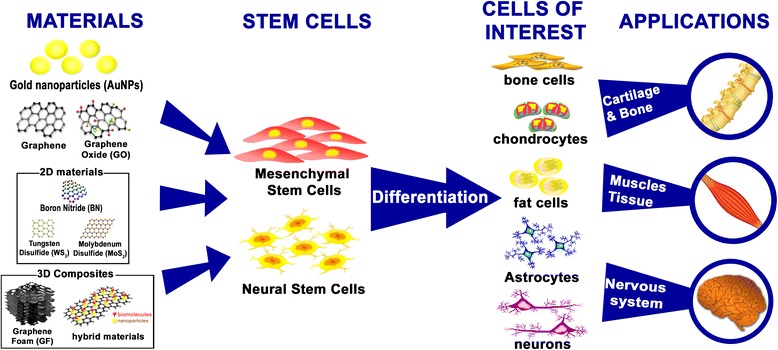
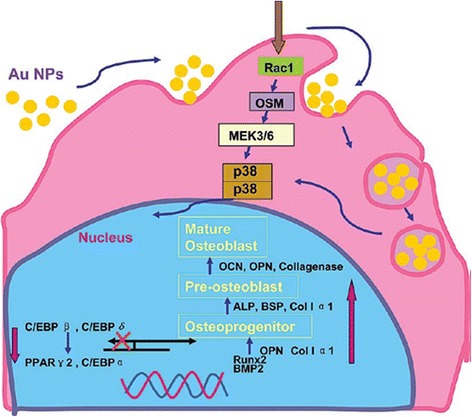
In this review, we discuss several prior studies regarding the application of various nanomaterials in controlling the behavior of stem cells. We focus on the potential of different types of nanomaterials, such as two-dimensional materials, gold nanoparticles, and three-dimensional nanohybrid composites, to control the differentiation of human mesenchymal stem cells (hMSCs). These materials have been found to affect stem cell functions via the adsorption of growth/differentiation factors on the surfaces of nanomaterials and the activation of signaling pathways that are mostly related to cell adhesion and differentiation (e.g., FAK, Smad, Erk, and Wnt).
Controlling stem cell differentiation using biophysical factors, especially the use of nanohybrid materials to functionalize underlying substrates wherein the cells attach and grow, is a promising strategy to achieve cells of interest in a highly efficient manner. We hope that this review will facilitate the use of other types of newly discovered and/or synthesized nanomaterials (e.g., metal transition dichalcogenides, non-toxic quantum dots, and metal oxide frameworks) for stem cell-based regenerative therapies.
在过去十年中,干细胞因其能够分化为各种类型的细胞,已被证明在再生医学和组织工程中具有重要价值。尽管干细胞具有修复受损器官和组织的能力,但其应用仍存在一些局限性,如分化效率低和诱导分化困难。为了解决这些局限性,纳米技术方法最近已被应用于干细胞研究。研究发现,干细胞与碳基功能材料相结合,在不同的生物物理条件下表现出增强的再生性能。特别是,一些研究报告了利用纳米杂化材料的协同效应解决生物医学工程中的传统难题,以及进一步开发从骨折和中风等各种健康状况中恢复的技术。
在本综述中,我们讨论了几项关于各种纳米材料在控制干细胞行为方面应用的先前研究。我们重点关注不同类型纳米材料的潜力,如二维材料、金纳米颗粒和三维纳米杂化复合材料,以控制人间充质干细胞(hMSCs)的分化。这些材料已被发现通过生长/分化因子在纳米材料表面的吸附以及激活主要与细胞粘附和分化相关的信号通路(如FAK、Smad、Erk和Wnt)来影响干细胞功能。
利用生物物理因素控制干细胞分化,特别是使用纳米杂化材料对细胞附着和生长的底层基质进行功能化,是一种以高效方式获得所需细胞的有前景的策略。我们希望本综述将促进使用其他类型新发现和/或合成的纳米材料(如金属过渡二硫属化物、无毒量子点和金属氧化物框架)用于基于干细胞的再生治疗。