Petriceks Aldis H, Salmi Darren
Division of Clinical Anatomy, Stanford University School of Medicine, Stanford, CA, USA.
Department of Pathology, Stanford University School of Medicine, Stanford, CA, USA.
Acad Pathol. 2018 Mar 28;5:2374289518765457. doi: 10.1177/2374289518765457. eCollection 2018 Jan-Dec.
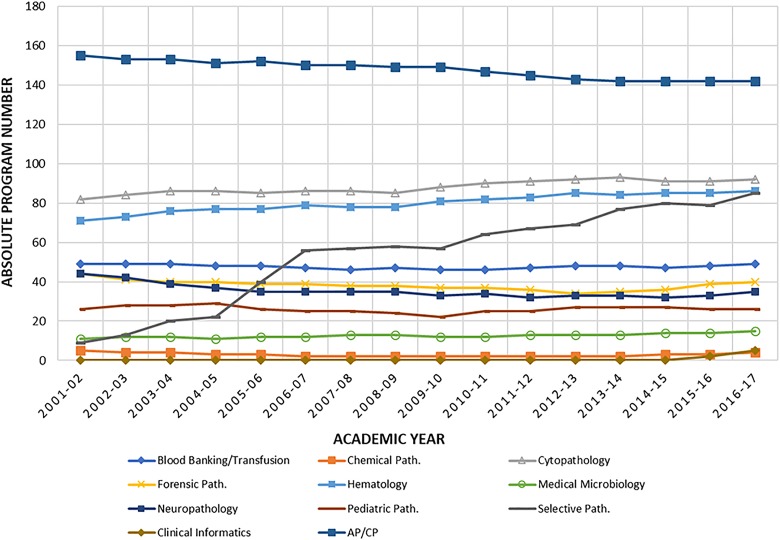
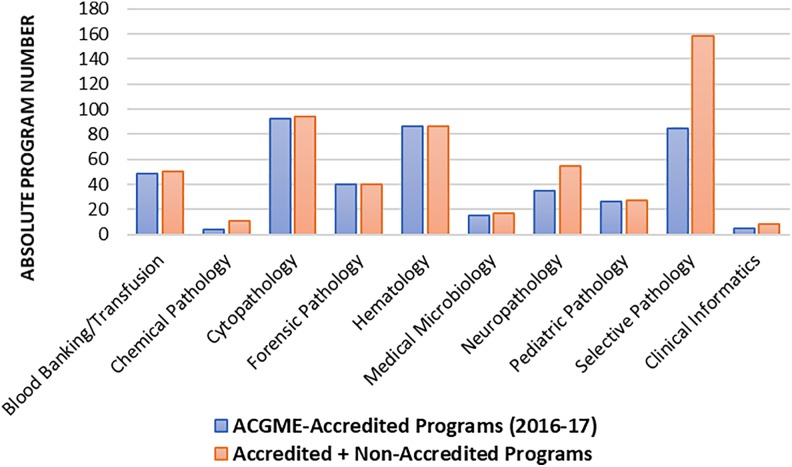
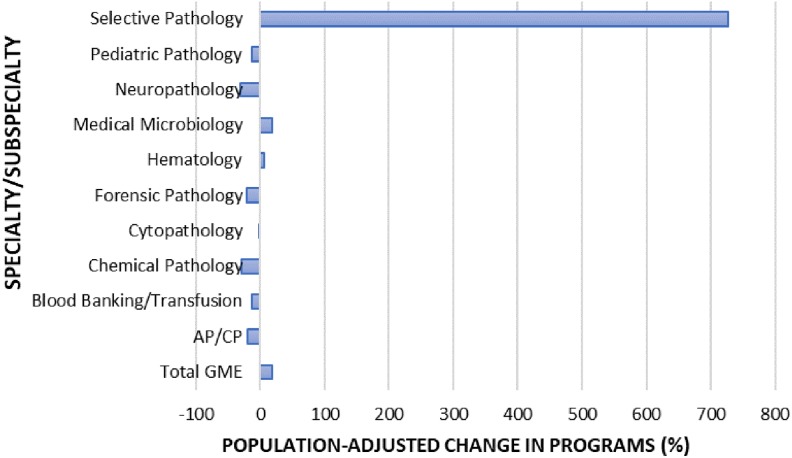
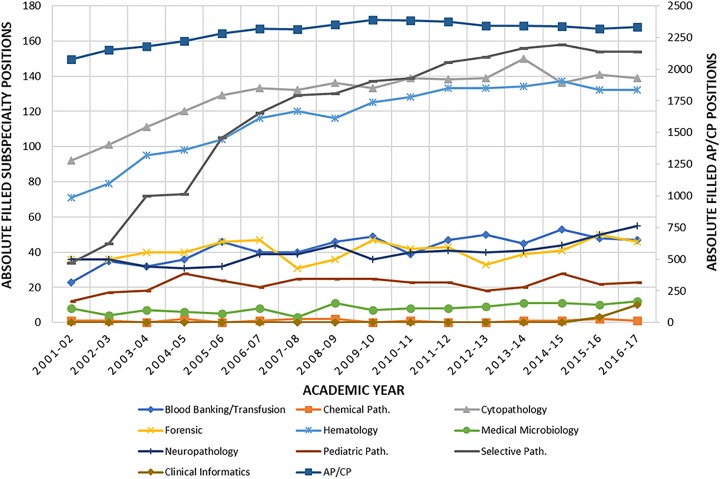
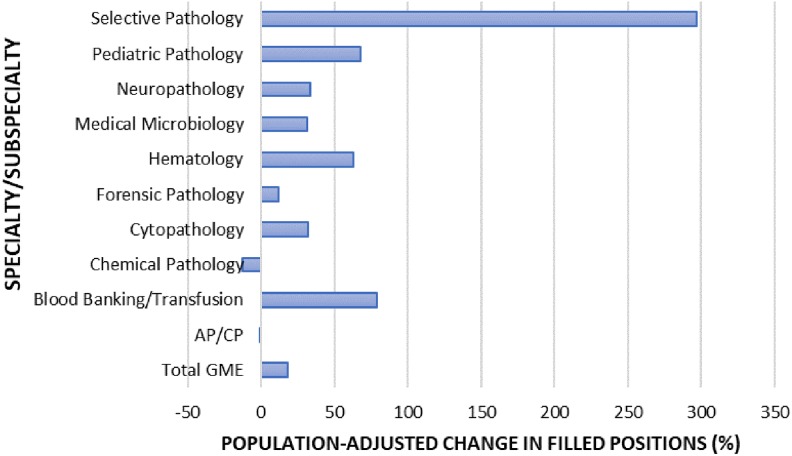
The US medical workforce is facing an impending physician shortage. This shortage holds special concern for pathologists, as many senior practitioners are set to retire in the coming years. Indeed, studies indicate a "pathologist gap" may grow through 2030. As such, it is important to understand current and future trends in US pathology. One key factor is graduate medical education. In this study, we analyzed data from the Accreditation Council of Graduate Medical Education, to determine the change in pathology graduate medical education programs and positions, from 2001 to 2017. We found that pathology programs and positions have increased since the 2001 to 2002 academic year, even after adjusting for population growth. However, this increase is much lower than that of total graduate medical education. Furthermore, many pathology subspecialties have declined in population-adjusted levels. Other subspecialties, such as selective pathology, have grown disproportionately. Our findings may be valuable for understanding the state of US pathology, now and in the future. They imply that more resources-or technological innovations-may be needed for specific pathology programs, in hopes of closing the pathologist gap for both this specialty and its subspecialties.
美国医疗劳动力正面临迫在眉睫的医生短缺问题。这种短缺对病理学家来说尤为令人担忧,因为许多资深从业者预计将在未来几年退休。事实上,研究表明,到2030年“病理学家缺口”可能会扩大。因此,了解美国病理学的当前和未来趋势非常重要。一个关键因素是毕业后医学教育。在本研究中,我们分析了毕业后医学教育认证委员会的数据,以确定2001年至2017年病理学毕业后医学教育项目和职位的变化。我们发现,自2001至2002学年以来,即使在考虑人口增长因素后,病理学项目和职位仍有所增加。然而,这一增长远低于毕业后医学教育的总体增长。此外,许多病理学亚专业按人口调整后的水平有所下降。其他亚专业,如选择性病理学,则增长不成比例。我们的研究结果对于了解美国病理学的现状和未来可能具有重要价值。它们意味着可能需要为特定的病理学项目提供更多资源或技术创新,以期缩小该专业及其亚专业的病理学家缺口。