Zhu Xi, Du Xiaofei, Kerich Mike, Lohoff Falk W, Momenan Reza
Clinical NeuroImaging Research Core, National Institute on Alcohol Abuse and Alcoholism, National Institutes of Health, Bethesda, MD, United States.
Data Scientist Team, Adtheorent, New York, NY, United States.
Neurosci Lett. 2018 May 29;676:27-33. doi: 10.1016/j.neulet.2018.04.007. Epub 2018 Apr 4.
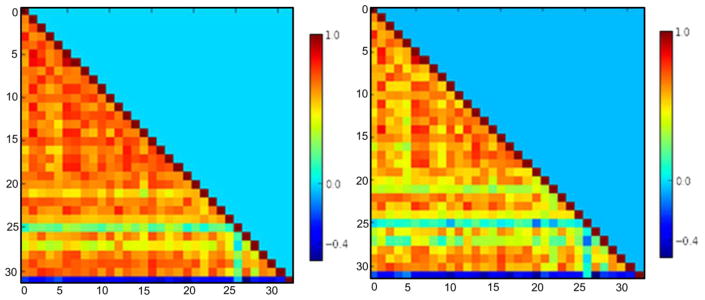
Currently, classification of alcohol use disorder (AUD) is made on clinical grounds; however, robust evidence shows that chronic alcohol use leads to neurochemical and neurocircuitry adaptations. Identifications of the neuronal networks that are affected by alcohol would provide a more systematic way of diagnosis and provide novel insights into the pathophysiology of AUD. In this study, we identified network-level brain features of AUD, and further quantified resting-state within-network, and between-network connectivity features in a multivariate fashion that are classifying AUD, thus providing additional information about how each network contributes to alcoholism. Resting-state fMRI were collected from 92 individuals (46 controls and 46 AUDs). Probabilistic Independent Component Analysis (PICA) was used to extract brain functional networks and their corresponding time-course for AUD and controls. Both within-network connectivity for each network and between-network connectivity for each pair of networks were used as features. Random forest was applied for pattern classification. The results showed that within-networks features were able to identify AUD and control with 87.0% accuracy and 90.5% precision, respectively. Networks that were most informative included Executive Control Networks (ECN), and Reward Network (RN). The between-network features achieved 67.4% accuracy and 70.0% precision. The between-network connectivity between RN-Default Mode Network (DMN) and RN-ECN contribute the most to the prediction. In conclusion, within-network functional connectivity offered maximal information for AUD classification, when compared with between-network connectivity. Further, our results suggest that connectivity within the ECN and RN are informative in classifying AUD. Our findings suggest that machine-learning algorithms provide an alternative technique to quantify large-scale network differences and offer new insights into the identification of potential biomarkers for the clinical diagnosis of AUD.
目前,酒精使用障碍(AUD)的分类基于临床依据;然而,有力证据表明,长期饮酒会导致神经化学和神经回路适应性变化。识别受酒精影响的神经网络将提供一种更系统的诊断方法,并为AUD的病理生理学提供新的见解。在本研究中,我们识别了AUD的网络层面脑特征,并以多变量方式进一步量化了静息状态下网络内和网络间的连接特征,这些特征可对AUD进行分类,从而提供了关于每个网络如何导致酗酒的更多信息。从92名个体(46名对照者和46名AUD患者)收集了静息态功能磁共振成像(fMRI)数据。使用概率独立成分分析(PICA)提取AUD患者和对照者的脑功能网络及其相应的时间进程。每个网络的网络内连接以及每对网络的网络间连接均用作特征。应用随机森林进行模式分类。结果表明,网络内特征分别能够以87.0%的准确率和90.5%的精确率识别AUD患者和对照者。信息量最大的网络包括执行控制网络(ECN)和奖赏网络(RN)。网络间特征的准确率为67.4%,精确率为70.0%。RN-默认模式网络(DMN)与RN-ECN之间的网络间连接对预测贡献最大。总之,与网络间连接相比,网络内功能连接为AUD分类提供了最大信息。此外,我们的结果表明,ECN和RN内的连接在AUD分类中具有信息量。我们的研究结果表明,机器学习算法提供了一种替代技术,可量化大规模网络差异,并为识别AUD临床诊断的潜在生物标志物提供新的见解。