Joslin Diabetes Center, Harvard Medical School, One Joslin Place, Boston, MA, 02215, USA.
Department of Nutrition and Dietetics, Faculty of Medicine and Health Sciences, Universiti Putra Malaysia, Selangor, Malaysia.
Nutr J. 2018 Apr 7;17(1):42. doi: 10.1186/s12937-018-0351-0.
Nutrition Therapy (NT) is essential in type 2 diabetes (T2D) management. Standards of care recommend that each patient engages with a nutritionist (RDN) to develop an individualized eating plan. However, it is unclear if it is the most efficient method of NT. This study evaluates the effects of three different methods of NT on HbA1c and cardiovascular disease risk factors in overweight and obese patients with T2D.
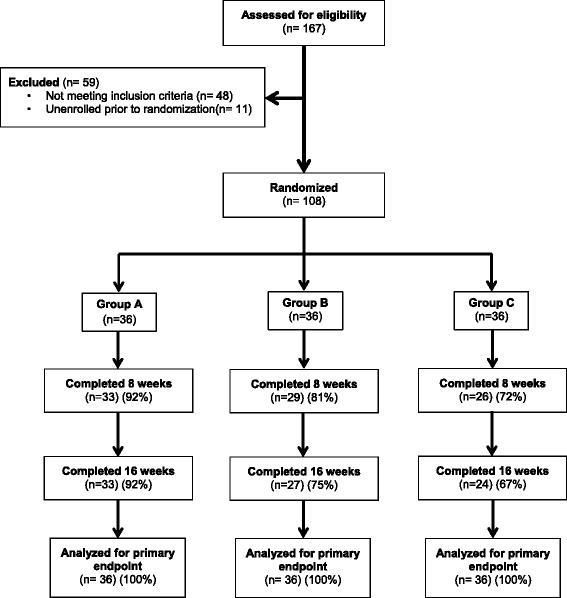
We randomized 108 overweight and obese patients with T2D (46 M/62F; age 60 ± 10 years; HbA1c 8.07 ± 1.05%; weight 101.4 ± 21.1 kg and BMI 35.2 ± 7.7 kg/m) into three groups. Group A met with RDN to develop an individualized eating plan. Group B met with RDN and followed a structured meal plan. Group C did similar to group B and received weekly phone support by RDN.
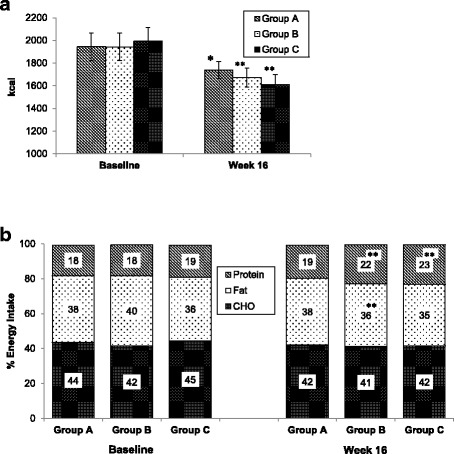
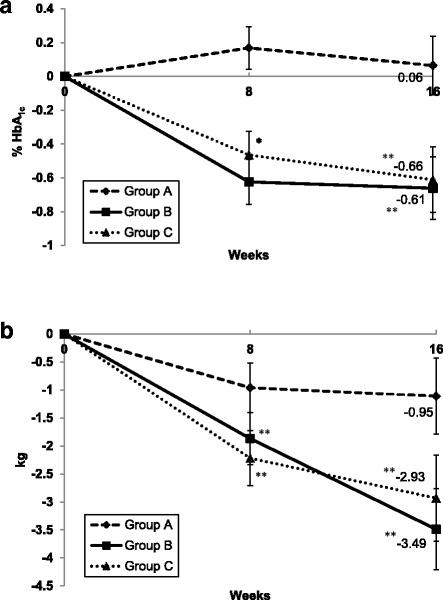
After 16 weeks, all three groups had a significant reduction of their energy intake compared to baseline. HbA1c did not change from baseline in group A, but decreased significantly in groups B (- 0.66%, 95% CI -1.03 to - 0.30) and C (- 0.61%, 95% CI -1.0 to - 0.23) (p value for difference among groups over time < 0.001). Groups B and C also had significant reductions in body weight, body fat percentage and waist circumference.
Structured NT alone improves glycemia in comparison to individualized eating plans in overweight and obese patients with T2D. It also reduces other important cardiovascular disease risk factors like body fat percentage and waist circumference.
The trial was retrospectively registered at clinicaltrials.gov( NCT02520050 ).
营养疗法(NT)是 2 型糖尿病(T2D)管理的重要组成部分。护理标准建议每位患者与营养师(RDN)合作制定个性化饮食计划。然而,目前尚不清楚这是否是 NT 最有效的方法。本研究评估了三种不同 NT 方法对超重和肥胖 T2D 患者的 HbA1c 和心血管疾病危险因素的影响。
我们将 108 名超重和肥胖的 T2D 患者(46 名男性/62 名女性;年龄 60±10 岁;HbA1c 8.07±1.05%;体重 101.4±21.1kg 和 BMI 35.2±7.7kg/m)随机分为三组。A 组与 RDN 会面以制定个性化饮食计划。B 组与 RDN 会面并遵循结构化膳食计划。C 组与 B 组类似,并接受 RDN 的每周电话支持。
经过 16 周,与基线相比,三组患者的能量摄入均显著减少。A 组患者的 HbA1c 与基线相比没有变化,但 B 组(-0.66%,95%CI-1.03 至-0.30)和 C 组(-0.61%,95%CI-1.0 至-0.23)显著下降(组间差异的 p 值<0.001)。B 组和 C 组的体重、体脂百分比和腰围也显著减少。
与个体化饮食计划相比,单独进行结构化 NT 可改善超重和肥胖 T2D 患者的血糖水平。它还降低了其他重要的心血管疾病危险因素,如体脂百分比和腰围。
该试验在 clinicaltrials.gov(NCT02520050)上进行了回顾性注册。