Bai Bing
Department of Laboratory Medicine, Nanjing Drum Tower Hospital, Nanjing University Medical School, Nanjing, China.
Front Aging Neurosci. 2018 Mar 23;10:75. doi: 10.3389/fnagi.2018.00075. eCollection 2018.
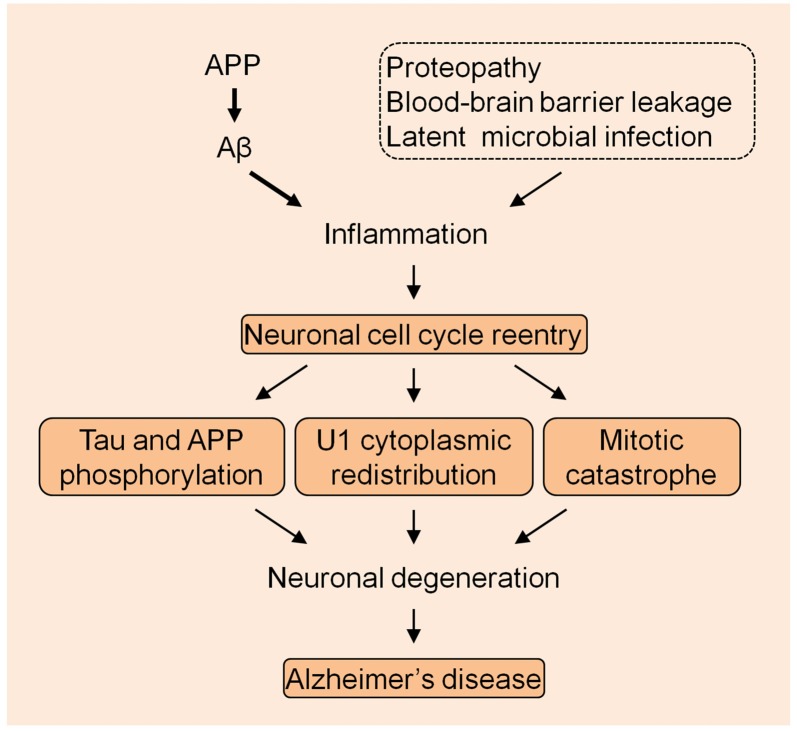
The aberrancy of U1 small nuclear ribonucleoprotein (snRNP) complex and RNA splicing has been demonstrated in Alzheimer's disease (AD). Importantly, the U1 proteopathy is AD-specific, widespread and early-occurring, thus providing a very unique clue to the AD pathogenesis. The prominent feature of U1 histopathology is its nuclear depletion and redistribution in the neuronal cytoplasm. According to the preliminary data, the initial U1 cytoplasmic distribution pattern is similar to the subcellular translocation of the spliceosome in cells undergoing mitosis. This implies that the U1 mislocalization might reflect the neuronal cell cycle-reentry (CCR) which has been extensively evidenced in AD brains. The CCR phenomenon explains the major molecular and cellular events in AD brains, such as Tau and amyloid precursor protein (APP) phosphorylation, and the possible neuronal death through mitotic catastrophe (MC). Furthermore, the CCR might be mechanistically linked to inflammation, a critical factor in the AD etiology according to the genetic evidence. Therefore, the discovery of U1 aberrancy might strengthen the involvement of CCR in the AD neuronal degeneration.
在阿尔茨海默病(AD)中,U1小核核糖核蛋白(snRNP)复合体的异常和RNA剪接已得到证实。重要的是,U1蛋白病具有AD特异性、广泛存在且早期出现,因此为AD发病机制提供了一个非常独特的线索。U1组织病理学的突出特征是其在细胞核内缺失并重新分布于神经元细胞质中。根据初步数据,U1最初在细胞质中的分布模式类似于有丝分裂细胞中剪接体的亚细胞易位。这意味着U1定位错误可能反映了神经元细胞周期重新进入(CCR),这在AD大脑中已得到广泛证实。CCR现象解释了AD大脑中的主要分子和细胞事件,如Tau和淀粉样前体蛋白(APP)磷酸化,以及通过有丝分裂灾难(MC)可能导致的神经元死亡。此外,根据遗传学证据,CCR可能在机制上与炎症相关,而炎症是AD病因中的一个关键因素。因此,U1异常的发现可能会加强CCR在AD神经元变性中的作用。