Yang Jie, Chen Hao, Wang Qiang, Deng Shihao, Huang Mi, Ma Xinhua, Song Ping, Du Jingwen, Huang Yun, Wen Yanzhang, Ren Yongshen, Yang Xinzhou
School of Pharmaceutical Sciences, South-Central University for Nationalities, Wuhan, China.
College of Pharmacy, Guangxi University of Chinese Medicine, Nanning, China.
Front Pharmacol. 2018 Mar 23;9:252. doi: 10.3389/fphar.2018.00252. eCollection 2018.
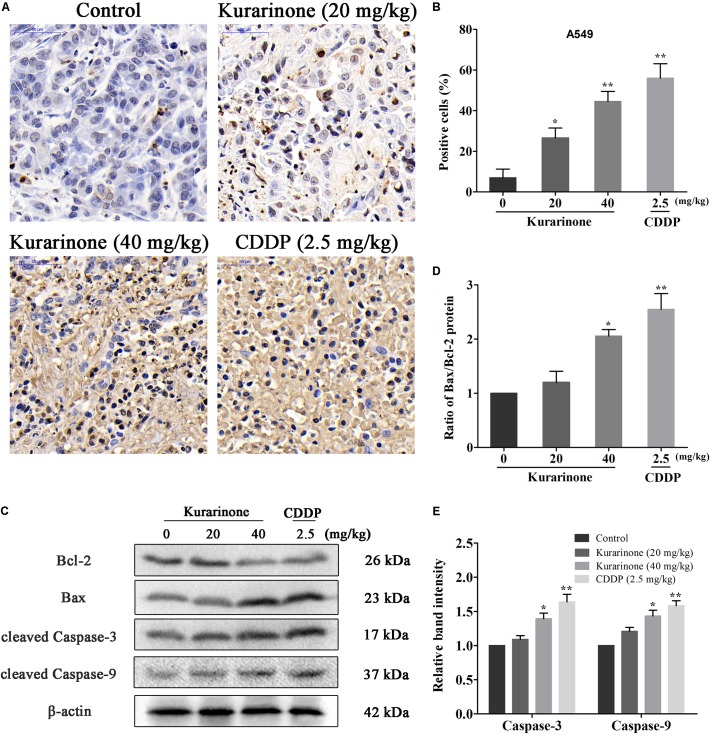
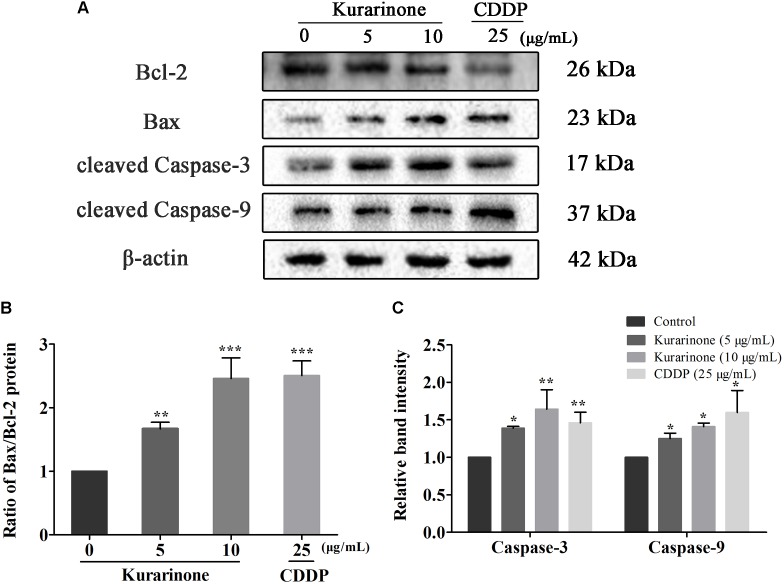
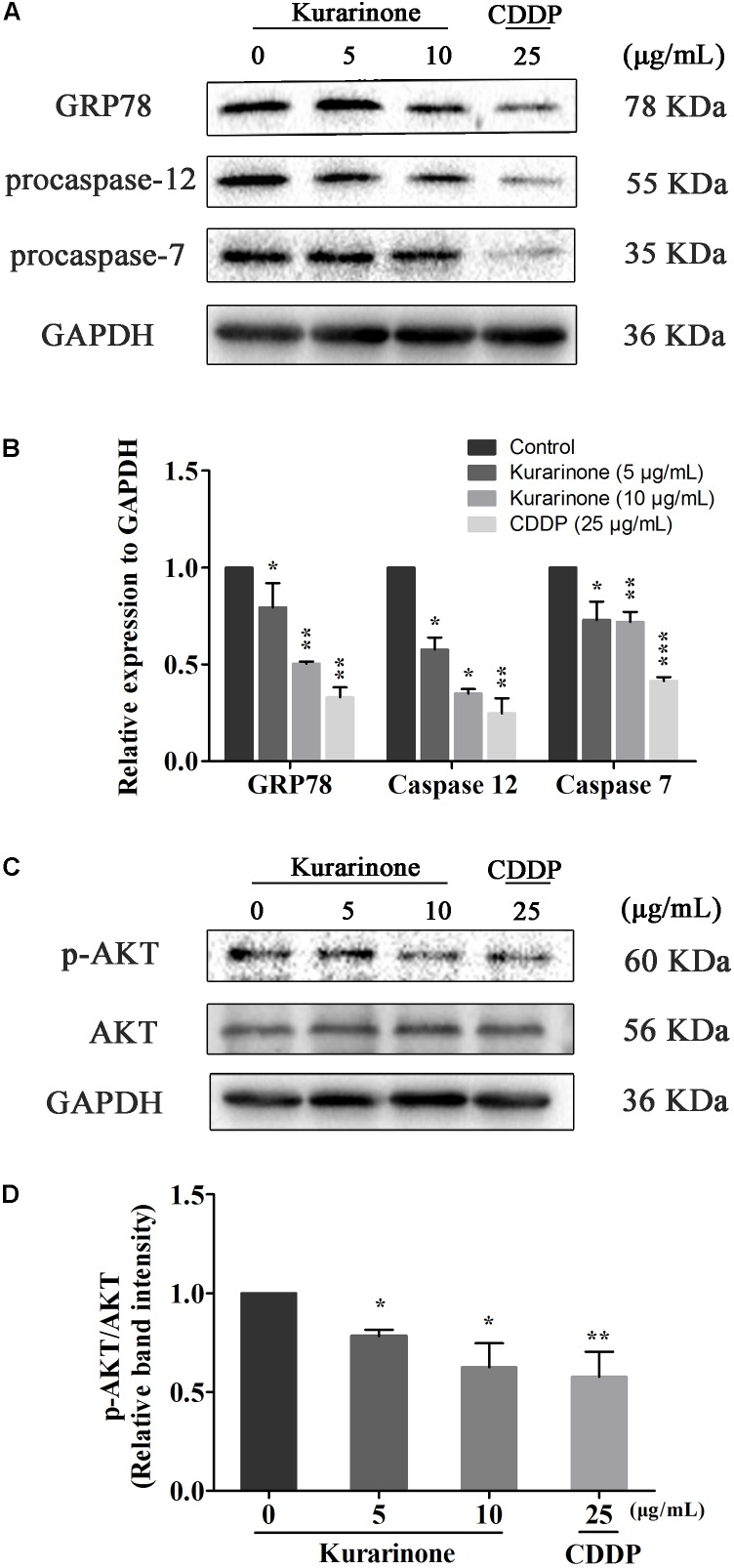
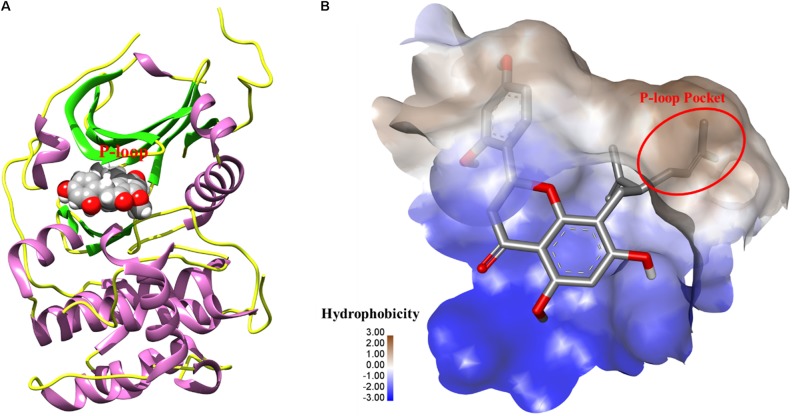
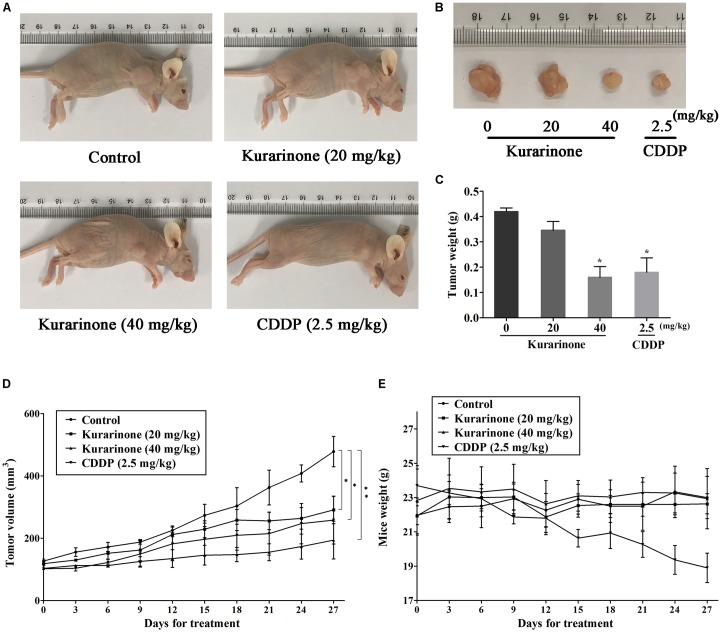
Kurarinone, a flavonoid isolated from Aiton, has been reported to have significant antitumor activity. However, the cytotoxic activity of kurarinone against non-small cell lung cancer (NSCLC) cells is still under explored. In our study, we have evaluated the inhibitory effects of kurarinone on the growth of NSCLC both and as well as the molecular mechanisms underlying kurarinone-induced A549 cell apoptosis. The results showed that kurarinone effectively inhibited the proliferation of A549 cells with little toxic effects on human bronchial epithelial cell line BEAS-2B. FASC examination and Hoechst 33258 staining assay showed that kurarinone dose-dependently provoked A549 cells apoptosis. Mechanistically, kurarinone significantly decreased the ratio of Bcl-2/Bax, thereby causing the activation of caspase 9 and caspase 3, and reduced the expression of Grp78, which led to relieve the inhibition of caspase-12 and caspase-7, as well as suppressing the activity of AKT. Meanwhile, modeling results from the Surflex-Dock program suggested that residue Ser473 of Akt is a potential binding site for kurarinone. , kurarinone inhibited the growth of A549 xenograft mouse models without apparent signs of toxicity. Our study indicated that kurarinone has the potential effects of anti-NSCLC, implemented through activating mitochondria apoptosis signaling pathway, as well as repressing the activity of endoplasmic reticulum pathway and AKT in A549 cells.
苦参黄酮是从爱冬叶中分离出的一种黄酮类化合物,据报道具有显著的抗肿瘤活性。然而,苦参黄酮对非小细胞肺癌(NSCLC)细胞的细胞毒性活性仍在探索中。在我们的研究中,我们评估了苦参黄酮对NSCLC生长的抑制作用以及苦参黄酮诱导A549细胞凋亡的分子机制。结果表明,苦参黄酮有效抑制A549细胞的增殖,对人支气管上皮细胞系BEAS-2B几乎没有毒性作用。流式细胞术检测和Hoechst 33258染色分析表明,苦参黄酮剂量依赖性地诱导A549细胞凋亡。机制上,苦参黄酮显著降低Bcl-2/Bax的比值,从而导致caspase 9和caspase 3的激活,并降低Grp78的表达,这导致解除对caspase-12和caspase-7的抑制,以及抑制AKT的活性。同时,Surflex-Dock程序的建模结果表明,Akt的Ser473残基是苦参黄酮的潜在结合位点。此外,苦参黄酮抑制A549异种移植小鼠模型的生长,且无明显毒性迹象。我们的研究表明,苦参黄酮具有抗NSCLC的潜在作用,通过激活线粒体凋亡信号通路以及抑制A549细胞内质网通路和AKT的活性来实现。