Shirvalkar Prasad, Veuthey Tess L, Dawes Heather E, Chang Edward F
Pain Management Division, Departments of Neurology and Anesthesiology, University of California, San Francisco, San Francisco, CA, United States.
Department of Neurological Surgery, University of California, San Francisco, San Francisco, CA, United States.
Front Comput Neurosci. 2018 Mar 26;12:18. doi: 10.3389/fncom.2018.00018. eCollection 2018.
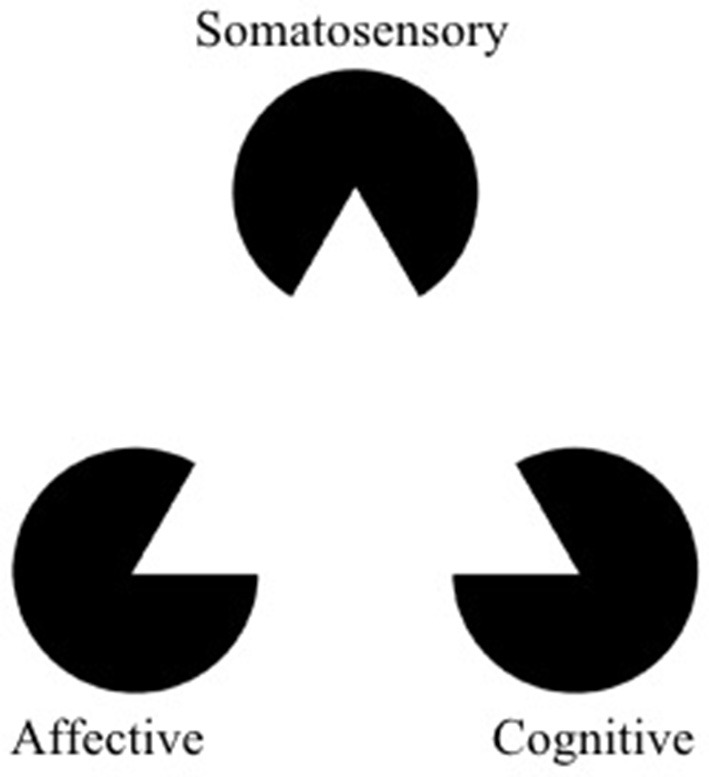
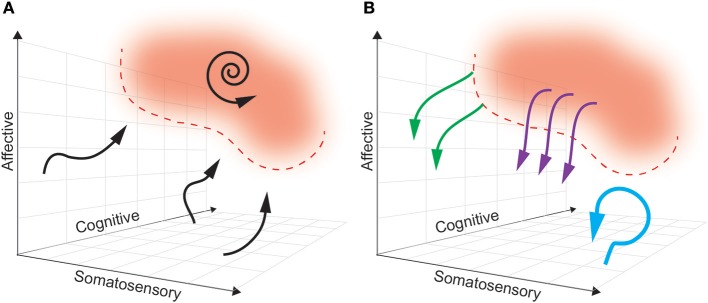
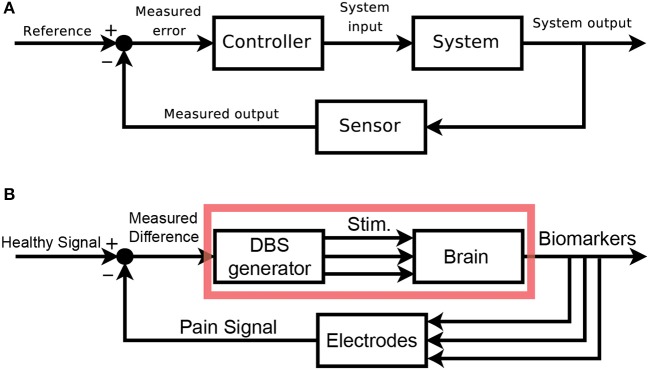
Pain is a subjective experience that alerts an individual to actual or potential tissue damage. Through mechanisms that are still unclear, normal physiological pain can lose its adaptive value and evolve into pathological chronic neuropathic pain. Chronic pain is a multifaceted experience that can be understood in terms of somatosensory, affective, and cognitive dimensions, each with associated symptoms and neural signals. While there have been many attempts to treat chronic pain, in this article we will argue that feedback-controlled 'closed-loop' deep brain stimulation (DBS) offers an urgent and promising route for treatment. Contemporary DBS trials for chronic pain use "open-loop" approaches in which tonic stimulation is delivered with fixed parameters to a single brain region. The impact of key variables such as the target brain region and the stimulation waveform is unclear, and long-term efficacy has mixed results. We hypothesize that chronic pain is due to abnormal synchronization between brain networks encoding the somatosensory, affective and cognitive dimensions of pain, and that multisite, closed-loop DBS provides an intuitive mechanism for disrupting that synchrony. By (1) identifying biomarkers of the subjective pain experience and (2) integrating these signals into a state-space representation of pain, we can create a predictive model of each patient's pain experience. Then, by establishing how stimulation in different brain regions influences individual neural signals, we can design real-time, closed-loop therapies tailored to each patient. While chronic pain is a complex disorder that has eluded modern therapies, rich historical data and state-of-the-art technology can now be used to develop a promising treatment.
疼痛是一种主观体验,它会提醒个体注意实际的或潜在的组织损伤。通过仍不清楚的机制,正常的生理性疼痛会失去其适应性价值,并演变成病理性慢性神经病理性疼痛。慢性疼痛是一种多方面的体验,可以从躯体感觉、情感和认知维度来理解,每个维度都有相关的症状和神经信号。虽然已经有许多治疗慢性疼痛的尝试,但在本文中我们将论证,反馈控制的“闭环”深部脑刺激(DBS)为治疗提供了一条紧迫且有前景的途径。当代针对慢性疼痛的DBS试验采用“开环”方法,即采用固定参数向单个脑区进行持续刺激。诸如目标脑区和刺激波形等关键变量的影响尚不清楚,长期疗效也参差不齐。我们假设慢性疼痛是由于编码疼痛的躯体感觉、情感和认知维度的脑网络之间异常同步所致,而多部位闭环DBS提供了一种直观的机制来破坏这种同步。通过(1)识别主观疼痛体验的生物标志物,以及(2)将这些信号整合到疼痛的状态空间表示中,我们可以创建每个患者疼痛体验的预测模型。然后,通过确定不同脑区的刺激如何影响个体神经信号,我们可以设计针对每个患者的实时闭环治疗方案。虽然慢性疼痛是一种复杂的疾病,现代疗法一直难以攻克,但丰富的历史数据和最先进的技术现在可用于开发一种有前景的治疗方法。