Mohebbati Reza, Bavarsad Kosar, Rahimi Maryam, Rakhshandeh Hasan, Khajavi Rad Abolfazl, Shafei Mohammad Naser
Department of Physiology, Faculty of Medicine, Mashhad University of Medical Sciences, Mashhad, Iran.
Pharmacological Research Center of Medicinal Plants, Mashhad University of Medical Sciences, Mashhad, Iran.
Avicenna J Phytomed. 2018 Mar-Apr;8(2):143-151.
stimulates the release of nitric oxide (NO). Because NO is involved in cardiovascular regulations, in this study the effects of hydroalcoholic extract of on cardiovascular responses in acute NG-nitro-L-arginine methyl ester (L-NAME) hypertensive rats were evaluated.
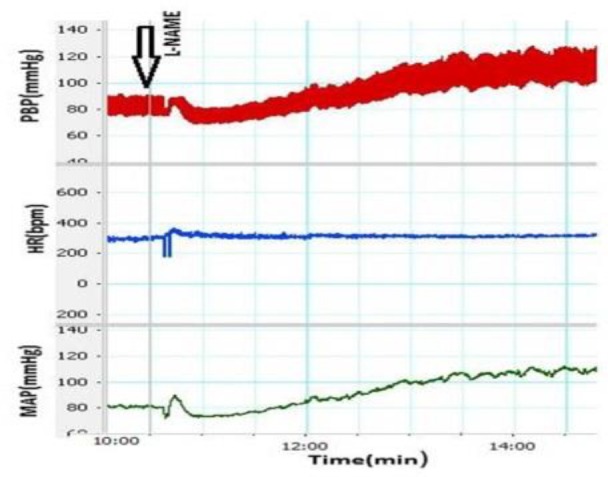
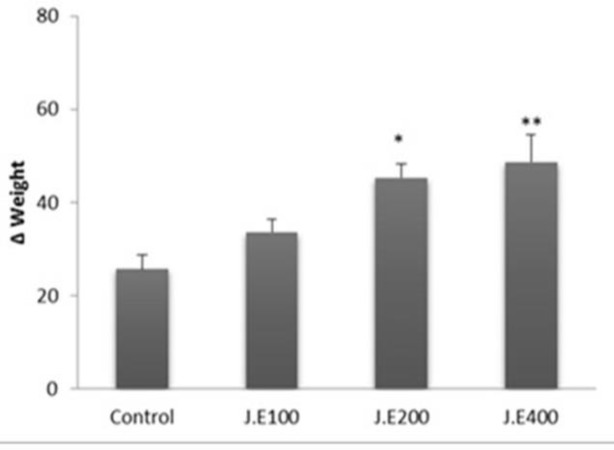
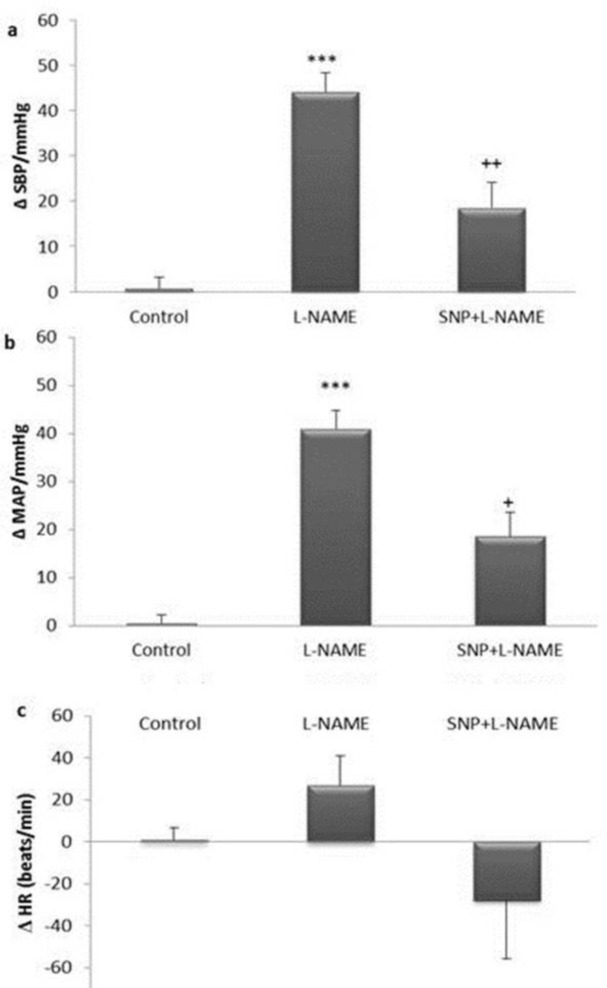
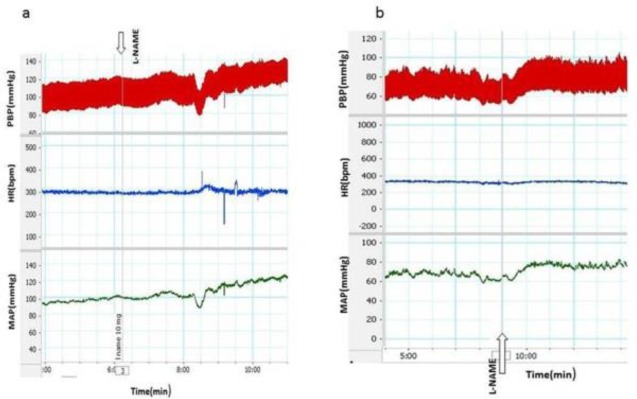
Rats were divided into 6 group (n=6): 1) saline, 2) L-NAME received (10mg/kg) intravenously, 3) sodium nitroprusside (SNP) (50µg/kg)+L-NAME group received SNP before L-NAME and 4-6) three groups of (100, 200 and 400mg/kg) that treated for four weeks and on the 28 day, L-NAME was injected. Femoral artery and vein were cannulated for recording cardiovascular responses and drug injection, respectively. Systolic blood pressure (SBP), Mean arterial pressure (MAP) and heart rate (HR) were recorded continuously. Maximal changes (∆) of SBP, MAP and HR were calculated and compared to control and L-NAME groups.
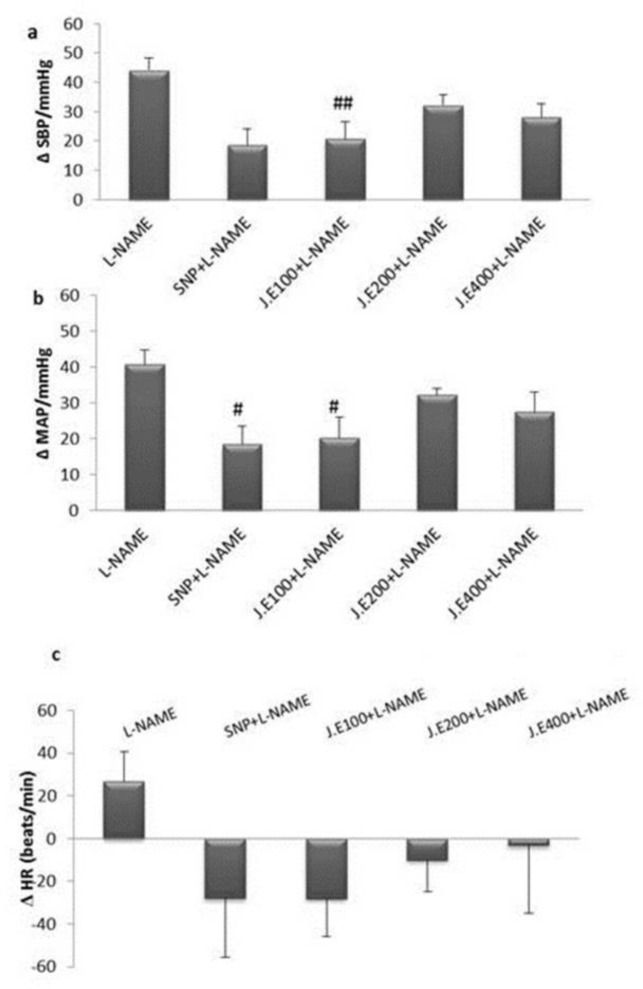
In L-NAME group, maximal ΔSBP (L-NAME: 44.15±4.0 mmHg vs control: 0.71±2.1 mmHg) and ΔMAP (L-NAME: 40.8±4.0 mmHg vs control: 0.57±1.6 mmHg) significantly increased (p<0.001 in both) but ∆HR was not significant as compared to control (p>0.05). All doses of attenuated maximal ∆SBP and ∆MAP induced by L-NAME but only the lowest dose (100 mg/kg) had significant effects (ΔSBP: 20.36±5.6 mmHg vs L-NAME: 44.1±4.0 mmHg and ΔMAP: 20.8±4.5 mmHg vs L-NAME: 40.8±3.8 mmHg (p<0.05 to p<0.01)). The ∆HR at three doses was not significantly different from that of L-NAME group (p>0.05).
Because long-term consumption of extract, especially its lowest dose, attenuated cardiovascular responses induced by L-NAME, we suggest that has potential beneficial effects in prevention of hypertension induced by NO deficiency.
刺激一氧化氮(NO)的释放。由于NO参与心血管调节,因此在本研究中评估了[提取物名称]水醇提取物对急性NG-硝基-L-精氨酸甲酯(L-NAME)高血压大鼠心血管反应的影响。
将大鼠分为6组(每组n = 6):1)生理盐水组;2)静脉注射L-NAME(10mg/kg)组;3)硝普钠(SNP)(50μg/kg)+L-NAME组,在注射L-NAME前注射SNP;4-6)[提取物名称]三组(100、200和400mg/kg),治疗四周,在第28天注射L-NAME。分别插入股动脉和股静脉用于记录心血管反应和注射药物。连续记录收缩压(SBP)、平均动脉压(MAP)和心率(HR)。计算SBP、MAP和HR的最大变化值(∆),并与对照组和L-NAME组进行比较。
在L-NAME组中,最大∆SBP(L-NAME组:44.15±4.0 mmHg,对照组:0.71±2.1 mmHg)和∆MAP(L-NAME组:40.8±4.0 mmHg,对照组:0.57±1.6 mmHg)显著升高(两者p均<0.001),但与对照组相比,∆HR无显著差异(p>0.05)。所有剂量的[提取物名称]均减弱了L-NAME诱导的最大∆SBP和∆MAP,但只有最低剂量(100mg/kg)有显著作用(∆SBP:20.36±5.6 mmHg,L-NAME组:44.1±4.0 mmHg;∆MAP:20.8±4.5 mmHg,L-NAME组:40.8±3.8 mmHg(p<0.05至p<0.01))。三个剂量组的∆HR与L-NAME组无显著差异(p>0.05)。
由于长期服用[提取物名称]提取物,尤其是其最低剂量,减弱了L-NAME诱导的心血管反应,我们认为[提取物名称]在预防NO缺乏诱导的高血压方面具有潜在的有益作用。