University of Tennessee-Oak Ridge National Laboratory Graduate School of Genome Science and Technology, University of Tennessee, Knoxville, TN 37996, USA.
National Science Foundation, 2415 Eisenhower Avenue, Alexandria, VA 22314, USA.
Sci Adv. 2018 Apr 4;4(4):eaas8667. doi: 10.1126/sciadv.aas8667. eCollection 2018 Apr.
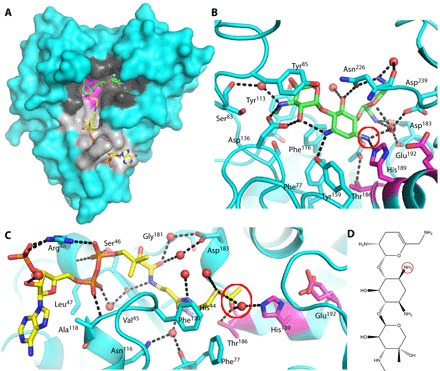
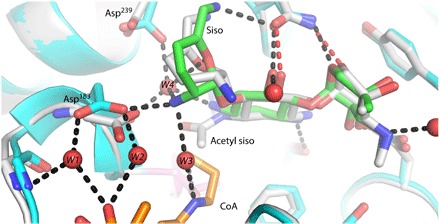
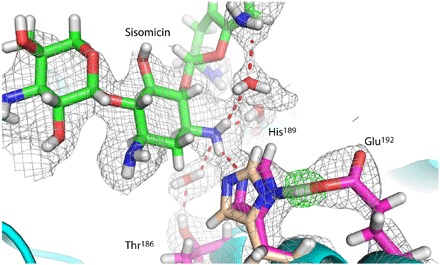
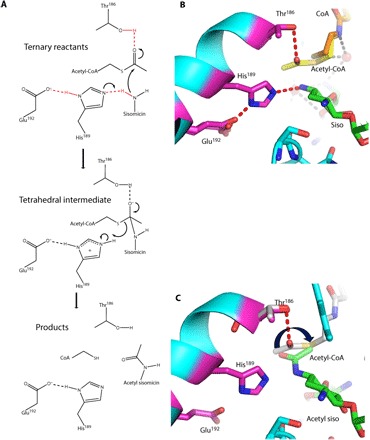
One group of enzymes that confer resistance to aminoglycoside antibiotics through covalent modification belongs to the GCN5-related -acetyltransferase (GNAT) superfamily. We show how a unique GNAT subfamily member uses a previously unidentified noncanonical catalytic triad, consisting of a glutamic acid, a histidine, and the antibiotic substrate itself, which acts as a nucleophile and attacks the acetyl donor molecule. Neutron diffraction studies allow for unambiguous identification of a low-barrier hydrogen bond, predicted in canonical catalytic triads to increase basicity of the histidine. This work highlights the role of this unique catalytic triad in mediating antibiotic resistance while providing new insights into the design of the next generation of aminoglycosides.
一组通过共价修饰赋予抗生素抗性的酶属于 GCN5 相关乙酰转移酶 (GNAT) 超家族。我们展示了一个独特的 GNAT 亚家族成员如何使用以前未被识别的非典型催化三联体,由谷氨酸、组氨酸和抗生素底物本身组成,作为亲核试剂攻击乙酰供体分子。中子衍射研究能够明确鉴定出一个低势垒氢键,在典型的催化三联体中预测该氢键会增加组氨酸的碱性。这项工作突出了这个独特的催化三联体在介导抗生素抗性中的作用,同时为设计下一代氨基糖苷类抗生素提供了新的见解。