Human Molecular Genetics Group, Bellvitge Biomedical Research Institute (IDIBELL), 08908 L'Hospitalet de Llobregat, Barcelona, Spain.
Laboratory of Seminology and Embryology, Andrology Service-Fundació Puigvert, 08025 Barcelona, Spain.
Hum Reprod. 2018 Jun 1;33(6):1087-1098. doi: 10.1093/humrep/dey072.
Are exosomal microRNAs (miRNAs) in seminal plasma (SP) useful as markers of the origin of azoospermia and the presence of sperm in the testis?
Our study demonstrated the potential of several miRNAs contained in small extracellular vesicles (sEVs) of seminal fluid as sensitive and specific biomarkers for selecting those azoospermic individuals with real chances of obtaining spermatozoa from the testicular biopsy.
There are no precise non-invasive diagnostic methods for classifying the origin of the sperm defects in semen and the spermatogenic reserve of the testis in those infertile men with a total absence of sperm in the ejaculate (azoospermia). The diagnosis of such individuals is often based on the practice of biopsies. In this context it is reasonable to study the presence of organ-specific markers in human semen that contains fluid from the testis and the male reproductive glands, which could help in the diagnosis and prognosis of male infertility. Additionally, seminal fluid contains high concentrations of sEVs that are morphologically and molecularly consistent with exosomes, which originate from multiple cellular sources in the male reproductive tract.
STUDY DESIGN, SIZE, DURATION: A case and control prospective study was performed. This study compares the miRNA content of exosomes in semen samples obtained from nine normozoospermic fertile individuals (control group), 14 infertile men diagnosed with azoospermia due to spermatogenic failure, and 13 individuals with obstructive azoospermia and conserved spermatogenesis. Additionally, three severe oligozoospermic individuals (<5 × 10⁶ sperm/ml) were included in the study.
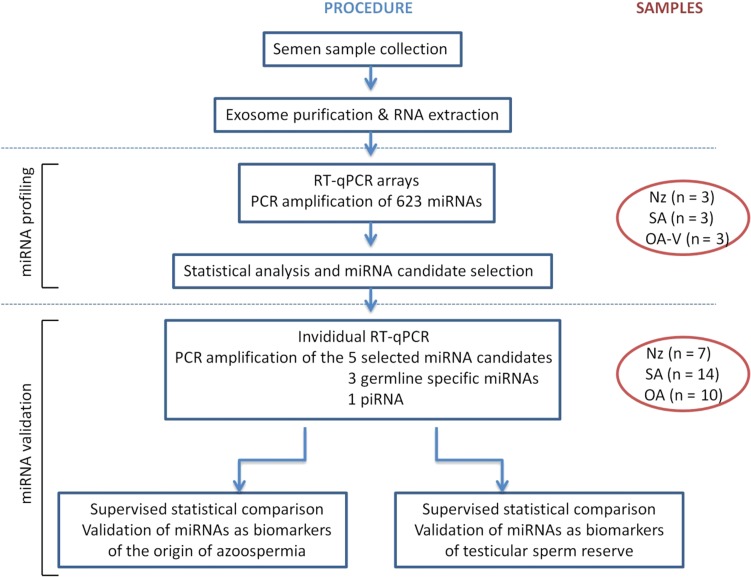
PARTICIPANTS/MATERIALS, SETTING, METHODS: A differential high-throughput miRNA profiling analysis using miRNA quantitative PCR panels was performed in SP exosomes from azoospermic patients and fertile individuals.
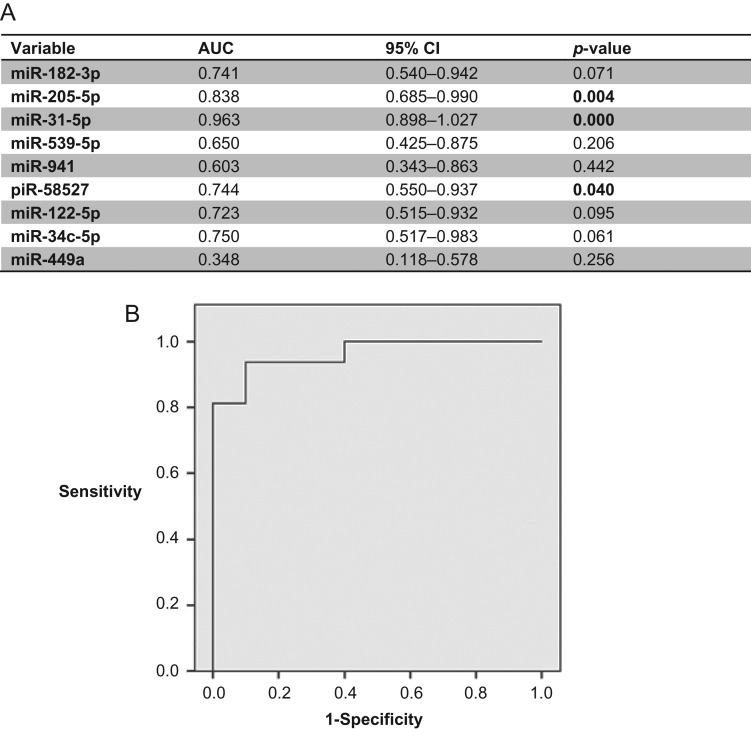
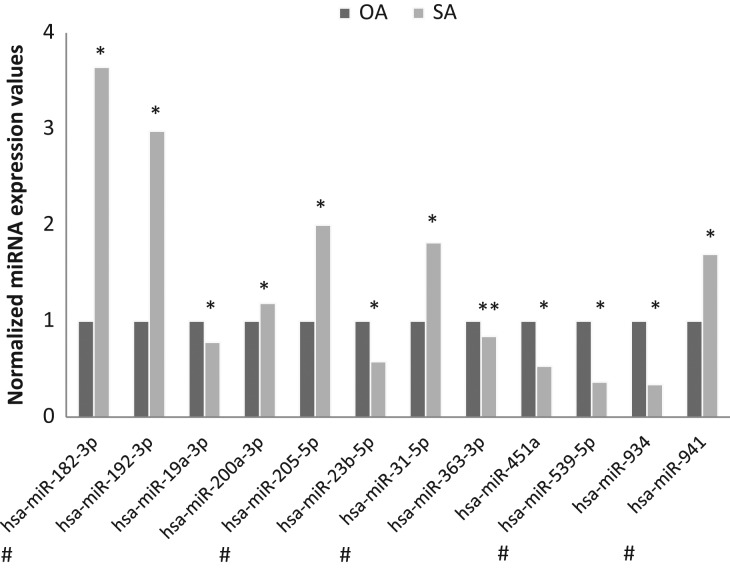
A total of 623 miRNAs were included in the miRNA profiling stage of the study. A total of 397 miRNAs (63.7%) were consistently detected in samples from all groups and statistically analysed, which revealed altered patterns of miRNA expression in infertile patients. We focused on the miRNAs that were differentially expressed between azoospermia as a result of an obstruction in the genital tract (i.e. having conserved spermatogenesis) and azoospermia caused by spermatogenic failure, and described, in a miRNA validation stage of the study, the expression values of one miRNA (miR-31-5p) in exosomes from semen as a predictive biomarker test for the origin of azoospermia with high sensitivity and specificity (>90%). The efficacy of the predictive test was even better when the blood FSH values were included in the analysis. Furthermore a model that included miR-539-5p and miR-941 expression values is also described as being useful for predicting the presence of residual spermatogenesis in individuals with severe spermatogenic disorders with diagnostic accuracy.
LIMITATIONS, REASONS FOR CAUTION: Further studies, with an independent second population involving a larger number of samples, are needed to confirm our findings.
Our findings contribute to the search for the most valuable genetic markers that are potentially useful as tools for predicting the presence of testicular sperm in azoospermic individuals.
STUDY FUNDING/COMPETING INTEREST(S): This work was financially supported by grants from the Fondo de Investigaciones Sanitarias/Fondo Europeo de Desarrollo Regional "Una manera de hacer Europa" (FIS/FEDER) [Grant number PI15/00153], the Generalitat de Catalunya [Grant number 2014SGR5412]. S.L. is sponsored by the Researchers Stabilization Program (ISCIII/Generalitat de Catalunya) from the Spanish National Health System [CES09/020].
精液中的外泌体 microRNAs(miRNAs)是否可作为无精子症和睾丸内精子存在的起源标志物?
我们的研究表明,精液中小细胞外囊泡(sEV)中包含的几种 miRNA 具有作为敏感和特异性生物标志物的潜力,可用于选择那些真正有机会从睾丸活检中获得精子的无精子症个体。
对于精液中精子缺陷的起源和睾丸生精储备的分类,尚无精确的非侵入性诊断方法,这些缺陷存在于那些精液中完全没有精子(无精子症)的不育男性中。此类个体的诊断通常基于活检的实践。在这种情况下,研究男性生殖液中存在器官特异性标志物是合理的,这些标志物可能有助于男性不育的诊断和预后。此外,精液中含有高浓度的 sEV,其形态和分子与起源于男性生殖道多个细胞来源的外泌体一致。
研究设计、规模、持续时间:进行了一项病例对照前瞻性研究。本研究比较了来自 9 名正常生育力的健康个体(对照组)、14 名因生精失败而被诊断为无精子症的不育男性和 13 名梗阻性无精子症和保留生精功能的个体的精液样本中外泌体中的 miRNA 含量。此外,还纳入了 3 名严重少精子症个体(<5×10⁶ 精子/ml)。
参与者/材料、设置、方法:使用 miRNA 定量 PCR 面板进行了外泌体 miRNA 的高通量差异表达谱分析。在研究的 miRNA 分析阶段,共包括 623 个 miRNA。在所有组的样本中均检测到 397 个 miRNA(63.7%),并进行了统计学分析,揭示了不育患者中 miRNA 表达模式的改变。我们专注于在生殖道阻塞(即保留生精功能)和生精失败导致的无精子症之间差异表达的 miRNA,并在 miRNA 验证阶段描述了精液中 exosomes 中一个 miRNA(miR-31-5p)的表达值作为具有高灵敏度和特异性(>90%)的无精子症起源的预测生物标志物检测。当将血液 FSH 值纳入分析时,预测测试的效果甚至更好。此外,还描述了一个包含 miR-539-5p 和 miR-941 表达值的模型,该模型也可用于预测严重生精障碍个体中残留生精功能的存在,具有诊断准确性。
局限性、谨慎的理由:需要进一步的研究,包括具有更大样本量的独立第二人群,以证实我们的发现。
我们的发现有助于寻找最有价值的遗传标志物,这些标志物可能作为预测无精子症个体睾丸内精子存在的有用工具。
研究资金/利益冲突:这项工作得到了西班牙 Fondo de Investigaciones Sanitarias/Fondo Europeo de Desarrollo Regional "Una manera de hacer Europa"(FIS/FEDER)[资助号 PI15/00153]和加泰罗尼亚政府[资助号 2014SGR5412]的资助。S.L. 得到了西班牙国家卫生系统(ISCIII/Generalitat de Catalunya)的研究人员稳定计划的支持[CES09/020]。