Nordic Bioscience, Herlev Hovedgade 205-207, 2730, Herlev, Denmark.
Division of Molecular Medicine and Gene Therapy, Lund Strategic Center for Stem Cell Biology, Lund, Sweden.
Arthritis Res Ther. 2018 Apr 10;20(1):67. doi: 10.1186/s13075-018-1564-5.
Osteoclasts have been strongly implicated in osteoarthritic cartilage degradation, at least indirectly via bone resorption, and have been shown to degrade cartilage in vitro. The osteoclast resorption processes required to degrade subchondral bone and cartilage-the remodeling of which is important in the osteoarthritic disease process-have not been previously described, although cathepsin K has been indicated to participate. In this study we profile osteoclast-mediated degradation of bovine knee joint compartments in a novel in vitro model using biomarkers of extracellular matrix (ECM) degradation to assess the potential of osteoclast-derived resorption processes to degrade different knee joint compartments.
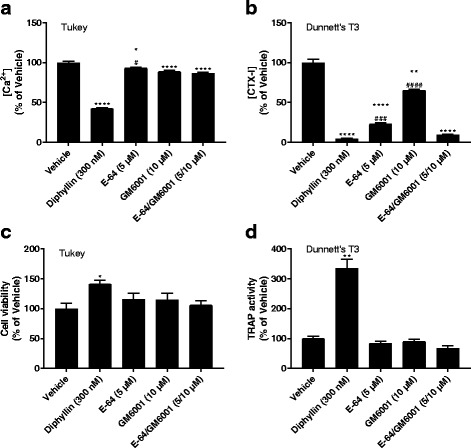
Mature human osteoclasts were cultured on ECMs isolated from bovine knees-articular cartilage, cortical bone, and osteochondral junction ECM (a subchondral bone-calcified cartilage mixture)-in the presence of inhibitors: the cystein protease inhibitor E-64, the matrix metalloproteinase (MMP) inhibitor GM6001, or the vacuolar-type H-ATPase (V-ATPase) inhibitor diphyllin. Biomarkers of bone (calcium and C-terminal type I collagen (CTX-I)) and cartilage (C2M) degradation were measured in the culture supernatants. Cultures without osteoclasts were used as background samples. Background-subtracted biomarker levels were normalized to the vehicle condition and were analyzed using analysis of variance with Tukey or Dunnett's T3 post hoc test, as applicable.
Osteochondral CTX-I release was inhibited by E-64 (19% of vehicle, p = 0.0008), GM6001 (51% of vehicle, p = 0.013), and E-64/GM6001 combined (4% of vehicle, p = 0.0007)-similarly to bone CTX-I release. Diphyllin also inhibited osteochondral CTX-I release (48% of vehicle, p = 0.014), albeit less than on bone (4% of vehicle, p < 0.0001). Osteochondral C2M release was only inhibited by E-64 (49% of vehicle, p = 0.07) and GM6001 (14% of vehicle, p = 0.006), with complete abrogation when combined (0% of vehicle, p = 0.004). Cartilage C2M release was non-significantly inhibited by E-64 (69% of vehicle, p = 0.98) and was completely abrogated by GM6001 (0% of vehicle, p = 0.16).
Our study supports that osteoclasts can resorb non-calcified and calcified cartilage independently of acidification. We demonstrated both MMP-mediated and cysteine protease-mediated resorption of calcified cartilage. Osteoclast functionality was highly dependent on the resorbed substrate, as different ECMs required different osteoclast processes for degradation. Our novel culture system has potential to facilitate drug and biomarker development aimed at rheumatic diseases, e.g. osteoarthritis, where pathological osteoclast processes in specific joint compartments may contribute to the disease process.

破骨细胞在骨关节炎软骨降解中起着重要作用,至少通过骨吸收间接地起作用,并且已被证明在体外降解软骨。降解软骨下骨和软骨所需的破骨细胞吸收过程——其重塑对于骨关节炎疾病过程很重要——以前没有被描述过,尽管已表明组织蛋白酶 K 参与其中。在本研究中,我们在一种新的体外模型中使用细胞外基质 (ECM) 降解的生物标志物来描述成骨细胞介导的牛膝关节隔室的降解,以评估成骨细胞衍生的吸收过程降解不同膝关节隔室的潜力。
在存在抑制剂的情况下,将成熟的人破骨细胞培养在从牛膝关节分离的 ECM 上 - 关节软骨、皮质骨和骨软骨连接 ECM(软骨下骨-钙化软骨混合物)- 抑制剂为半胱氨酸蛋白酶抑制剂 E-64、基质金属蛋白酶 (MMP) 抑制剂 GM6001 或液泡型 H+-ATP 酶 (V-ATPase) 抑制剂二苯并庚嗪。在培养上清液中测量骨(钙和 C 末端 I 型胶原 (CTX-I))和软骨(C2M)降解的生物标志物。没有成骨细胞的培养物用作背景样本。使用方差分析和 Tukey 或 Dunnett 的 T3 事后检验(适用),将背景减去的生物标志物水平标准化为载体条件。
E-64(车辆的 19%,p=0.0008)、GM6001(车辆的 51%,p=0.013)和 E-64/GM6001 联合(车辆的 4%,p=0.0007)抑制了软骨下骨 CTX-I 的释放,与骨 CTX-I 释放相似。二苯并庚嗪也抑制了软骨下骨 CTX-I 的释放(车辆的 48%,p=0.014),尽管低于骨(车辆的 4%,p<0.0001)。软骨下 C2M 的释放仅被 E-64(车辆的 49%,p=0.07)和 GM6001(车辆的 14%,p=0.006)抑制,当联合使用时完全被阻断(车辆的 0%,p=0.004)。软骨 C2M 的释放不受 E-64(车辆的 69%,p=0.98)的显著抑制,并且完全被 GM6001 阻断(车辆的 0%,p=0.16)。
我们的研究支持破骨细胞可以独立于酸化来吸收未钙化和钙化的软骨。我们证明了 MMP 介导的和半胱氨酸蛋白酶介导的钙化软骨吸收。成骨细胞的功能高度依赖于被吸收的基质,因为不同的 ECM 需要不同的成骨细胞过程来降解。我们的新型培养系统有可能促进针对风湿性疾病(例如骨关节炎)的药物和生物标志物的开发,其中特定关节隔室中的病理性成骨细胞过程可能会导致疾病过程。