Kyokunzire Catherine, Matovu Nicholas, Mayega Roy William
Department of Community Health and Behavioural Sciences, School of Public Health, College of Health Sciences, Makerere University, Kampala, Uganda.
Department of Community Health, Division of Noncommunicable Diseases, Ministry of Health - Uganda, Kampala, Uganda.
Diabetes Metab Syndr Obes. 2018 Mar 29;11:93-104. doi: 10.2147/DMSO.S156858. eCollection 2018.
The purpose of this study was to determine the level of adherence and the factors associated with adherence to diabetes care recommendations among type 1 diabetic children and adolescents at two urban diabetes clinics in Kampala, Uganda.
A facility-based cross-sectional study was carried out among 200 children and adolescents with type 1 diabetes at two major diabetes clinics in Kampala. Caretakers of the children and adolescents were interviewed using pretested questionnaires to provide information on sociodemographic characteristics, diabetes care, knowledge, attitudes, and adherence to diabetes care recommendations in type 1 diabetes. Prevalence rate ratios (PRRs) at the 95% confidence interval (CI) were used to establish the factors associated with adherence using modified Poisson regression, with robust standard errors. The data were analyzed by using STATA Version 13.0.
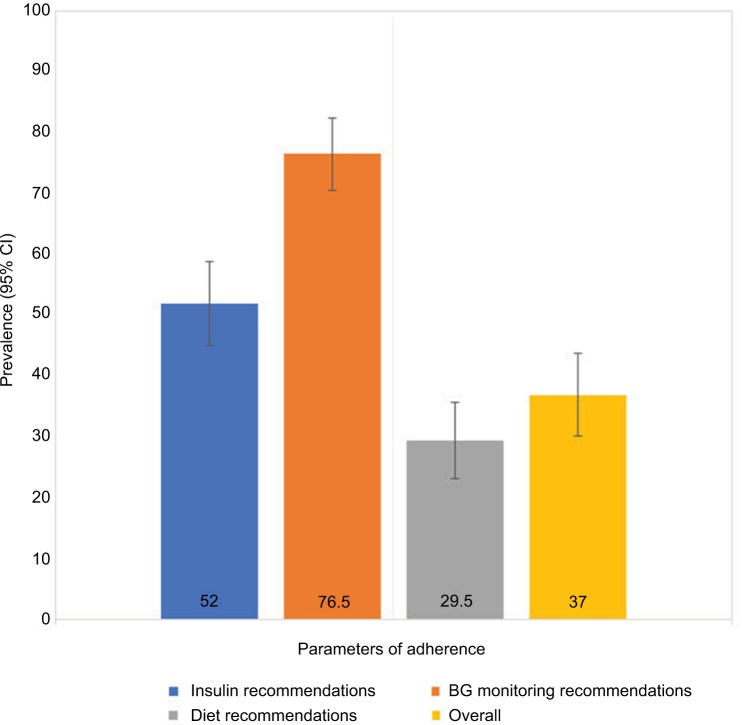
The overall prevalence of adherence to diabetes care recommendations was at 37%. However, evaluating adherence to specific treatment parameters showed that 52%, 76.5%, and 29.5% of the children and adolescents adhered to insulin, blood glucose monitoring, and dietary recommendations, respectively. In the final adjusted model, active diet monitoring (adjusted PRR [APRR]: 1.95; 95% CI: 1.01, 3.78), being under care of a sibling (APRR: 1.66; 95% CI: 1.61, 1.71), being under care of a married caretaker (APRR: 1.10; 95% CI: 1.05, 1.14) and a separated or divorced caretaker (APRR: 1.60; 95% CI: 1.12, 2.27), taking three or less tests of blood glucose per day (APRR: 0.63; 95% CI: 0.42, 0.95), and having a caretaker with poor knowledge about diabetes (APRR: 0.49; 95% CI: 0.43, 0.57) and who is inactive in supervision of insulin injections (APRR: 0.58; 95% CI: 0.56, 0.60) were associated with adherence to type 1 diabetes care recommendations.
Adherence to type 1 diabetes care recommendations is still low among this population. The results suggest that reinforcing caretaker involvement could be vital in improving adherence to diabetes care recommendations in this population.
本研究旨在确定乌干达坎帕拉两家城市糖尿病诊所中1型糖尿病儿童和青少年对糖尿病护理建议的依从水平及其相关因素。
在坎帕拉的两家主要糖尿病诊所对200名1型糖尿病儿童和青少年进行了一项基于机构的横断面研究。使用预先测试的问卷对儿童和青少年的照顾者进行访谈,以提供有关社会人口学特征、糖尿病护理、知识、态度以及对1型糖尿病护理建议的依从性的信息。采用修正的泊松回归模型,以稳健标准误计算95%置信区间(CI)的患病率比(PRR),以确定与依从性相关的因素。数据使用STATA 13.0版本进行分析。
对糖尿病护理建议的总体依从率为37%。然而,对具体治疗参数的依从性评估显示,分别有52%、76.5%和29.5%的儿童和青少年依从胰岛素治疗、血糖监测和饮食建议。在最终调整模型中,积极的饮食监测(调整后PRR [APRR]:1.95;95% CI:1.01,3.78)、由兄弟姐妹照顾(APRR:1.66;95% CI:1.61,1.71)、由已婚照顾者照顾(APRR:1.10;95% CI:1.05,1.14)以及由分居或离婚照顾者照顾(APRR:1.60;95% CI:1.12,2.27)、每天进行三次或更少的血糖检测(APRR:0.63;95% CI:0.42,0.95),以及照顾者对糖尿病知识了解不足(APRR:0.49;95% CI:0.43,0.57)且对胰岛素注射监督不积极(APRR:0.58;95% CI:0.56,0.60)与对1型糖尿病护理建议的依从性相关。
该人群对1型糖尿病护理建议的依从性仍然较低。结果表明,加强照顾者的参与对于提高该人群对糖尿病护理建议的依从性可能至关重要。