Haertner Linda, Elshehabi Morad, Zaunbrecher Laura, Pham Minh H, Maetzler Corina, van Uem Janet M T, Hobert Markus A, Hucker Svenja, Nussbaum Susanne, Berg Daniela, Liepelt-Scarfone Inga, Maetzler Walter
Center for Neurology and Hertie-Institute for Clinical Brain Research, Department of Neurodegeneration, University of Tübingen, Tübingen, Germany.
German Center for Neurodegenerative Diseases, Tübingen, Germany.
Front Aging Neurosci. 2018 Mar 27;10:78. doi: 10.3389/fnagi.2018.00078. eCollection 2018.
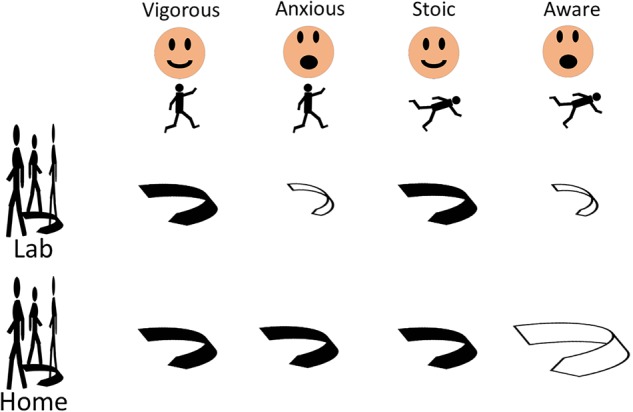
Parkinson's disease (PD) is a neurodegenerative movement disorder associated with gait and balance problems and a substantially increased risk of falling. Falls occur often during complex movements, such as turns. Both fear of falling (FOF) and previous falls are relevant risk factors for future falls. Based on recent studies indicating that lab-based and home assessment of similar movements show different results, we hypothesized that FOF and a positive fall history would influence the quantitative turning parameters differently in the laboratory and home. Fifty-five PD patients (43 underwent a standardized lab assessment; 40 were assessed over a mean of 12 days at home with approximately 10,000 turns per participant; and 28 contributed to both assessments) were classified regarding FOF and previous falls as "vigorous" (no FOF, negative fall history), "anxious" (FOF, negative fall history), "stoic" (no FOF, positive fall history) and "aware" (FOF, positive fall history). During the assessments, each participant wore a sensor on the lower back. In the lab assessment, FOF was associated with a longer turning duration and lowered maximum and middle angular velocities of turns. In the home evaluations, a of FOF was associated with lowered maximum and average angular velocities of turns. Positive falls history was not significantly associated with turning parameters, neither in the lab nor in the home. FOF but not a positive fall history influences turning metrics in PD patients in both supervised and unsupervised environments, and this association is different between lab and home assessments. Our findings underline the relevance of comprehensive assessments including home-based data collection strategies for fall risk evaluation.
帕金森病(PD)是一种神经退行性运动障碍,与步态和平衡问题相关,且跌倒风险大幅增加。跌倒常发生在诸如转弯等复杂动作过程中。害怕跌倒(FOF)和既往跌倒史都是未来跌倒的相关风险因素。基于近期研究表明,在实验室和家中对类似动作的评估结果不同,我们推测FOF和阳性跌倒史在实验室和家中对定量转弯参数的影响会有所不同。55名帕金森病患者(43名接受了标准化实验室评估;40名在家中平均接受了12天的评估,每位参与者约有10,000次转弯;28名参与了两项评估)根据FOF和既往跌倒史被分为“活力型”(无FOF,阴性跌倒史)、“焦虑型”(FOF,阴性跌倒史)、“坚忍型”(无FOF,阳性跌倒史)和“警觉型”(FOF,阳性跌倒史)。在评估过程中,每位参与者在下背部佩戴一个传感器。在实验室评估中,FOF与转弯持续时间延长以及转弯的最大和中间角速度降低相关。在家中评估中,FOF与转弯的最大和平均角速度降低相关。阳性跌倒史在实验室和家中与转弯参数均无显著关联。在有监督和无监督环境中,FOF而非阳性跌倒史会影响帕金森病患者的转弯指标,且这种关联在实验室和家中评估之间有所不同。我们的研究结果强调了包括基于家庭的数据收集策略在内的全面评估对于跌倒风险评估的相关性。