Hudson Lee, Kinra Sanjay, Wong Ian, Cole Tim J, Deanfield John, Viner Russell
UCL Great Ormond Street Institute of Child Health, London, UK.
London School of Hygiene and Tropical Medicine, London, UK.
BMJ Paediatr Open. 2017 Aug 11;1(1):e000061. doi: 10.1136/bmjpo-2017-000061. eCollection 2017.
Cardiovascular disease (CVD) prediction is problematic within groups of obese adolescents as measures such as adiposity and metabolic markers lack validation. Pulse wave velocity (PWV), a proxy for arterial stiffening, is a potential way to contemporaneously capture adolescents at greater risk of CVD.
To investigate associations between PWV and 1) adiposity and 2) other conventional metabolic factors in a community sample of (>95th centile body mass index (BMI)).
Cross-sectional measurement and analysis in a hospital-based research centre drawn from a community sample of adolescents recruited to an obesity intervention at baseline.
174 adolescents (12-19 years) with obesity (>95th centile BMI). 37% were male, while 66 (38%) were white, 53 (30%) black, 36 (21%) South Asian, 19 (11%) mixed/other. Participants with endocrine, genetic causes of obesity and chronic medical conditions (excluding asthma) were excluded.
BMI z-score (zBMI), waist z-score, fat mass index (FMI: measured using bioimpedance), sagittal abdominal dimension (SAD), cardiometabolic blood tests and resting blood pressure (BP) were collected. Carotid-radial PWV was measured by a single operator.
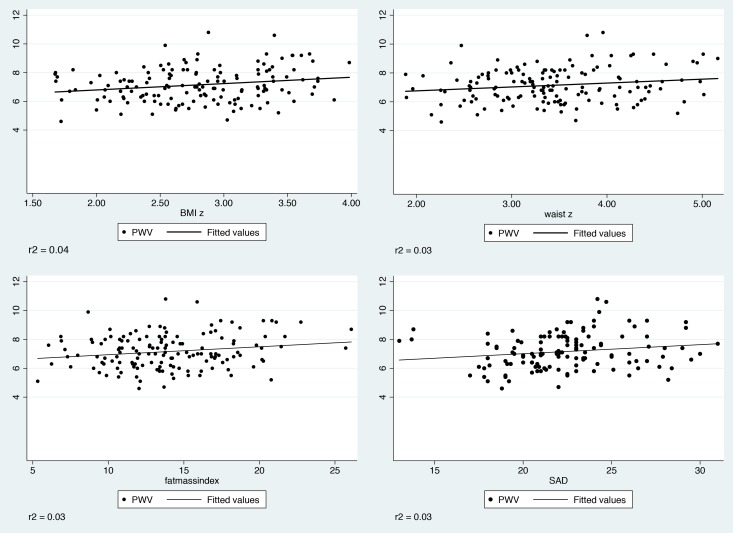
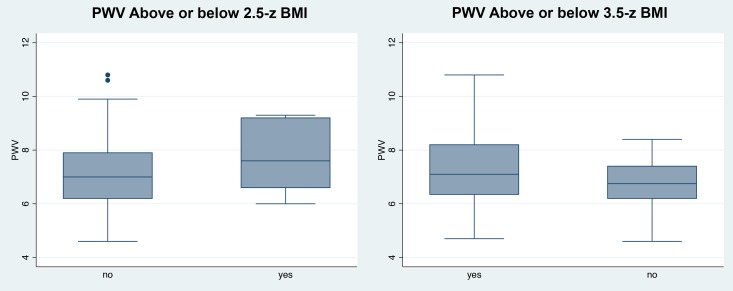
PWV was associated with age but not pubertal stage. PWV was positively associated with adiposity (zBMI: coefficient 0.44 (95% CI 0.08 to 0.79); FMI: coefficient 0.05 (95% CI 0.00 to 0.10); waist z-score: coefficient 0.27 (95% CI 0.00 to 0.53); SAD: coefficient 0.06 (95% CI: 0.00 to 0.12)). There was no association between PWV and BP, and few associations with cardiometabolic bloods. Associations between PWV and adiposity measures were robust to adjustment in multivariable models except for SAD. Participants with zBMI >2.5 SD and >3.5 SD had greater average PWV but overlap between groups was large.
In our sample, increasing adiposity was positively associated with arterial stiffness, however partitioning by severity was not reliable. Lack of associations between BP, cardiometabolic bloods and arterial stiffness questions the reliability of these factors for predicting CVD risk in adolescents with obesity.
在肥胖青少年群体中,心血管疾病(CVD)预测存在问题,因为诸如肥胖度和代谢标志物等指标缺乏有效性验证。脉搏波速度(PWV)是动脉僵硬度的一个替代指标,是一种同时捕捉CVD风险较高青少年的潜在方法。
在一个社区样本(体重指数(BMI)>第95百分位数)中,研究PWV与1)肥胖度和2)其他传统代谢因素之间的关联。
在一个基于医院的研究中心进行横断面测量和分析,该研究中心的样本来自于基线时招募到肥胖干预项目的青少年社区样本。
174名肥胖青少年(12 - 19岁,BMI>第95百分位数)。37%为男性,66名(38%)为白人,53名(30%)为黑人,36名(21%)为南亚人,19名(11%)为混合/其他种族。排除患有内分泌、遗传原因导致的肥胖以及慢性疾病(不包括哮喘)的参与者。
收集BMI z评分(zBMI)、腰围z评分、脂肪量指数(FMI:使用生物电阻抗测量)、腹部矢状径(SAD)、心脏代谢血液检测结果和静息血压(BP)。由一名操作人员测量颈动脉 - 桡动脉PWV。
PWV与年龄相关,但与青春期阶段无关。PWV与肥胖度呈正相关(zBMI:系数0.44(95%可信区间0.08至0.79);FMI:系数0.05(95%可信区间0.00至0.10);腰围z评分:系数0.27(95%可信区间0.00至0.53);SAD:系数0.06(95%可信区间:0.00至0.12))。PWV与BP之间无关联,与心脏代谢血液指标的关联也较少。除SAD外,在多变量模型中,PWV与肥胖度指标之间的关联在调整后仍然显著。zBMI>2.5标准差和>3.5标准差的参与者平均PWV更高,但两组之间的重叠较大。
在我们的样本中,肥胖度增加与动脉僵硬度呈正相关,然而按严重程度进行划分并不可靠。BP、心脏代谢血液指标与动脉僵硬度之间缺乏关联,这质疑了这些因素在预测肥胖青少年CVD风险方面的可靠性。