Li Jin-Ling, Li Ge, Jing Xi-Zhong, Li Yun-Feng, Ye Qiu-Ying, Jia Huan-Huan, Liu Shu-Hua, Li Xue-Jiao, Li Hang, Huang Ren, Zhang Yu, Wang Hui
1 School of Traditional Chinese Medicine, Guangdong Pharmaceutical University, Guangzhou, Guangdong province, China.
2 Guangdong Laboratory Animals Monitoring Institute, Guangdong Provincial Key Laboratory of Laboratory Animals, Guangzhou, Guangdong province, China.
J Int Med Res. 2018 Jun;46(6):2410-2422. doi: 10.1177/0300060518764717. Epub 2018 Apr 12.
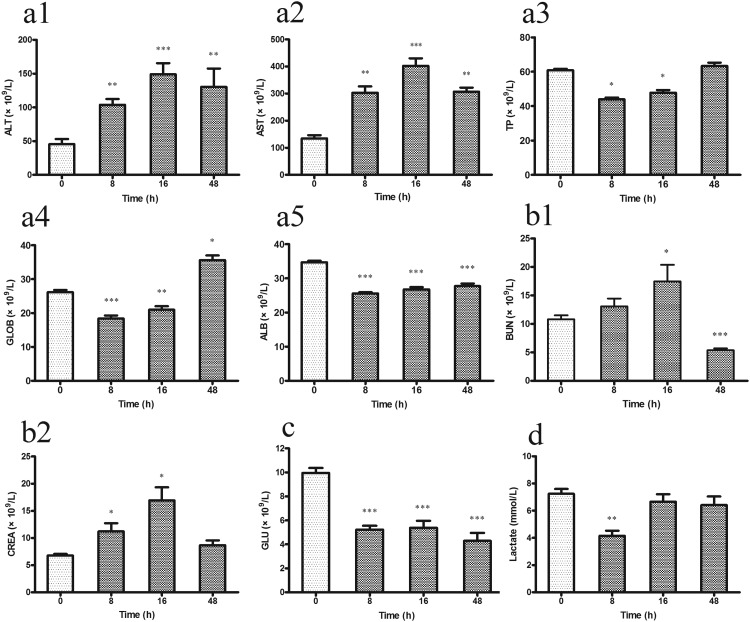
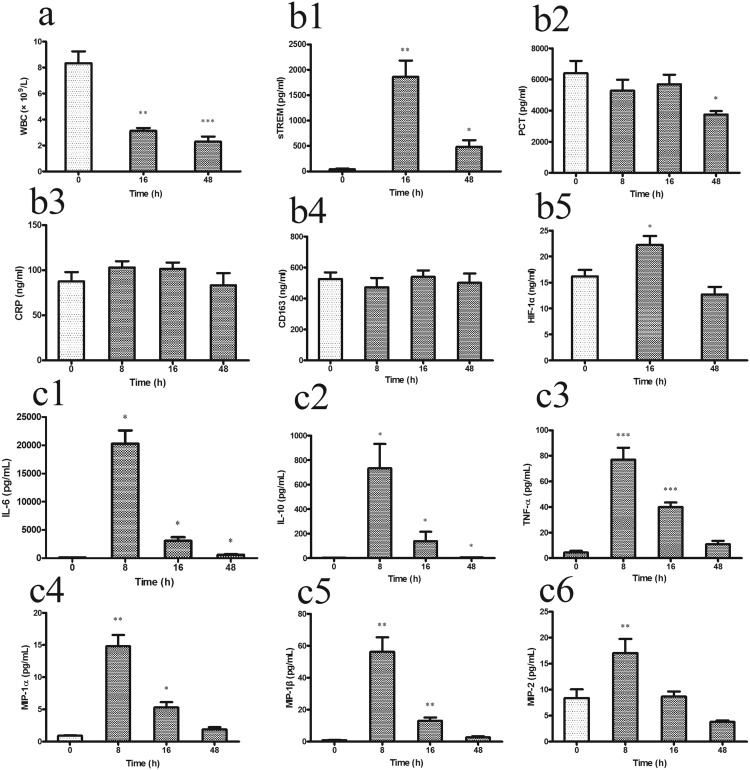
Objective Clinical sepsis-associated biomarkers were utilized in a cecal ligation and puncture (CLP) septic mouse model to provide a reference for investigating pathophysiological mechanisms and evaluating novel therapeutic interventions for sepsis. Methods Sepsis in mice was induced by CLP, and clinical biomarkers were evaluated (survival rate, blood physiological and biochemical indices, cytokines, hepatorenal function parameters, and blood coagulation). Results The mortality rate was >70%. The body temperature, blood pressure, and heart rate decreased within 48 h. Low lactic acid was found at 8 h. The CLP mice showed typical inflammatory symptoms with decreased white blood cells and procalcitonin and increased levels of soluble triggering receptor expressed on myeloid cells-1, interleukin (IL)-6, IL-10, tumor necrosis factor-α, macrophage inflammatory protein (MIP)-1α, MIP-1β, and MIP-2. The platelet count and activated partial thromboplastin time significantly decreased, and the prothrombin time and prothrombin time-international normalized ratio markedly increased. Phenotypes of multiple organ dysfunction were found in the CLP model, including increased liver alanine aminotransferase and aspartate transaminase; significantly reduced total protein, globulin, and serum albumin; increased blood urea nitrogen and creatinine; and decreased blood glucose. Conclusion The clinical features of the CLP mouse model were similar to those of human patients with sepsis.
利用临床脓毒症相关生物标志物,在盲肠结扎穿孔(CLP)脓毒症小鼠模型中,为研究脓毒症的病理生理机制和评估新型治疗干预措施提供参考。方法:通过CLP诱导小鼠发生脓毒症,并评估临床生物标志物(生存率、血液生理生化指标、细胞因子、肝肾功能参数和凝血功能)。结果:死亡率>70%。48小时内体温、血压和心率下降。8小时时发现乳酸水平降低。CLP小鼠表现出典型的炎症症状,白细胞和降钙素原减少,髓系细胞表达的可溶性触发受体-1、白细胞介素(IL)-6、IL-10、肿瘤坏死因子-α、巨噬细胞炎性蛋白(MIP)-1α、MIP-1β和MIP-2水平升高。血小板计数和活化部分凝血活酶时间显著降低,凝血酶原时间和凝血酶原时间国际标准化比值明显升高。CLP模型中发现多器官功能障碍的表型,包括肝丙氨酸氨基转移酶和天冬氨酸氨基转移酶升高;总蛋白、球蛋白和血清白蛋白显著降低;血尿素氮和肌酐升高;血糖降低。结论:CLP小鼠模型的临床特征与脓毒症人类患者相似。