Photonics Group, Department of Physics, Imperial College London, London, United Kingdom.
The Medical Research Council Cancer Cell Unit, Hutchison/MRC Research Centre, Cambridge, United Kingdom.
PLoS Biol. 2018 Apr 12;16(4):e2003998. doi: 10.1371/journal.pbio.2003998. eCollection 2018 Apr.
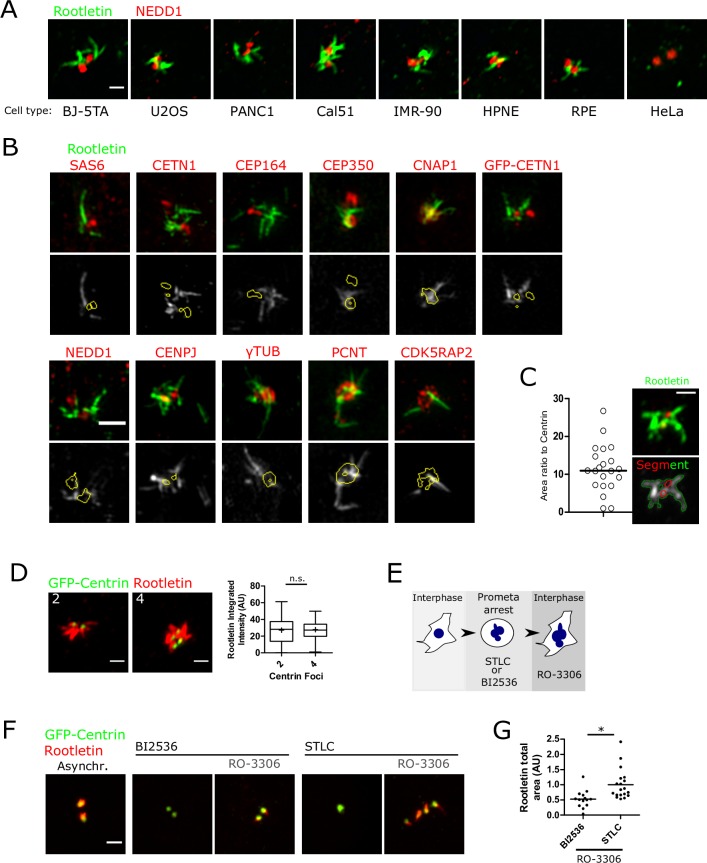
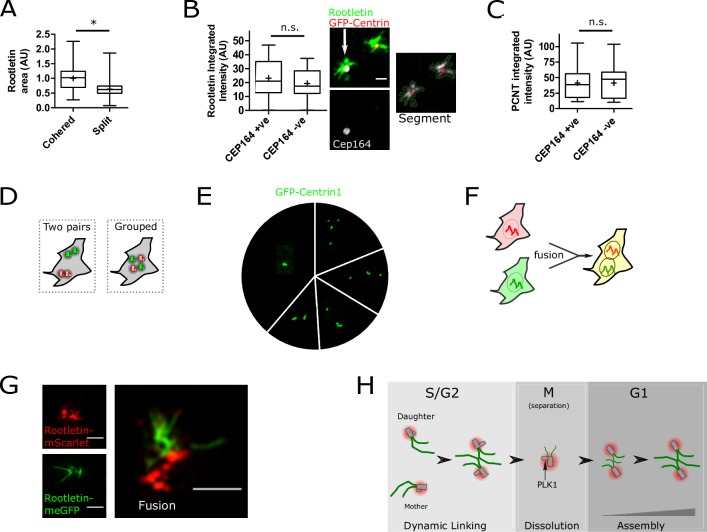
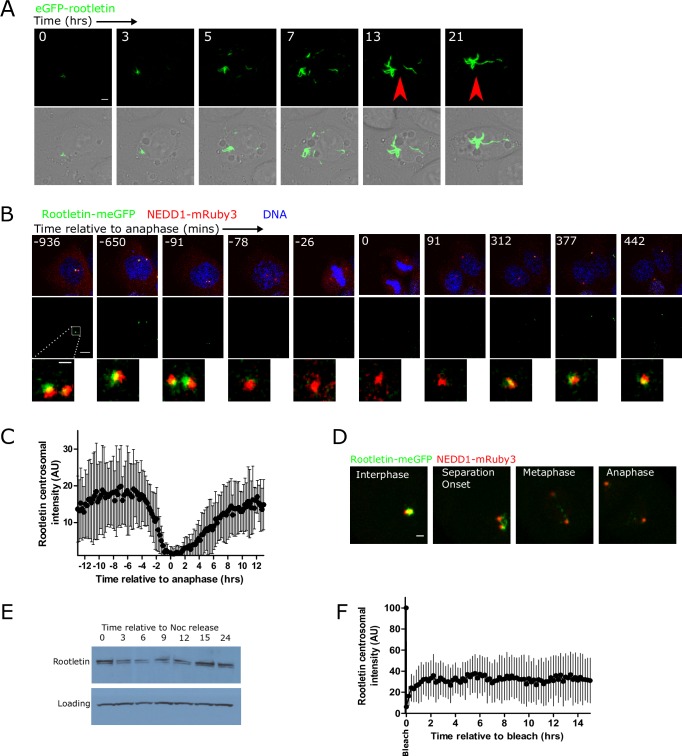
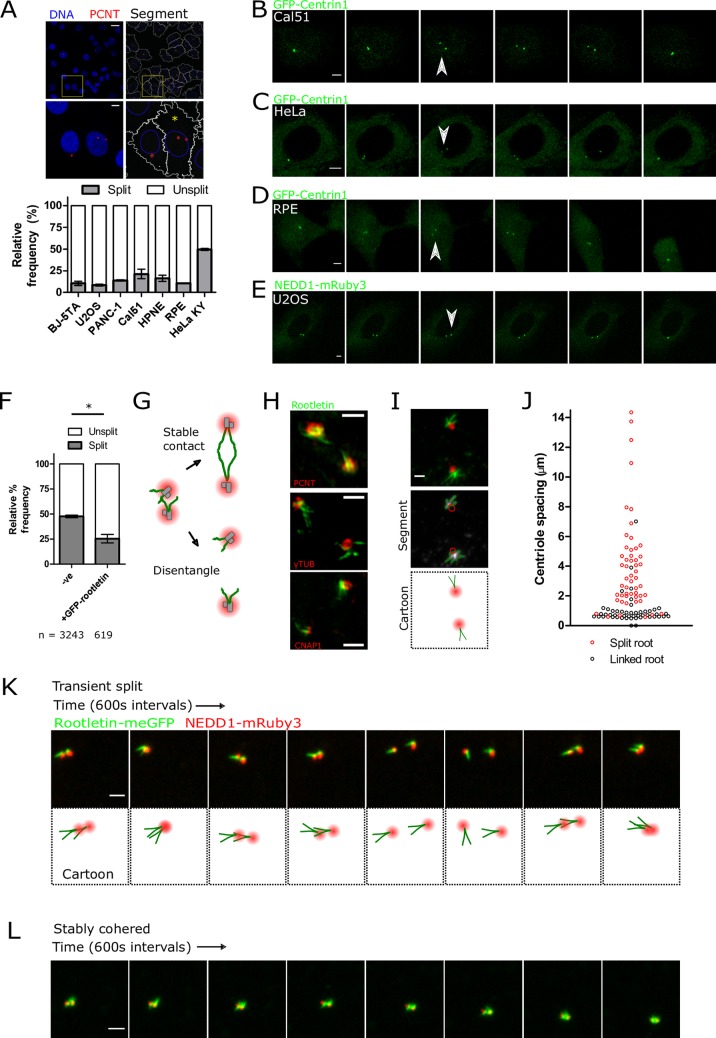
The centrosome is a non-membrane-bound cellular compartment consisting of 2 centrioles surrounded by a protein coat termed the pericentriolar material (PCM). Centrioles generally remain physically associated together (a phenomenon called centrosome cohesion), yet how this occurs in the absence of a bounding lipid membrane is unclear. One model posits that pericentriolar fibres formed from rootletin protein directly link centrioles, yet little is known about the structure, biophysical properties, or assembly kinetics of such fibres. Here, I combine live-cell imaging of endogenously tagged rootletin with cell fusion and find previously unrecognised plasticity in centrosome cohesion. Rootletin forms large, diffusionally stable bifurcating fibres, which amass slowly on mature centrioles over many hours from anaphase. Nascent centrioles (procentrioles), in contrast, do not form roots and must be licensed to do so through polo-like kinase 1 (PLK1) activity. Transient separation of roots accompanies centriolar repositioning during the interphase, suggesting that centrioles organize as independent units, each containing discrete roots. Indeed, forced induction of duplicate centriole pairs allows independent reshuffling of individual centrioles between the pairs. Therefore collectively, these findings suggest that progressively nucleated polymers mediate the dynamic association of centrioles as either 1 or 2 interphase centrosomes, with implications for the understanding of how non-membrane-bound organelles self-organise.
中心体是一个无膜结合的细胞区室,由两个中心粒组成,周围环绕着一种称为中心粒周围物质(PCM)的蛋白质外壳。中心粒通常保持物理上的相互关联(一种称为中心体凝聚的现象),但在没有边界脂质膜的情况下,这种情况是如何发生的尚不清楚。一种模型假设,由根蛋白形成的中心粒周围纤维直接连接中心粒,但对于这些纤维的结构、生物物理特性或组装动力学知之甚少。在这里,我将内源性标记的根蛋白的活细胞成像与细胞融合结合起来,发现了以前未被识别的中心体凝聚的可塑性。根蛋白形成大的、扩散稳定的分叉纤维,这些纤维在有丝分裂后期从几个小时缓慢地积累在成熟的中心粒上。相比之下,新生的中心粒(前中心粒)不会形成根,必须通过 polo 样激酶 1(PLK1)的活性来获得许可。根的短暂分离伴随着有丝分裂期间中心粒的重新定位,这表明中心粒作为独立的单位组织起来,每个中心粒都包含离散的根。事实上,强迫诱导重复的中心粒对允许单个中心粒在对之间独立地重新排列。因此,总的来说,这些发现表明,逐渐核化的聚合物介导了中心粒的动态关联,作为 1 个或 2 个间期中的中心体,这对理解非膜结合细胞器如何自我组织具有重要意义。