Department of Biology, Stanford University, E200 Clark Center, 318 Campus Drive, Stanford, CA 94305, USA; Department of Microbiology and Immunology, University of California, San Francisco, 600 16th Street, GH-S572, UCSF Box 2280, San Francisco, CA 94143-2280, USA.
Department of Microbiology and Immunology, University of California, San Francisco, 600 16th Street, GH-S572, UCSF Box 2280, San Francisco, CA 94143-2280, USA.
Cell Host Microbe. 2018 Apr 11;23(4):435-446. doi: 10.1016/j.chom.2018.03.012.
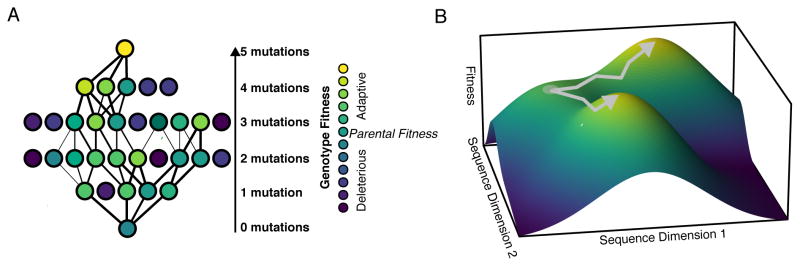
The deterministic force of natural selection and stochastic influence of drift shape RNA virus evolution. New deep-sequencing and microfluidics technologies allow us to quantify the effect of mutations and trace the evolution of viral populations with single-genome and single-nucleotide resolution. Such experiments can reveal the topography of the genotype-fitness landscapes that shape the path of viral evolution. By combining historical analyses, like phylogenetic approaches, with high-throughput and high-resolution evolutionary experiments, we can observe parallel patterns of evolution that drive important phenotypic transitions. These developments provide a framework for quantifying and anticipating potential evolutionary events. Here, we examine emerging technologies that can map the selective landscapes of viruses, focusing on their application to pathogenic viruses. We identify areas where these technologies can bolster our ability to study the evolution of viruses and to anticipate and possibly intervene in evolutionary events and prevent viral disease.
自然选择的决定性力量和随机漂移的影响塑造了 RNA 病毒的进化。新的高通量测序和微流控技术使我们能够定量评估突变的影响,并以单基因组和单核苷酸分辨率追踪病毒群体的进化。此类实验可以揭示决定病毒进化路径的基因型与适合度景观的地形。通过将历史分析(如系统发育方法)与高通量和高分辨率的进化实验相结合,我们可以观察到推动重要表型转变的平行进化模式。这些进展为量化和预测潜在的进化事件提供了框架。在这里,我们研究了可以描绘病毒选择景观的新兴技术,重点关注它们在致病性病毒中的应用。我们确定了这些技术可以增强我们研究病毒进化以及预测和可能干预进化事件和预防病毒性疾病的能力的领域。