Department of Mechanical Engineering, University of Washington, Seattle, WA.
Department of Rehabilitation Science, KU Leuven, Leuven, Belgium; Clinical Motion Analysis Laboratory, University Hospitals Leuven, Pellenberg, Pellenberg, Belgium.
Arch Phys Med Rehabil. 2018 Nov;99(11):2175-2182. doi: 10.1016/j.apmr.2018.03.006. Epub 2018 Apr 10.
To determine whether patient-specific differences in motor control quantified using muscle synergy analysis were associated with changes in gait after treatment of cerebral palsy (CP) across 2 clinical centers with different treatments and clinical protocols.
Retrospective cohort study.
Clinical medical center.
Center 1: children with CP (n=473) and typically developing (TD) children (n=84). Center 2: children with CP (n=163) and TD children (n=12).
Standard clinical care at each center.
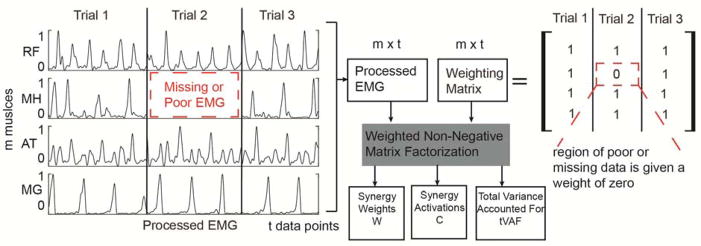
The Dynamic Motor Control Index During Walking (walk-DMC) was computed from electromyographic data during gait using muscle synergy analysis. Regression analysis was used to evaluate whether pretreatment walking speed or kinematics, muscle synergies, treatment group, prior treatment, or age were associated with posttreatment changes in gait at both clinical centers.
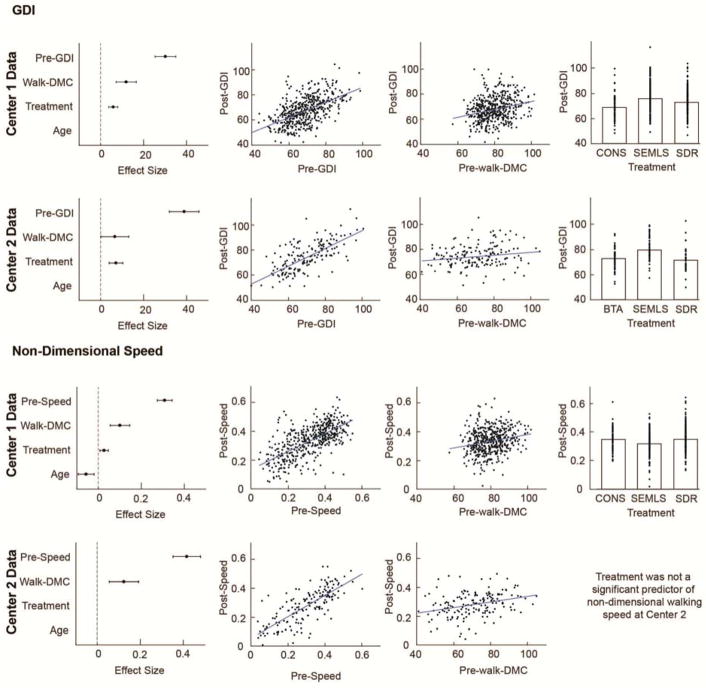
Walk-DMC was significantly associated with changes in speed and kinematics after treatment with similar regression models at both centers. Children with less impaired motor control were more likely to have improvements in walking speed and gait kinematics after treatment, independent of treatment group.
Dynamic motor control evaluated with synergy analysis was associated with changes in gait after treatment at both centers, despite differences in treatments and clinical protocols. This study further supports the finding that walk-DMC provides additional information, not captured in traditional gait analysis, that may be useful for treatment planning.
通过肌肉协同分析来确定运动控制的个体差异是否与脑瘫(CP)治疗后步态的变化有关,该研究跨越了两个具有不同治疗方法和临床方案的临床中心。
回顾性队列研究。
临床医疗中心。
中心 1:脑瘫患儿(n=473)和正常发育儿童(n=84)。中心 2:脑瘫患儿(n=163)和正常发育儿童(n=12)。
每个中心的标准临床护理。
采用肌肉协同分析从步态中的肌电图数据计算出行走时动态运动控制指数(walk-DMC)。回归分析用于评估治疗前行走速度或运动学、肌肉协同、治疗组、既往治疗或年龄是否与两个临床中心的治疗后步态变化有关。
walk-DMC 与治疗后速度和运动学的变化显著相关,两个中心的回归模型相似。运动控制受损程度较小的儿童在治疗后更有可能提高行走速度和步态运动学,这与治疗组无关。
尽管治疗方法和临床方案存在差异,但通过协同分析评估的动态运动控制与两个中心治疗后的步态变化相关。这项研究进一步支持了 walk-DMC 提供了传统步态分析无法捕捉到的额外信息,这些信息可能对治疗计划有用的发现。