Department of Movement Sciences, KU Leuven, Leuven, Belgium.
Department of Rehabilitation Sciences, KU Leuven, Leuven, Belgium.
PLoS One. 2020 Feb 12;15(2):e0228851. doi: 10.1371/journal.pone.0228851. eCollection 2020.
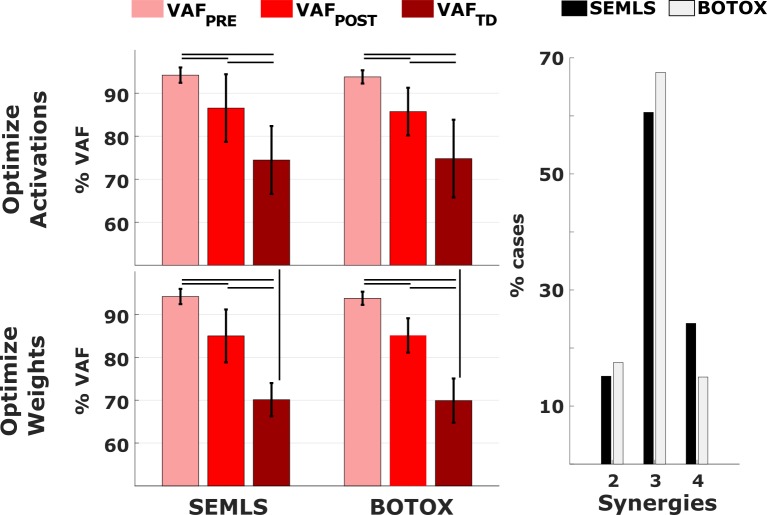
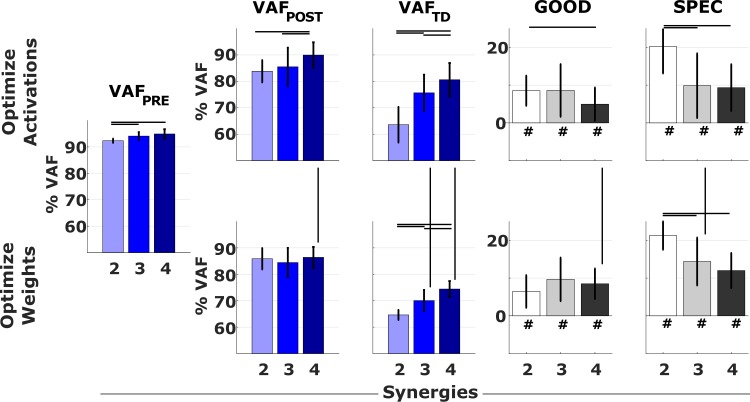
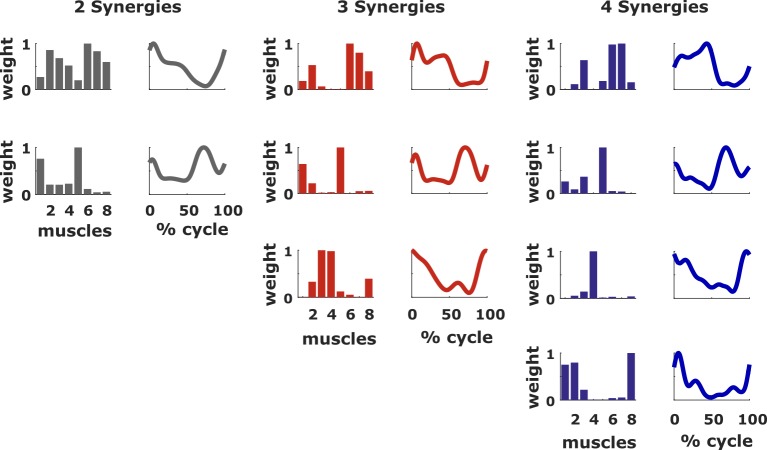
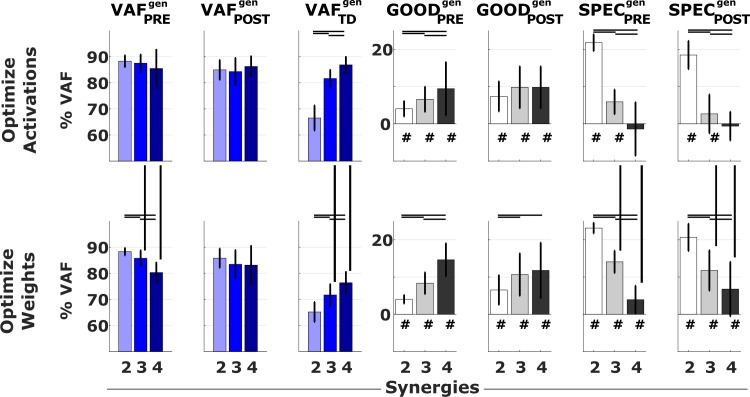
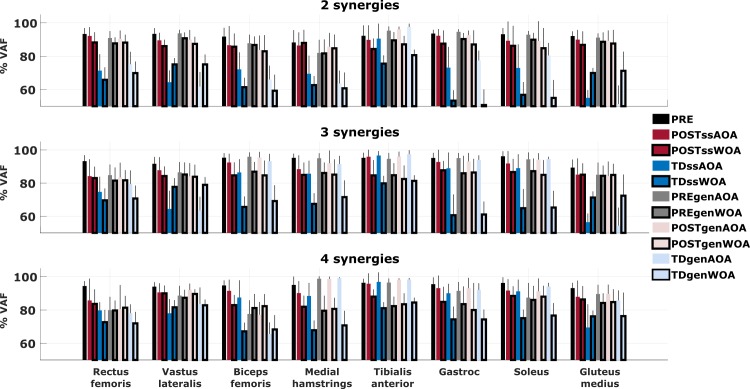
When treating children with Cerebral Palsy (CP), computational simulations based on musculoskeletal models have a great potential in assisting the clinical decision-making process towards the most promising treatments. In particular, predictive simulations could be used to predict and compare the functional outcome of a series of candidate interventions. In order to be able to benefit from these predictive simulations however, it is important to know how much information about the post-treatment patient's motor control could be gathered from data available before the intervention. Within this paper, we quantified how much of the muscle activity measured after a treatment could be explained by subject-specific muscle synergies computed from EMG data collected before the intervention. We also investigated whether generic synergies could be used, in case no EMG data is available when running predictive simulations, to reproduce both pre- and post-treatment muscle activity in children with CP. Subject-specific synergies proved to be a good indicator of the patient's post-treatment motor control, explaining on average more than 85% of the post-treatment muscle activity, compared to an average of 94% when applied to the original pre-treatment data. Generic synergies explained 84% of the pre-treatment and 83% of the post-treatment muscle activity on average, but performed relatively well for patients with low selective motor control and poorly in patients with more selectivity. Our results suggest that subject-specific muscle synergies computed from pre-treatment EMG data could be used with confidence to represent the post-treatment motor control of children with CP during walking. In addition, when performing simulations involving patients with a low selective motor control, generic synergies could be a valid alternative.
在治疗脑瘫(CP)儿童时,基于肌肉骨骼模型的计算模拟在辅助最有前途的治疗方法的临床决策过程中具有巨大潜力。特别是,预测性模拟可用于预测和比较一系列候选干预措施的功能结果。然而,为了能够从这些预测性模拟中受益,了解在干预之前可从现有数据中收集多少有关治疗后患者运动控制的信息非常重要。在本文中,我们量化了从干预前收集的肌电图数据中计算出的特定于个体的肌肉协同作用可以解释治疗后测量的肌肉活动的程度。我们还研究了在运行预测性模拟时,如果没有肌电图数据,是否可以使用通用协同作用来复制 CP 儿童的治疗前后的肌肉活动。特定于个体的协同作用被证明是患者治疗后运动控制的良好指标,与应用于原始治疗前数据时的平均 94%相比,平均可解释 85%以上的治疗后肌肉活动。通用协同作用平均解释了 84%的治疗前和 83%的治疗后肌肉活动,但对于选择性运动控制较低的患者表现相对较好,而对于选择性较高的患者表现不佳。我们的结果表明,可以从治疗前肌电图数据中计算出的特定于个体的肌肉协同作用,可以有信心地代表 CP 儿童在行走时的治疗后运动控制。此外,在涉及选择性运动控制较低的患者的模拟中,通用协同作用可能是一种有效的替代方法。