Chiang Nicole, Guo Michael, Amico K Rivet, Atkins Lou, Lester Richard T
Independent Researcher, Vancouver, BC, Canada.
Faculty of Medicine, University of British Columbia, Vancouver, BC, Canada.
JMIR Mhealth Uhealth. 2018 Apr 12;6(4):e87. doi: 10.2196/mhealth.9187.
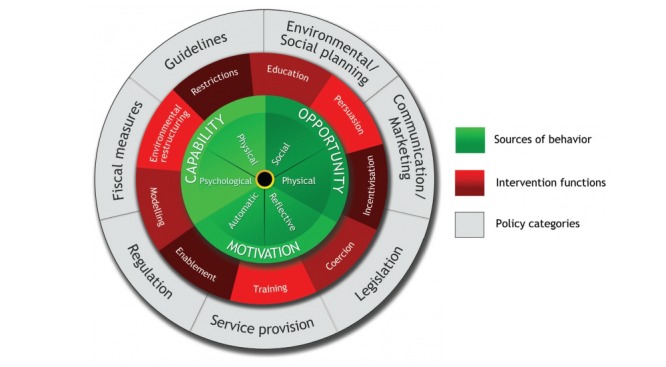
Medication adherence is an important but highly complex set of behaviors, which for life-threatening and infectious diseases such as HIV carry critical consequences for individual and public health. There is growing evidence that mobile phone text messaging interventions (mHealth) connecting providers with patients positively impact medication adherence, particularly two-way engagement platforms that require bidirectional communication versus one-way in which responses are not mandatory. However, mechanisms of action have not been well defined. The Behavior Change Wheel is a comprehensive framework for behavior change that includes an all-encompassing model of behavior known as Capability Opportunity Motivation-Behavior and is complemented by a taxonomy of behavior change techniques. Evaluating mHealth interventions for medication adherence using these tools could provide useful insights that may contribute to optimizing their integration into the healthcare system and successful scaling-up.
This study aimed to help address the current knowledge gap regarding how two-way mHealth interventions for medication adherence may work by applying the Behavior Change Wheel to characterize WelTel: an interactive digital health outreach platform with robust evidence for improving adherence to antiretroviral therapy.
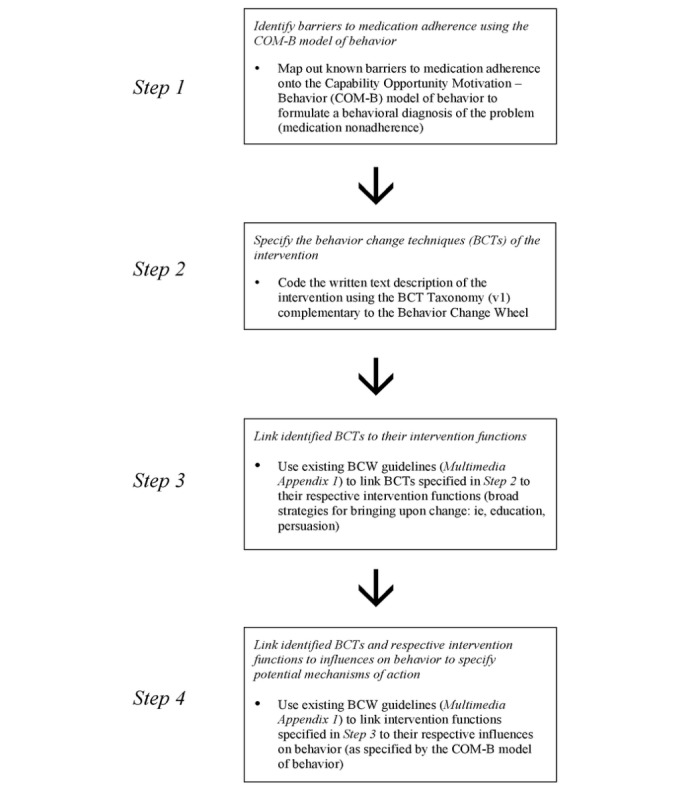
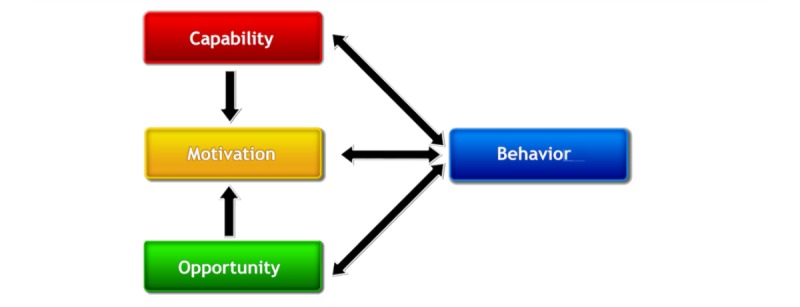
To characterize how WelTel may promote medication adherence, we applied the Behavior Change Wheel to systematically (1) generate a behavioral diagnosis through mapping known antiretroviral therapy adherence barriers onto the Capability Opportunity Motivation-Behavior model of behavior, (2) specify the behavior change techniques that WelTel delivers, (3) link identified behavior change techniques to corresponding intervention functions of the Behavior Change Wheel, and (4) connect these behavior change techniques and intervention functions to respective Capability Opportunity Motivation-Behavior influences on behavior to determine potential mechanisms of action.
Our evaluation of WelTel using the Behavior Change Wheel suggests that most of its impact is delivered primarily through its personalized communication component, in which 8 different behavior change techniques were identified and linked with 5 intervention functions (environmental restructuring, enablement, education, persuasion, and training). Its mechanisms of action in promoting antiretroviral therapy adherence may involve addressing all Capability Opportunity Motivation-Behavior influences on behavior (physical and psychological capability, physical and social opportunity, reflective and automatic motivation).
Systematically unpacking the potential active ingredients of effective interventions facilitates the creation and implementation of more parsimonious, tailored, and targeted approaches. Evaluating WelTel using the Behavior Change Wheel has provided valuable insights into how and why such interactive two-way mHealth interventions may produce greater impact than one-way in addressing both nonintentional and intentional forms of nonadherence. The application of the Behavior Change Wheel for evidence synthesis across mHealth interventions targeting various conditions would contribute to strengthening the knowledge base regarding how they may work to impact medication adherence behavior.
药物依从性是一组重要但高度复杂的行为,对于诸如艾滋病等危及生命的传染病而言,其对个人和公共健康有着至关重要的影响。越来越多的证据表明,将医护人员与患者联系起来的手机短信干预措施(移动健康)对药物依从性有积极影响,特别是那些需要双向沟通的双向参与平台,而不是单向且回复非强制性的平台。然而,其作用机制尚未得到明确界定。行为改变轮是一个全面的行为改变框架,其中包括一个被称为“能力-机会-动机-行为”的行为综合模型,并辅以行为改变技术分类法。使用这些工具评估移动健康干预措施对药物依从性的影响,可能会提供有用的见解,有助于优化其融入医疗保健系统并成功扩大规模。
本研究旨在通过应用行为改变轮来描述WelTel,以帮助填补目前关于双向移动健康干预措施对药物依从性如何起作用的知识空白。WelTel是一个交互式数字健康推广平台,在提高抗逆转录病毒疗法依从性方面有充分证据。
为了描述WelTel如何促进药物依从性,我们应用行为改变轮来系统地:(1)通过将已知的抗逆转录病毒疗法依从性障碍映射到“能力-机会-动机-行为”行为模型上,进行行为诊断;(2)确定WelTel所提供的行为改变技术;(3)将确定的行为改变技术与行为改变轮的相应干预功能联系起来;(4)将这些行为改变技术和干预功能与“能力-机会-动机-行为”对行为的各自影响联系起来,以确定潜在的作用机制。
我们使用行为改变轮对WelTel的评估表明,其大部分影响主要通过其个性化沟通部分实现,其中确定了8种不同的行为改变技术,并与5种干预功能(环境重构、赋能、教育、劝服和培训)相关联。它在促进抗逆转录病毒疗法依从性方面的作用机制可能涉及解决“能力-机会-动机-行为”对行为的所有影响(身体和心理能力、身体和社会机会、反思性和自动性动机)。
系统地剖析有效干预措施的潜在有效成分,有助于创建和实施更简洁、量身定制且有针对性的方法。使用行为改变轮对WelTel进行评估,为这种交互式双向移动健康干预措施在解决无意和有意的不依从形式方面如何以及为何可能比单向干预产生更大影响提供了宝贵见解。行为改变轮在针对各种情况的移动健康干预措施的证据综合中的应用,将有助于加强关于它们如何影响药物依从性行为的知识库。