Laboratory of Applied Chemistry, Institute of Organic Chemistry (IOC), Karlsruhe Institute of Technology (KIT), Straße am Forum 7, Karlsruhe, 76131, Germany.
Institute of Nano Technology (INT), Karlsruhe Institute of Technology (KIT), Hermann-von-Helmholtz-Platz 1, Eggenstein-Leopoldshafen, 76344, Germany.
Nat Commun. 2018 Apr 12;9(1):1439. doi: 10.1038/s41467-018-03784-x.
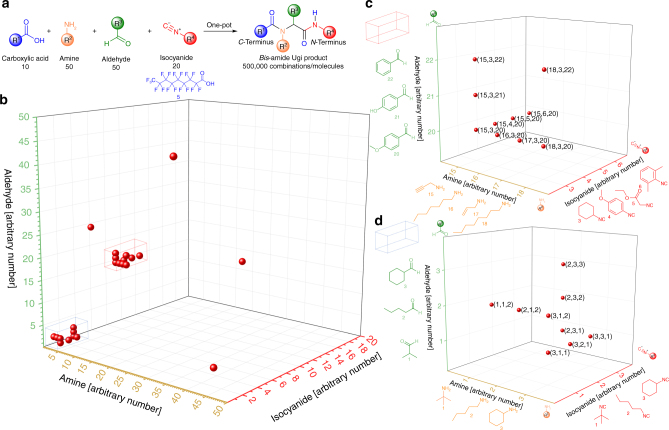
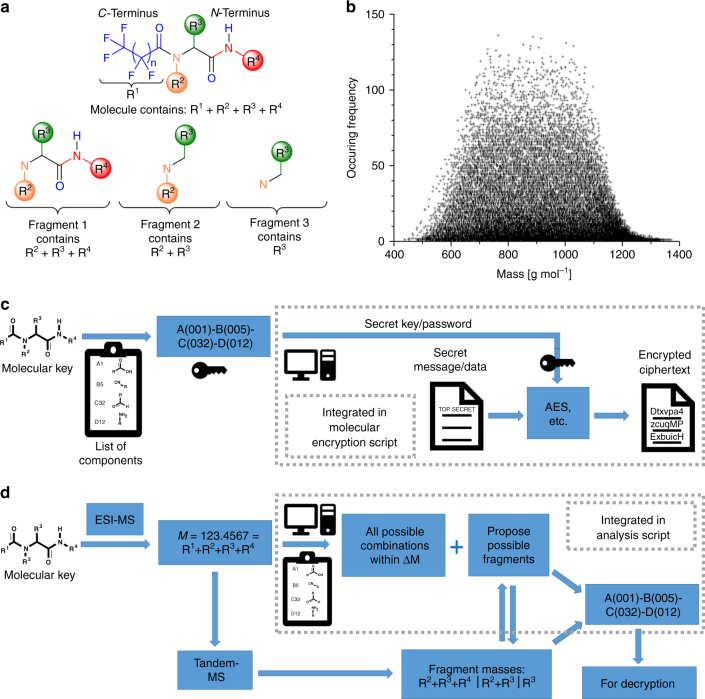
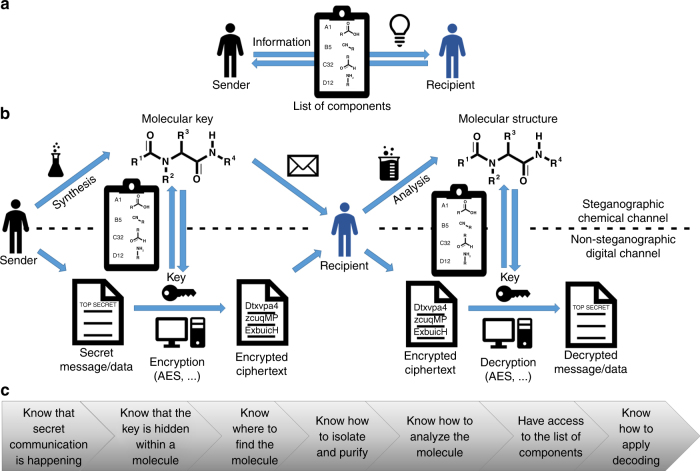
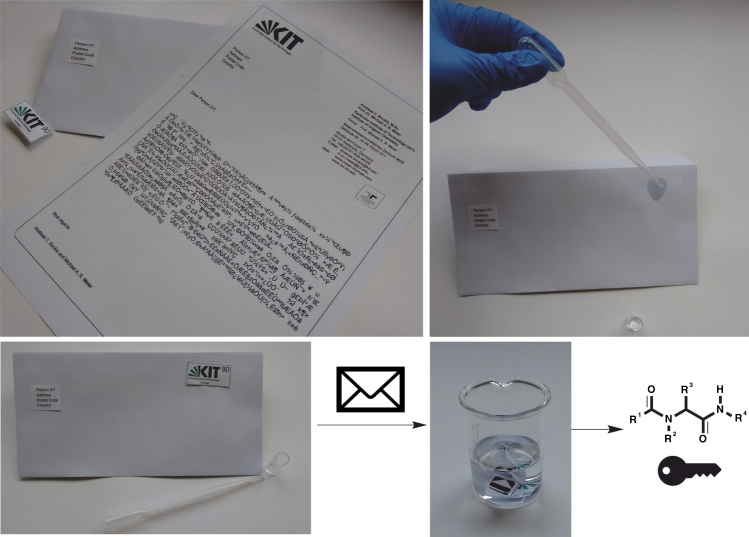
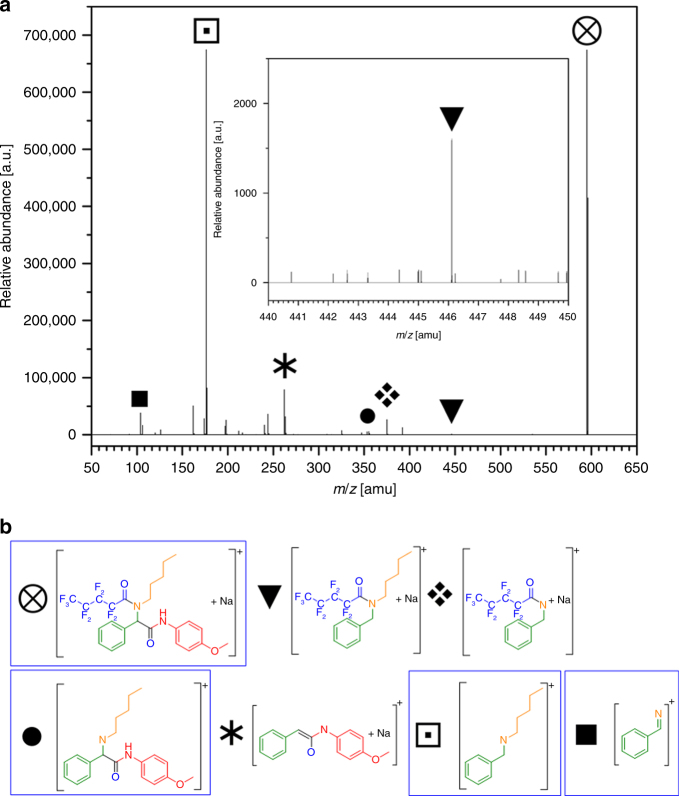
A convenient and inherently more secure communication channel for encoding messages via specifically designed molecular keys is introduced by combining advanced encryption standard cryptography with molecular steganography. The necessary molecular keys require large structural diversity, thus suggesting the application of multicomponent reactions. Herein, the Ugi four-component reaction of perfluorinated acids is utilized to establish an exemplary database consisting of 130 commercially available components. Considering all permutations, this combinatorial approach can unambiguously provide 500,000 molecular keys in only one synthetic procedure per key. The molecular keys are transferred nondigitally and concealed by either adsorption onto paper, coffee, tea or sugar as well as by dissolution in a perfume or in blood. Re-isolation and purification from these disguises is simplified by the perfluorinated sidechains of the molecular keys. High resolution tandem mass spectrometry can unequivocally determine the molecular structure and thus the identity of the key for a subsequent decryption of an encoded message.
通过将高级加密标准密码学与分子隐写术相结合,引入了一种通过专门设计的分子键对消息进行编码的便捷且固有更安全的通信渠道。必要的分子键需要大的结构多样性,因此建议使用多组分反应。在这里,利用全氟酸的 Ugi 四组分反应来建立一个由 130 种市售成分组成的示例数据库。考虑到所有排列,这种组合方法仅在每个键的一个合成步骤中就可以明确地提供 50 万个分子键。分子键以非数字方式传输,并通过吸附在纸张、咖啡、茶或糖上,或溶解在香水或血液中进行隐藏。通过分子键的全氟侧链,可以简化从这些伪装物中重新分离和纯化。高分辨率串联质谱可以明确确定分子结构,从而确定键的身份,以便随后对编码消息进行解密。