Department of Experimental Psychology, University of Oxford, Oxford, UK.
Oxford Centre for Anxiety Disorders and Trauma, The Old Rectory, Paradise Square, Oxford, OX1 1TW, UK.
Clin Child Fam Psychol Rev. 2018 Sep;21(3):388-414. doi: 10.1007/s10567-018-0258-5.
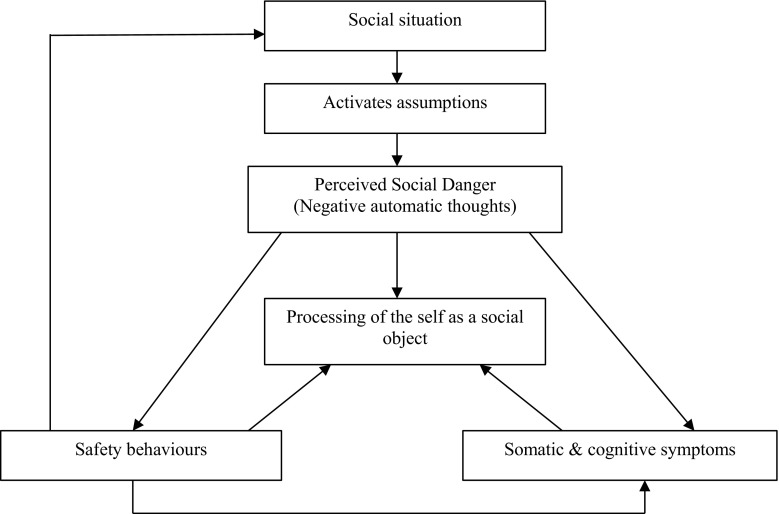
Social anxiety disorder is a condition characterised by a marked and persistent fear of being humiliated or scrutinised by others. Age-of-onset data point to adolescence as a developmentally sensitive period for the emergence of the condition, at a time when the peer group becomes increasingly important. Social anxiety in adolescence is associated with considerable impairment that persists through to adulthood. There are clear potential benefits to delivering effective interventions during adolescence. However, there is limited evidence on the specific efficacy of available therapies. This is in contrast to adults, for whom we have interventions with very specific treatment effects. One such treatment is individual cognitive therapy. Cognitive therapy is based on the cognitive model of social anxiety proposed by Clark and Wells (in: Heimberg, Leibowitz, Hope, Scheiber (eds) Social phobia: diagnosis, assessment and treatment, The Guilford Press, New York, 1995). The present review examines the potential application of this adult cognitive model to the understanding of adolescent social anxiety and considers additional adolescent-specific factors that need to be accommodated. It is suggested that a developmentally sensitive adoption of the cognitive model of social anxiety disorder (Clark and Wells 1995) for adolescents may lead to better treatment outcomes.
社交焦虑障碍是一种以明显和持续的害怕被他人羞辱或审视为特征的疾病。发病年龄数据表明,青春期是该疾病出现的一个发育敏感时期,此时同龄人群体变得越来越重要。青春期的社交焦虑与持续到成年的严重障碍有关。在青春期提供有效干预措施显然有潜在的好处。然而,关于现有疗法的具体疗效的证据有限。这与成年人形成对比,对于成年人,我们有非常特定的治疗效果的干预措施。其中一种治疗方法是个体认知疗法。认知疗法基于 Clark 和 Wells(in: Heimberg, Leibowitz, Hope, Scheiber (eds) Social phobia: diagnosis, assessment and treatment, The Guilford Press, New York, 1995)提出的社交焦虑认知模型。本综述探讨了将这种成人认知模型应用于理解青少年社交焦虑的可能性,并考虑了需要适应的其他青少年特有的因素。有人认为,对社交焦虑障碍的认知模型(Clark 和 Wells 1995)进行发展敏感的采用可能会导致更好的治疗效果。