UCL Institute of Cardiovascular Sciences, University College London, London, UK; National Institute for Health Research, UCL Hospitals Biomedical Research Centre, London, UK.
Medicines Monitoring Unit, Molecular and Clinical Medicine, University of Dundee, Dundee, UK.
Lancet Diabetes Endocrinol. 2018 Jun;6(6):464-475. doi: 10.1016/S2213-8587(18)30071-8. Epub 2018 Apr 11.
In the PATHWAY-2 study of resistant hypertension, spironolactone reduced blood pressure substantially more than conventional antihypertensive drugs. We did three substudies to assess the mechanisms underlying this superiority and the pathogenesis of resistant hypertension.
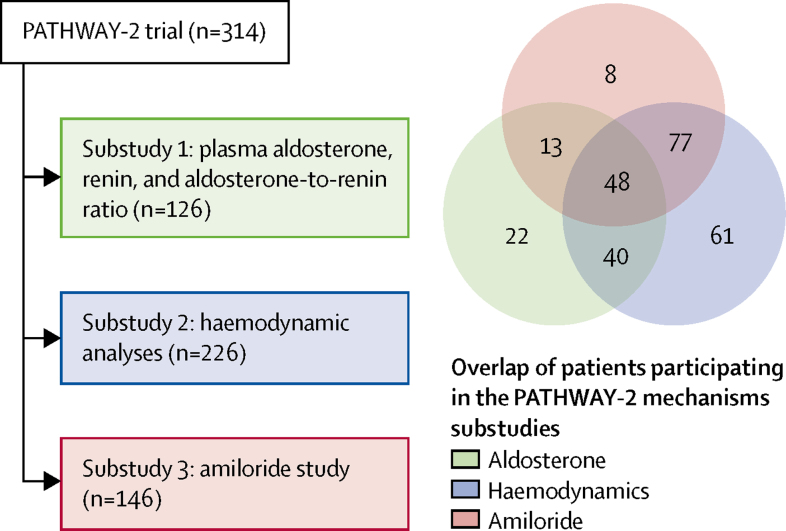
PATHWAY-2 was a randomised, double-blind crossover trial done at 14 UK primary and secondary care sites in 314 patients with resistant hypertension. Patients were given 12 weeks of once daily treatment with each of placebo, spironolactone 25-50 mg, bisoprolol 5-10 mg, and doxazosin 4-8 mg and the change in home systolic blood pressure was assessed as the primary outcome. In our three substudies, we assessed plasma aldosterone, renin, and aldosterone-to-renin ratio (ARR) as predictors of home systolic blood pressure, and estimated prevalence of primary aldosteronism (substudy 1); assessed the effects of each drug in terms of thoracic fluid index, cardiac index, stroke index, and systemic vascular resistance at seven sites with haemodynamic monitoring facilities (substudy 2); and assessed the effect of amiloride 10-20 mg once daily on clinic systolic blood pressure during an optional 6-12 week open-label runout phase (substudy 3). The PATHWAY-2 trial is registered with EudraCT, number 2008-007149-30, and ClinicalTrials.gov, number NCT02369081.
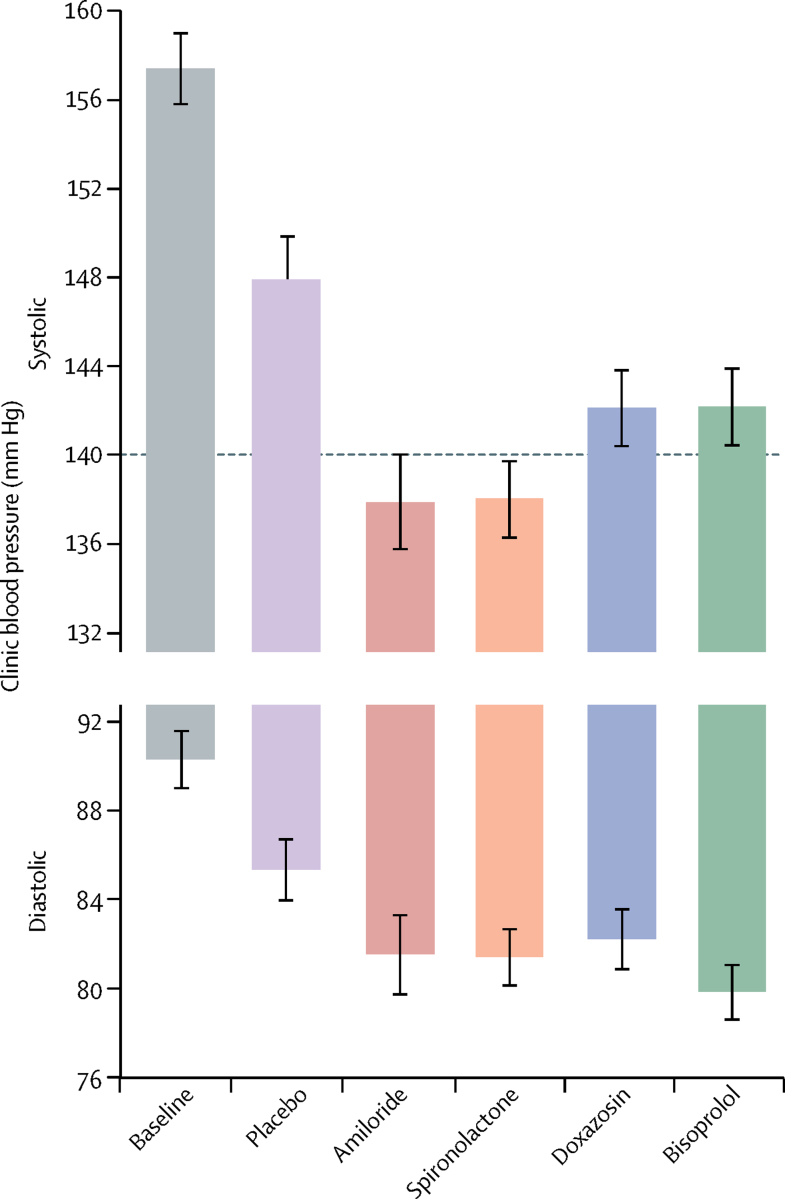
Of the 314 patients in PATHWAY-2, 269 participated in one or more of the three substudies: 126 in substudy 1, 226 in substudy 2, and 146 in substudy 3. Home systolic blood pressure reduction by spironolactone was predicted by ARR (r=0·13, p<0·0001) and plasma renin (r=0·11, p=0·00024). 42 patients had low renin concentrations (predefined as the lowest tertile of plasma renin), of which 31 had a plasma aldosterone concentration greater than the mean value for all 126 patients (250 pmol/L). Thus, 31 (25% [95% CI 17-33]) of 126 patients were deemed to have inappropriately high aldosterone concentrations. Thoracic fluid content was reduced by 6·8% from baseline (95% CI 4·0 to 8·8; p<0·0001) with spironolactone, but not other treatments. Amiloride (10 mg once daily) reduced clinic systolic blood pressure by 20·4 mm Hg (95% CI 18·3-22·5), compared with a reduction of 18·3 mm Hg (16·2-20·5) with spironolactone (25 mg once daily). No serious adverse events were recorded, and adverse symptoms were not systematically recorded after the end of the double-blind treatment. Mean plasma potassium concentrations increased from 4·02 mmol/L (95% CI 3·95-4·08) on placebo to 4·50 (4·44-4·57) on amiloride (p<0·0001).
Our results suggest that resistant hypertension is commonly a salt-retaining state, most likely due to inappropriate aldosterone secretion. Mineralocorticoid receptor blockade by spironolactone overcomes the salt retention and resistance of hypertension to treatment. Amiloride seems to be as effective an antihypertensive as spironolactone, offering a substitute treatment for resistant hypertension.
British Heart Foundation and UK National Institute for Health Research.
在 PATHWAY-2 研究中,螺内酯与传统降压药物相比,显著降低了血压。我们进行了三项子研究,以评估这种优越性的机制和难治性高血压的发病机制。
PATHWAY-2 是一项在英国 14 个初级和二级保健机构进行的随机、双盲交叉试验,共纳入 314 名难治性高血压患者。患者接受了为期 12 周的单药治疗,包括安慰剂、螺内酯 25-50mg、比索洛尔 5-10mg 和多沙唑嗪 4-8mg,以家庭收缩压的变化作为主要终点。在我们的三项子研究中,我们评估了血浆醛固酮、肾素和醛固酮与肾素比值(ARR)作为家庭收缩压的预测指标,并评估了原发性醛固酮增多症的患病率(子研究 1);评估了在具有血流动力学监测设施的七个地点,每种药物对胸腔液指数、心指数、心排量指数和全身血管阻力的影响(子研究 2);并评估了阿米洛利 10-20mg 每日一次对可选的 6-12 周开放标签洗脱期期间的诊室收缩压的影响(子研究 3)。PATHWAY-2 试验在 EudraCT 注册,编号为 2008-007149-30,在 ClinicalTrials.gov 注册,编号为 NCT02369081。
在 PATHWAY-2 研究的 314 名患者中,269 名患者参加了一项或多项子研究:子研究 1 126 名,子研究 2 226 名,子研究 3 146 名。螺内酯降低家庭收缩压与 ARR(r=0·13,p<0·0001)和血浆肾素(r=0·11,p=0·00024)相关。42 名患者肾素浓度较低(定义为血浆肾素最低三分位),其中 31 名患者的血浆醛固酮浓度高于所有 126 名患者的平均值(250 pmol/L)。因此,126 名患者中有 31 名(25%[95%CI 17-33])被认为醛固酮浓度过高。螺内酯使胸腔液含量从基线减少了 6·8%(95%CI 4·0-8·8;p<0·0001),但其他治疗方法没有。与螺内酯(25mg 每日一次)相比,阿米洛利(每日 10mg)可使诊室收缩压降低 20·4mmHg(95%CI 18·3-22·5)。没有记录到严重的不良事件,双盲治疗结束后也没有系统地记录不良反应症状。与安慰剂相比,平均血浆钾浓度从 4·02mmol/L(95%CI 3·95-4·08)升高至 4·50mmol/L(4·44-4·57)(p<0·0001)。
我们的结果表明,难治性高血压通常是一种盐潴留状态,最可能是由于醛固酮分泌不当。螺内酯的盐皮质激素受体阻断作用克服了高血压对治疗的盐潴留和抵抗。阿米洛利似乎与螺内酯一样有效降压,为难治性高血压提供了一种替代治疗方法。
英国心脏基金会和英国国家健康研究所。