Sealy Center on Aging, University of Texas Medical Branch, Galveston, Texas.
Department of Internal Medicine, University of Texas Medical Branch, Galveston, Texas.
J Am Geriatr Soc. 2018 Oct;66(10):1880-1886. doi: 10.1111/jgs.15377. Epub 2018 Apr 14.
To determine how the risk of subsequent long-term care (LTC) placement varies between skilled nursing facilities (SNFs) and the SNF characteristics associated with this risk.
Population-based national cohort study with participants nested in SNFs and hospitals in a cross-classified multilevel model.
SNFs (N=6,680).
Fee-for-service Medicare beneficiaries (N=552,414) discharged from a hospital to a SNF in 2013.
Participant characteristics from Medicare data and the Minimum Data Set. SNF characteristics from Medicare and Nursing Home Compare. Outcome was a stay of 90 days or longer in a LTC nursing home within 6 months of SNF admission.
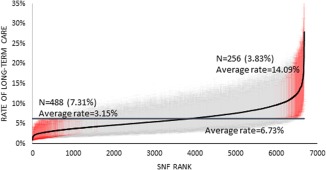
Within 6 months of SNF admission, 10.4% of participants resided in LTC. After adjustments for participant characteristics, the SNF where a participant received care explained 7.9% of the variance in risk of LTC, whereas the prior hospital explained 1.0%. Individuals in SNFs with excellent quality ratings had 22% lower odds of transitioning to LTC than those in SNFs with poor ratings (odds ratio=0.78, 95% confidence interval=0.74-0.84). Variation between SNFs and associations with quality markers were greater in sensitivity analyses limited to individuals least likely to require LTC. Results were essentially the same in a number of other sensitivity analyses designed to reduce potential confounding.
Risk of subsequent LTC placement, an important and negatively viewed outcome for older adults, varies substantially between SNFs. Individuals in higher-quality SNFs are at lower risk.
确定在熟练护理设施(SNF)之间,以及与这种风险相关的 SNF 特征之间,随后长期护理(LTC)安置的风险如何变化。
基于人群的全国队列研究,参与者嵌套在 SNF 和交叉分类多层次模型中的医院中。
SNF(N=6680)。
2013 年从医院出院到 SNF 的按费用付费的医疗保险受益人(N=552414)。
来自 Medicare 数据和最低数据集的参与者特征。来自 Medicare 和 Nursing Home Compare 的 SNF 特征。结果是在 SNF 入院后 6 个月内,LTC 疗养院的入住时间为 90 天或更长时间。
在 SNF 入院后 6 个月内,10.4%的参与者居住在 LTC 中。在调整了参与者特征后,参与者接受护理的 SNF 解释了 LTC 风险变化的 7.9%,而先前的医院解释了 1.0%。在质量评级优秀的 SNF 中的个体比质量评级较差的 SNF 中转到 LTC 的可能性低 22%(优势比=0.78,95%置信区间=0.74-0.84)。在仅限于最不可能需要 LTC 的个体的敏感性分析中,SNF 之间的差异和与质量标志物的关联更大。在旨在减少潜在混杂因素的许多其他敏感性分析中,结果基本相同。
随后的 LTC 安置风险是老年人的一个重要且负面的结果,在 SNF 之间差异很大。在更高质量的 SNF 中的个体风险较低。