Institute of Health and Biomedical Innovation, and School of Biomedical Sciences, Queensland University of Technology, Brisbane 4006, Queensland, Australia.
Viruses. 2018 Apr 16;10(4):198. doi: 10.3390/v10040198.
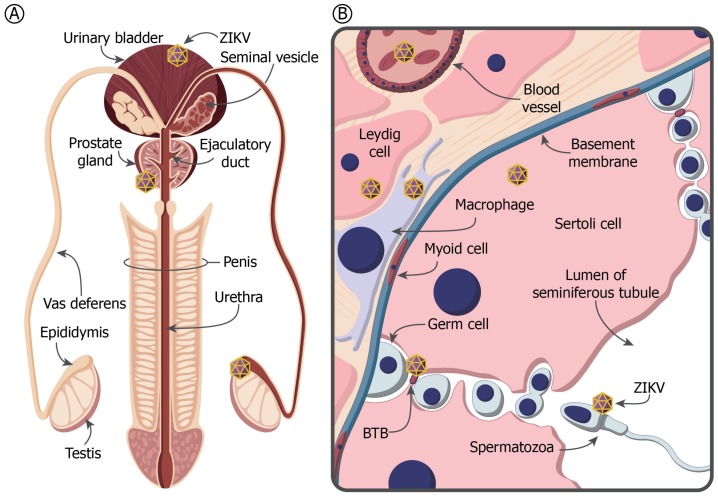
Arthropod-borne viruses (arboviruses) are resurging across the globe. Zika virus (ZIKV) has caused significant concern in recent years because it can lead to congenital malformations in babies and Guillain-Barré syndrome in adults. Unlike other arboviruses, ZIKV can be sexually transmitted and may persist in the male reproductive tract. There is limited information regarding the impact of ZIKV on male reproductive health and fertility. Understanding the mechanisms that underlie persistent ZIKV infections in men is critical to developing effective vaccines and therapies. Mouse and macaque models have begun to unravel the pathogenesis of ZIKV infection in the male reproductive tract, with the testes and prostate gland implicated as potential reservoirs for persistent ZIKV infection. Here, we summarize current knowledge regarding the pathogenesis of ZIKV in the male reproductive tract, the development of animal models to study ZIKV infection at this site, and prospects for vaccines and therapeutics against persistent ZIKV infection.
虫媒病毒(arboviruses)正在全球范围内重新出现。寨卡病毒(ZIKV)近年来引起了极大关注,因为它可导致婴儿先天畸形和成人吉兰-巴雷综合征。与其他虫媒病毒不同,寨卡病毒可以通过性传播,并且可能在男性生殖道中持续存在。关于寨卡病毒对男性生殖健康和生育能力的影响,信息有限。了解导致男性持续感染寨卡病毒的机制对于开发有效的疫苗和疗法至关重要。小鼠和猕猴模型已开始揭示寨卡病毒感染男性生殖道的发病机制,睾丸和前列腺被认为是寨卡病毒持续感染的潜在储库。在这里,我们总结了目前关于寨卡病毒在男性生殖道中的发病机制、用于研究该部位寨卡病毒感染的动物模型的发展以及针对寨卡病毒持续感染的疫苗和疗法的前景。